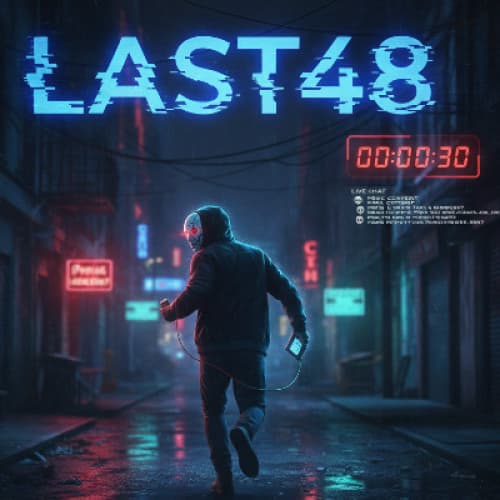
Dark neon slicked the alley like oil. The game called itself Last48 — a scavenger hunt for the desperate, a live-streamed roulette for the bored. Rules were simple: you signed in, you got a timer, you tried to survive. No respawns. Forty-eight hours. No mercy.
Kai grinned when he told Aran about it. “It’s just a thrill,” he said, fingers trembling on the confirmation button. Aran laughed and bought him the gear — a cheap mask, a charger, an extra clip. He thought it was bravado, teenage darkness for clicks. He was wrong.
The first night the chat loved Kai. He cracked jokes while he slept with one eye open. He filmed rooftops, the market at dawn, the old theatre where kids used to dare each other to kiss in the dark. The viewers stacked like a tide. A nicked voice in an anonymous feed called itself the Warden and promised a “real hunt” for the finale. Kai leaned into it. He wanted the rush. He wanted to be seen.
Forty-eight hours cleaved their lives in two.
Kai’s final hours were messy with the sort of panic that makes the world small — a corridor door that wouldn’t open, the wrong turn into an empty block, the sound of boots on tile. His last message was half a shout, half a laugh. Then the feed cut. The chat scrolled into static.
Aran watched the last thirty seconds frame by frame until his eyes blurred into red rings. The police called it an unfortunate death in an illegal game. The streamers called it peak content. The Warden posted a skull icon and moved on.
Grief made a map in Aran’s chest with only one road: down.
He signed into Last48 not to survive but to continue. Not to be another name on some morbid scoreboard — to become the answer. Where Kai had chased adrenaline, Aran chased tracking, study, patience. He learned the Warden’s patterns: the way he provoked, the usernames he used to seed panic, the placement of clues. He watched the feeds of the people who’d been near Kai in those last hours, dissected their faces, their habits. He let himself become small and cold. The old thrill died; something else grew — a meticulous hunger.
That hunger smelled different than grief. It was sharpening. It was a clock he wound up and let run.
He started with the obvious suspects: the streaming admins who had directed viewers toward Kai’s coordinates, the moderator who had muted cries long enough to keep the spectacle alive. He traced payments and proxies, followed VPN breadcrumbs into sleazy chatrooms, into the real lives hidden by avatars. Each discovery fed him — not satisfaction so much as fuel. The world revealed itself as less accidental than arranged.
Aran found the man who had pushed Kai toward the theatre: a pale, trembling influencer named Milo who wanted “moments” to sell his brand. He confronted him in a twelve-story car park while cameras thinned his courage. Milo babbled apologies that slicked into excuses. Aran did not kill him. He made Milo watch a loop of Kai’s last minutes until Milo couldn’t look away, until Milo vomited apologies for clicks he’d chased. Aran left him with the shame of being seen.
The trail curved dark and colder. A cleaner at the theatre had accepted envelopes for silence; a bouncer had walked past footage to avoid viruses in his rent check. They ended with the woman Kai had loved — Lila — a ghost who haunted every frame of Kai’s happier clips. Aran’s hands closed at the name like a fist.
Lila had been at Kai’s side for months. She had pushed him into the game like a dare, kissed his forehead, watched him stream, and then she had screamed his name on the phone and been too late. The message boards called her “the girlfriend.” Rumors swarmed: did she betray him? Did she lure him? The internet makes monsters out of absence.
Aran hunted the rumor first and found only echoes. Lila’s bank records, her texts, were anemic and raw with grief. She’d paid for no mod services. She had called the police. She had begged for leads. He watched her press palms to a memorial wall and felt, absurdly, the ghost of tenderness Kai had once shown her. The suspicion that had fueled him felt thin among real human fatigue.
But the thing about a man who has chosen vengeance as metabolism is that doubt only delays the appetite. Lila’s grief felt… inadequate to him. It was the wrong kind of weakness. He let himself imagine darker plots, the neat narrative that would make the hunt complete.
When he cornered her that night in the underpass where Kai had livestreamed his jokes into the dark, Lila’s face was ash, two dark hollows under eyes. People honed themselves on leads and theories; Aran had honed himself on decisions.
“You were with him,” he said, voice low. “You could have stopped him.”
She blinked at him like someone waking from fog. “Stop him? Aran, he chose this. He loved it. He screamed because he was scared. So was I.” Her hands shook. “I called. I tried—”
“Did you ever think you could stop the Warden?” He laughed, cracked like someone he didn’t recognize.
She took a step back and for a terrifying second Aran eyed the phone in her hand as if it might be a weapon. She showed him the call logs, the messages, the police reference number — all small proofs of too-late attempts. He wanted them to be lies, but the records were solid. He wanted to punish someone anyway.
He punished the system instead: the brokers who profited, the perfunctory moderators, the anonymous donators. He exposed them, leaked their names, sent clips of their indifference to the addresses of their employers. He shattered careers. He arranged for Milo to be interviewed live, forced the moderator to answer a camera for hours until the moderator’s hands trembled on live broadcast. He did not spare the Warden — not yet. He wanted the man to watch suffering stack like currency.
When he finally found the Warden, he was not cinematic. He was a bleached accountant, invisible in an office park miles from the neon. He had seventeen identities, a careful ledger, and a voice that said, with a blandness that was obscene, “They wanted it. I just gave them the structure.”
Aran had imagined a theatrical duel. Instead, he found the rust of ordinary cruelty. The Warden’s confession was not a roar but an apology that sounded like a commercial — hollow, practiced. Aran could have killed him. The temptation flashed — the clean, tribal logic of retribution. But when he stood over the man, watching the life he could end, the edges of Aran’s own reflection blurred. He saw a map drawn from the same shadow as the Warden’s: someone who’d made a business out of other people’s edges.
He left the man to the law instead.
That night, Aran sat on Kai’s rooftop and played back the last feed until dawn. He had broken things, exposed faceless predators, stolen their power in public. He had not brought Kai back. He had not saved himself.
In the hollow left behind, something else remained: not the appetite for blood, not the taste for screams, but a steady, terrible clarity. Revenge had been a machine that could be turned outward; it also rewired the one who used it. Aran felt the wiring in his bones.
“Was it worth it?” Lila asked later by the memorial wall, voice small as the coin rains of viewers in a dying stream.
He did not answer. There was no clean answer. He had enjoyed—yes, perhaps that was the part that frightened him most — the clarity of purpose, the heat of seeing consequences fall where they belonged. But pleasure and justice are close cousins and easy to mistake for one another in the dark.
The game that had taken Kai had not died; it had been revealed, dissected, and tarnished. People still signed in for thrills, but now there were cameras in places there hadn’t been, accountability sliding like sand. Aran had fed the beast to the light; he had also fed his shadow.
On nights when the city hummed and the screens lit up with other people’s bright small deaths, he would sometimes whisper Kai’s name into the static and imagine the boy laughing back at him. He had won and lost in the same breath. The thing that kept him moving after that was less a hunger for punishment than the slow, stubborn work of keeping the borders between sport and slaughter visible — and of learning what it meant to live with a grief that could not be named away by trophies or ruined men.
He kept Kai’s mask in a drawer. Sometimes he would touch it, and remember the laugh: high, ridiculous, rubbing against the edges of danger because he didn’t know any other way to be brave.