
The first penny hit the jar at 6:47 PM on a Tuesday, which was significant because Tuesdays were when the Wi-Fi password changed in the Chen household, and 6:47 PM was exactly thirteen minutes before the password was revealed at dinner. This was not a coincidence. Nothing in seventeen-year-old Marcus Webb's life was a coincidence anymore—it was all algorithmic, calculated, optimized by parents who treated parenting like a Silicon Valley startup.
"That's fifty cents," his mother said without looking up from her tablet. She was reading something called Mindful Parenting in the Digital Age while simultaneously monitoring the family swear jar app on her phone. The jar itself sat on the kitchen counter, a clear acrylic cylinder with a digital display showing "$847.50" in glowing red numbers. It had started as a joke when Marcus was twelve. It was now a monstrosity that funded his parents' annual couples' retreat to Sedona.
"I didn't swear," Marcus said, opening the refrigerator and staring into the void that was supposed to contain his future dinner. "I said 'frick.' That's not a swear. That's a linguistic compromise."
"You meant the F-word," his father said, entering from the garage in his trail-running shoes. Dr. David Webb taught statistics at the university and approached family dinner like a data collection exercise. "Intent matters. The jar detected your intent through tonal analysis."
"The jar is a plastic cylinder with a Bluetooth speaker, Dad. It doesn't have tonal analysis."
"It has my ears," his mother said. "And my ears heard you slam your backpack and mutter something that definitely wasn't 'frick.'"
Marcus turned around, holding a container of hummus that expired three days ago. "I was complaining about the parking ticket I got at school. The visitor spots were full, so I parked in the back lot for literally four minutes while I ran in to grab my chemistry book. Four minutes. Forty dollars. That's ten dollars per minute. Do you know what I make at the movie theater?"
"Minimum wage," his father said, washing his hands with the precision of a surgeon. "Which is why you should be more careful about where you park."
"That's not the point! The point is that the school has three hundred students and forty visitor spots, and they know this, and they deliberately don't build more parking because the ticket revenue pays for the principal's espresso machine or whatever. It's a racket."
"So pay the fine," his mother said. "Or appeal it."
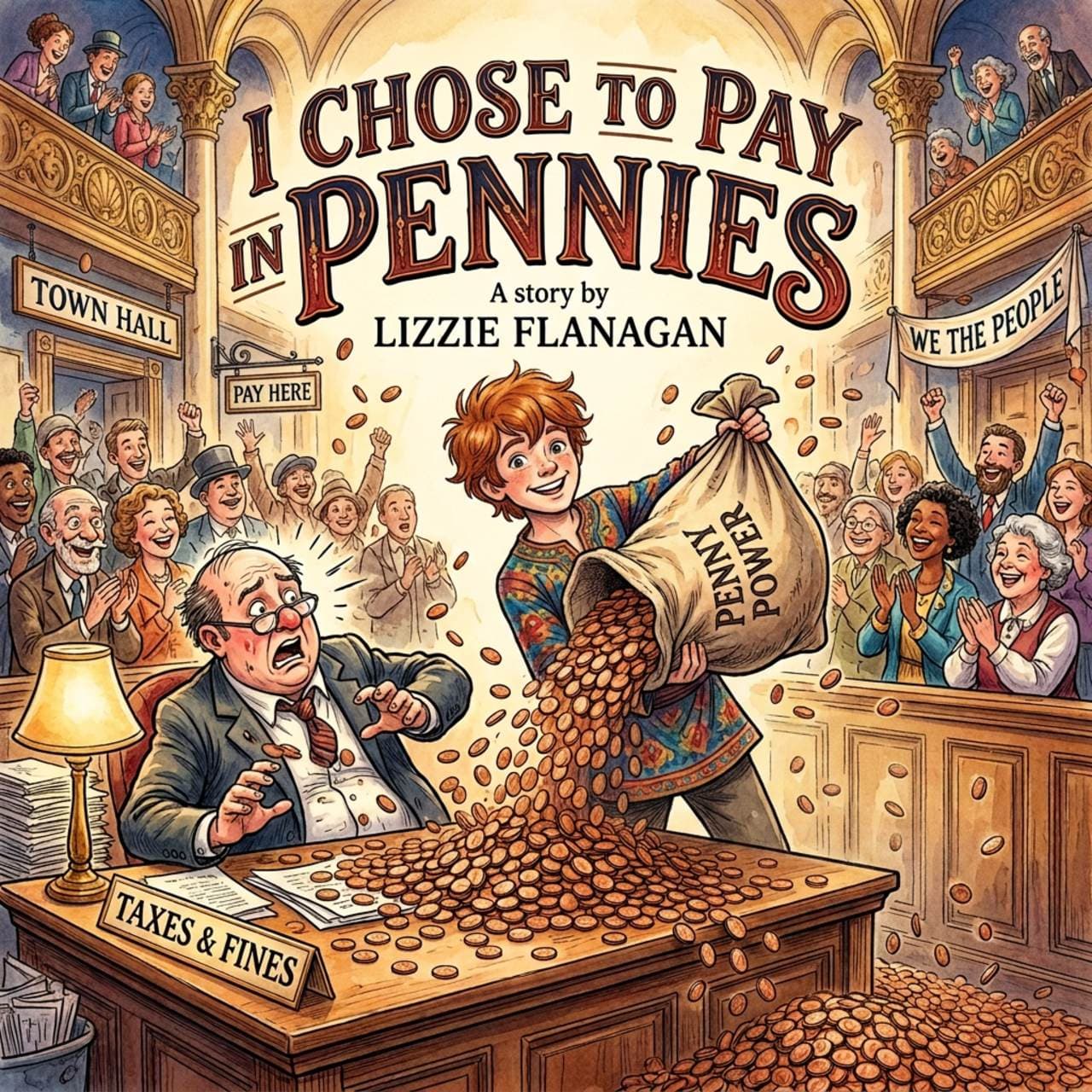
"I am going to pay it," Marcus said. He set the hummus down and pulled a ziplock bag from his backpack. It made a satisfying clink when he dropped it on the counter. "In pennies."
His parents looked at the bag. Then at each other. Then at Marcus.
"There's forty dollars in there," Marcus said. "Two thousand pennies. Rolled. I spent three hours at the credit union getting them. I'm going to the administration office tomorrow morning, and I'm going to pay my debt to society."
"Marcus," his father said, using his statistics voice, "that's going to create a logistical nightmare for Mrs. Patterson in the front office."
"Good," Marcus said. "Because my parking in the back lot for four minutes created a logistical nightmare for me, and she didn't seem to care about that when she was printing my ticket."
His mother sighed the sigh of a woman who had read too many parenting books. "This is about more than parking."
"Everything is about more than parking," Marcus said. "That's the problem. It's all systems and fines and algorithms and nobody actually cares if it's fair, they just care if it's enforceable. Well, pennies are legal tender. Pennies are enforceable too."
He left the bag on the counter. It sat there like a grenade.