The Serene Village and the
Abundance of the Sea
In a coastal village, where its mud houses embraced the golden sandy beach, and azure waves gently washed its shingle shore, its people lived for centuries in harmony with the sea. Their lives were simple yet rich with blessings and contentment, resembling a sweet sea song passed down through generations. The village fishermen's nets returned every dawn heavily laden with countless fish of various sizes and colors. The coral reefs near the shore, which they called "the Sea Gardens," teemed with life, providing abundant and easy sustenance even for novice fishermen. Children collected colorful shells and played with endless small fish in the shallow waters, while women gathered near the palm trees, cleaning fish and chatting with loud laughter like the echo of sea waves. The scent of fresh fish mingled with children's laughter and vendors' shouts in the bustling market, forming a daily symphony of abundance and happiness.
The Winds of Greed Spoil Harmony
But as years passed, winds of change began to blow over the village, winds that did not bring the usual goodness and blessings. Larger, more advanced fishing vessels began to appear on the horizon, coming from afar, carrying ambitions unknown to the villagers before. Fishing was no longer merely a means of livelihood; it transformed into a vast trade, and the sea became a source of quick profit. Greed also crept into the hearts of some villagers, those lured by promises of quick wealth. Wide nets began to be cast everywhere, sweeping up everything, small and large, without the slightest regard for balance or the future.
Kayan: The Voice of Wisdom in a Time of Avarice
In this changing atmosphere, there was a young man named Kayan. He had inherited the wisdom of the sea and the fear of God from his grandfather. Kayan was twenty-two years old, built strong like mangrove trees rooted in the mud, his eyes as clear as the calm sea on a serene day. He saw what many did not; he felt the sea's pulse quicken with anxiety, and saw the colors of the coral reefs begin to fade. On nights when the moon was full, Kayan would sit beside his elderly grandfather, listening to his tales of the "sacred balance" between man and the sea, and how disrupting this balance would inevitably bring ruin.
Kayan tried repeatedly to talk to the village fishermen, especially those who had drifted into the greed for money. He pointed to the torn nets filled with dead small fish and spoke of the decreasing numbers of large fish they relied on. But his words were often met with mockery and derision. "You are a young man with little experience, Kayan, leave it to those who know the sea better than you," Salem, one of the first to join the destructive fishing wave and who had accumulated a considerable fortune in a few years, would tell him. Others accused him of being jealous of their success or trying to ruin their livelihood.
In secret, Kayan felt deep bitterness. He saw with his own eyes how the greed of a few was destroying everyone's future. On some nights, he would sneak cautiously to the beach, watching the giant nets being cast into the water, feeling his heart ache for the marine creatures that would be deprived of life. An indescribable weight rested on his chest with every boat that docked laden with more than everyone needed. One moonlit night, after a heated argument with Salem, who openly accused him of madness, Kayan returned home, his heart wrung with anger and despair. As he walked alone on the beach, he saw a large, partially torn fishing net left on the sand. That night, Kayan decided to do what he could to stop this destruction. He began to sneak into the large fishing stores, his hands trembling, his heart pounding violently, not from fear of being discovered, but from pain for what he was doing to himself and to the future of his village. With an aching heart, he cut nets and sabotaged tools, desperately hoping to limit this depletion. He tried repeatedly to plead with his villagers, warning them with a voice full of certainty about the coming wrath of the sea. But his voice was lost amidst their mocking laughter and accusations of madness, and often they confronted him with hurtful words and veiled threats that he was "hindering their livelihood." Kayan felt a deadly loneliness, like a small island in an ocean of greed, seeing the catastrophe coming and unable to stop it. He began to talk to the children, teaching them about marine life and the importance of coral reefs, planting seeds of awareness in their hearts that the adults had lost.
The Silent Catastrophe: The Death of the Sea
But events accelerated faster than Kayan expected. Suddenly, fish quantities began to decrease significantly. The nets no longer returned laden as they once did, and worry began to appear on the faces of the fishermen, even those who used to boast of their abundant catches. The market began to lose its vitality, and complaints grew louder. But even in these moments, many did not connect the greed of the past with their barren present. They looked for other reasons, for conspiracies, for weather changes—anything but admitting their mistake.
Then the silent catastrophe struck. The villagers woke one morning to a frighteningly calm sea, but their nets returned completely empty. This continued for days, then weeks, then months. The sea, which had showered them with its bounty, turned into a desolate watery desert. Small and large fish disappeared, and the colors of the coral reefs faded. For the first time, the clamor of the markets was no longer heard; instead, a deadly silence reigned on the once bustling beach. The market closed its doors, and heavy silence replaced children's laughter. Hunger began to gnaw at their stomachs, and despair hung over the entire village. The houses looked more fragile, and faces paler. Salem, who only yesterday boasted of his wealth, now stood on the beach with vacant eyes, recalling his old days with bitter regret, while boats returned with a single scrawny fish, or at most two, their bones protruding and eyes hollow. These fish were not enough to feed a family, let alone sell in the village market, which had become deserted as if it had never been a source of livelihood. The village transformed from a paradise into a ghost town, its houses abandoned, its inhabitants starving, and on their faces were signs of utter despair, their eyes watching the sea without daring to hope. Even the children's voices faded, replaced by cries of hunger and pain.
Kayan's Journey of "Hope": A Search for a Glimmer of Light
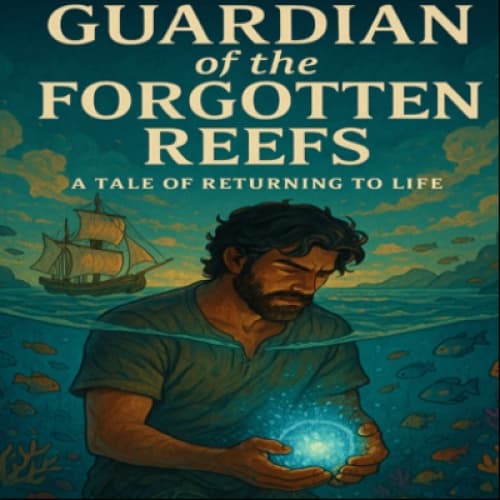
In this bitter reality, where the sea groaned under the weight of ruin, Kayan realized that the old ways of fishing were dead forever. It was not a problem of too few fishermen, but a problem of a sick sea, a dying sea that needed to be brought back to life. This is the essence of Kayan's journey in "The Guardian of the Forgotten Reefs": to revive this sea, and to bring marine life back to it not with the greed of fishing, but with the wisdom of loyalty to nature.
As hope dwindled in the village, a new resolve etched itself onto Kayan's face. He recalled his grandfather's tales of pristine areas of coral reefs rich with life, those that maintained the sea's balance and nurtured life within it. Now, most of them had died, but Kayan believed that a glimmer of hope still existed. In a moment of deep despair, Kayan looked up at the clear blue sky, as if searching for a sign or inspiration. Then, he distinctly remembered his grandfather's story about a very remote marine area that no one usually dared to reach, where it was said to still retain some of its original vitality.
Without hesitation, Kayan decided to embark on this perilous journey. He gathered what provisions he had left, repaired his old boat inherited from his father, and named it "Hope" Before leaving, he went to his elderly grandfather's house, who was confined to bed, and told him of his decision. His grandfather smiled weakly, placed his trembling hand on Kayan's, and said in a faint voice: "Go, my son, the sea will guide you if your heart is pure." His grandfather's words were like the last spark that illuminated Kayan's path in the sea of darkness.
Kayan set off alone on a journey that lasted days and nights. He faced strong currents and sudden storms that almost capsized his boat. The night was terrifying, surrounded by dense darkness and mysterious sea sounds. But his faith was strong, and the image of his grandfather and his advice lit his way. Finally, after a long struggle, he reached an undiscovered marine area, or one untouched by humans for a long time. The waters there were crystal clear and teeming with life; small marine creatures of all colors danced everywhere, living coral reefs glowed with vibrant hues, and rare marine creatures he had never seen before. This area was like a living museum of what their seas used to be.
Kayan spent days observing this pristine life, learning its secrets, and carefully collecting coral larvae (used for coral reef restoration) that the living reefs were releasing. He also noted the abundance of larvae and very small marine organisms that the reefs depended on. He collected them in special containers filled with pure seawater, preserving them as he would his own soul.
Return to Life: A Collective Effort to Revive the Sea
When Kayan returned to the village, its people had lost their last threads of hope. But when they saw his boat approaching, and Kayan returned bearing the tidings of life, they gathered on the shore with anxious hearts. Kayan told them his story and showed them the living coral larvae and the small marine creatures he had collected. At first, skepticism filled their eyes, but Kayan's persistence and the look of hope in his eyes convinced the elders, who remembered stories of the past. Salem was among the first to approach him, and with tearful eyes, he apologized to Kayan for his past mockery and pledged to offer all possible help to bring life back to the sea.
Led by Kayan, the villagers began their journey back to life. They imposed a strict fishing ban for an agreed period and launched a campaign to clean the sea of discarded nets and all pollution. Kayan led diving teams to plant coral larvae in the dead areas of their reefs, and little by little, these reefs began to regain their colors and life sprang from them. They established protected areas where all human activities were prohibited, to be a safe haven for small marine creatures. They learned to cultivate seaweed that provides food and shelter for marine life.
The process took years of hard work and patience, but eventually, the sea began to respond. Marine creatures returned in increasing numbers, and the colors of life returned to the coral reefs. Children's laughter returned to the beach, and the scent of marine life filled the air, but this time, it was accompanied by a new awareness and deep respect for the sea.
A New Dawn: The Guardian of the Forgotten Reefs and Sustainable Awareness
Kayan, once seen as a mad dreamer, became the village's guardian and hero. The sea was no longer viewed as an endless source of wealth but as a living entity to be respected and preserved. Thus, life returned to the village, not as temporary abundance, but as permanent sustainability, a story to be told to future generations about past mistakes and the wisdom of returning to balance with nature. The village became synonymous with hope and the ability to change, a testament that true wisdom lies in understanding the laws of nature and living in harmony with it. And every dawn, as the sun rose over the village's waters, sparkling with life, its people remembered the price of greed, the value of hope, and the power of one hand that believed in change.