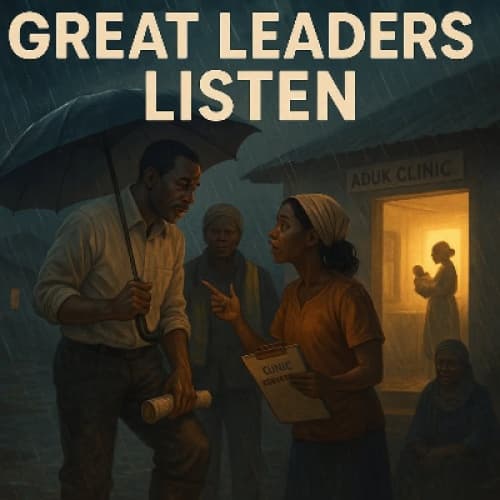
Great Leaders Listen. Correction is not an attack. It is a gift that keeps the lights on when the town goes dark.
Hon. Nkem was the elected local representative of the people. He won with a big smile and a long list of promises: fix the road, bring clean water, repair the school roof. On his first morning in office, he gathered a small team in the old council hall—Teacher Ruth, Driver Samuel, and Blessing, a 22-year-old youth leader who never missed a community meeting.
Nkem stood by a crooked map and tapped the place where the market road cut through the town like a scar. “We fix this first,” he said. “If the road is smooth, trade will grow. After that, water. Then the school.”
Everyone nodded. The room hummed with approval. It felt good.
Only Blessing raised her hand. “Sir,” she said softly, “the clinic needs a generator before the rains begin.”
Nkem’s smile thinned. “The road brings food and money. The clinic can wait a few months.”
Blessing took a breath. “Last week the power went off during a delivery. The midwife used a phone torch. The baby almost didn’t make it. Sir, if we get heavy rain and the road floods, people will still live to see tomorrow. But without light in the clinic, some will not.”
The room went quiet. Nkem felt pride rise in his chest like heat. He had just won an election. He had the right plan. He had done the math. Who was this young woman to push back?
Teacher Ruth cleared her throat. “She only asks that we look again,” she said gently.
Nkem stared at the map. He remembered his late father, a humble carpenter, who used to say, “My son, if everyone agrees with you, you are alone.” The memory softened something inside him.
“Show me,” Nkem said at last.
That night, they walked to the clinic. The sky was heavy with clouds, and the power cut out as if the town blinked and forgot to open its eyes. Inside, a midwife named Aunty Ladi held a crying baby and a cheap flashlight between her teeth. Her hands shook with fatigue. The light made a small trembling circle on the newborn’s face.
“Is this how you work?” Nkem asked, his voice low.
“Most nights,” she said. “We keep praying the light will stay long enough.”
Nkem felt shame move through him like cold water. He had promised a road because it was visible. Paved roads photograph well. A generator makes no speeches. It only hums in the dark while a mother breathes and a child fights to live.
He turned to Blessing. “I was wrong,” he said. The words tasted like medicine—bitter and healing at the same time.
The next day, he called another meeting. “We change the order,” he announced. “The clinic gets a generator now. The road will wait one month. If anyone thinks I am weak for changing my mind, say it to my face.”
An elder did. “Young man,” he said, “leaders who bend will break.”
Nkem nodded. “Or they will learn,” he replied. “If I refuse correction, I become the only person I can hear.”
They voted. It was close, but the team backed the generator.
Two weeks later, the rains came. They fell like a curtain and stayed. The market road turned to red soup. Trucks sank to their ankles. People complained. “Why did you not fix the road first?” they cried.
Nkem walked that muddy road every morning, listening, explaining, and sometimes just carrying a child across a pool of brown water. In the afternoons he went to the clinic, where the new generator sat like a quiet promise. He helped carry fuel cans. He watched the midwives practice with the new lights. He learned the sound of hope: a steady hum and a newborn’s first angry wail.
On a Thursday night, a storm hit hard. The wind dragged roofs by their edges. The town went dark again, all but the clinic. The lights stayed on.
A woman named Esther arrived in labor on the back of a motorbike. The river by the bridge had spilled its banks; the road was gone beneath it. There was no way to the city hospital, only the clinic with its humming heart of diesel and wire.
It was a long labor. Nkem stood outside with the fathers and brothers, holding umbrellas that shook like nervous birds. He prayed with them. He said nothing wise, only, “We are here. We are here.”
When the baby’s cry finally tore the night, men who rarely cried wiped their faces and said the rain was in their eyes. The midwife brought the child to the doorway for a second. “A girl,” she said, smiling for the first time that week.
Esther named the baby “Mmé,” meaning “Mercy.” Later, she added a middle name: “Blessing,” after the young woman who had insisted on the generator. She also asked to see the representative. When Nkem entered, she took his hand and said, “Thank you for letting someone correct you.”
He could not answer at first. He remembered the map, the easy plan, the applause that had felt so warm, and he thought of Mercy’s small breathing chest. He felt tears run without asking permission. “It was not weakness,” he whispered to himself. “It was love.”
The road got fixed a month later. People forgot the mud and praised the smooth ride to market. They cut ribbons and took photos. But Nkem kept one memory above all—Aunty Ladi’s steady hands under bright light, and a baby’s first scream echoing against the storm.
When the next election came, some opponents called him “the man who changes his mind.” They said it like an insult. Nkem smiled and said, “I hope I keep that name.” In the end, he won, but not by much. That night he stood on the same council steps, looking at the map again. His team gathered around him, older, braver.
“Keep me honest,” he said. “If I forget the quiet places, the hidden rooms where lives are saved, challenge me. If I speak too quickly, correct me. I am not a king. I am a pair of ears with a pen.”
Blessing laughed. “And a good pair of shoes,” she said, looking at his muddy boots.
He looked at them—Teacher Ruth with her calm eyes, Samuel with his cracked hands, Blessing with her bright, stubborn courage—and he understood something simple and hard: great leaders do not love being challenged because it is pleasant. They love it because it keeps them from becoming dangerous. It widens their sight. It turns power into service.
“Silence is the softest applause,” Nkem said, “and the loudest danger. Don’t ever give me that.”
They nodded. Outside, children chased each other in the dust. Somewhere in the clinic, a machine hummed. In that small sound, Nkem heard the truth about leadership: correction is not an attack—it is a gift that keeps the lights on when the town goes dark. And in that light, people live.