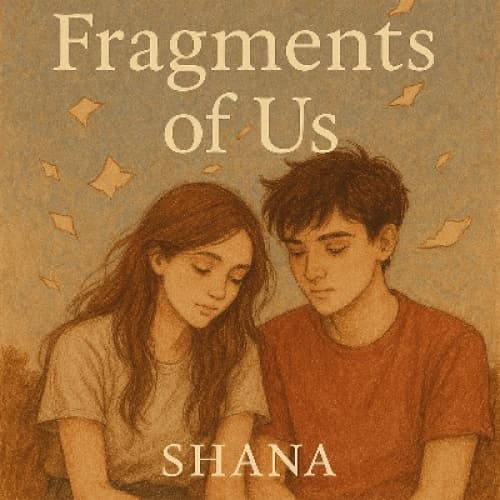
I want to treasure you!
Dawns know you,Dreams show you.
Time holds the key
Of what the world will never see
It's neither something I could have changed
It's not just somehow we could have escaped
Whatever happened it was meant to be
Whomsoever we become it is what we tend to be
This tale was not something to be concealed
Tells the world sometimes its best to be unsaid
Precious you are,Pre defined this is
You are not just something to be let go
You are someone to be kept in.
Moment of silence.
And then—a single clap.
Aditya. My best friend.
The silence shattered like glass, replaced with loud, enthusiastic applause. Phones rose to record. Teachers nodded appreciatively. But I stood still, the poem still buzzing in my fingertips, the mic heavy in my hands. I wasn’t used to being seen like this.
But I was glad it was Aditya who clapped first.
Tara screamed my name, practically flying at me in a whirlwind of bangles and enthusiasm.
"You slayed, girl! Literally slayed," she said, squeezing me in a hug.
"You were so beautiful in the limelight, Aashini. I’m sending your pictures to literally everyone—wait, I gotta run, Rahan’s performing next!" He vanished as quickly as he appeared.
Tara rolled her eyes. "That slug never stays still."
We laughed, that easy laugh only lifelong friends have. The three of us had grown up side by side. Bike rides, exam cramming, monsoon secrets—we were each other's foundation.
Then she leaned closer. "Oh! Ms. Shreya was looking for you."
My breath caught.
Ms. Shreya wasn’t just our class in-charge. She was elegance personified. Warm, wise, and the only teacher who ever said, "Write what you’re afraid to say out loud."
I walked toward the staff room, rehearsing what I might say. That I hoped my poem was okay. That I tried to speak from the heart.
But halfway down the hall, I paused.
People were whispering.
About me.
I didn’t let it sink in. Not yet.
Aashini, you are here.
"Aashini, you’re here," Ms. Shreya said as I entered.
I nodded. "Good morning, ma’am."
She walked beside me to the staff room. "You know about the National Scholar Championship, right? There’s been a small update."
I smiled nervously.
"In addition to the academic sections, you’ll need to participate in a non-curricular round too. Creative performance—music, drama, spoken word. There are also duo and team rounds."
I blinked. My heartbeat slowed. That wasn’t small. That was seismic.
I had signed up for this championship to focus on academics, not to stand on stages again.
"Don’t worry," she said gently.
"Excuse me , Miss", a voice echoed through the room.
Ruhan was there.
His voice was calm, confident, but carried the weight of someone who had read far too many books and felt far too many things. Ms. Shreya smiled warmly, clearly expecting him.
“Ah, Ruhan. Perfect timing. Aashini, meet your partner for the duo event.”
My stomach dropped.
He extended his hand, the faintest hint of a smile on his lips. “Hi. I’ve heard about you. Aashini, right? The quiet girl who writes words that stay.”
Stay.
Why did that word feel heavier than it should?
I shook his hand, trying to steady the storm that was beginning to gather in my mind. “Yeah, that’s me. The quiet girl.”
He tilted his head. “Not so quiet today. That poem you read at the farewell? I’ve never seen silence hold so much applause.”
I blinked. He had been there?
Ms. Shreya interrupted gently, “You both will be participating in the storytelling and performance round. You’ll need to write and perform a short piece—poetry, monologue, skit, anything creative. The theme will be given tomorrow.”
She handed us a file and excused herself, leaving behind a silence that wasn’t uncomfortable—just… different.
“I guess we’re stuck with each other,” I said, half-joking.
Ruhan leaned against the doorframe, a thoughtful look in his eyes. “I don’t believe in being stuck. Just temporarily placed where we’re meant to grow.”
I looked at him. “You always talk like that?”
He grinned. “Only when I think someone might actually understand.”
And just like that, something shifted.
Not dramatically. Not like a movie scene where violins play in the background.
But subtly.
Like the way ink bleeds into paper. Quiet. Soft. Lasting.
The theme was announced: "Fragments of Us."
Very fitting, I thought. A vague, poetic phrase open to interpretation. My kind of thing… or at least it used to be—before the pressure of representing my school, before I had to do it all with a stranger who spoke in metaphors like it was his native tongue.
I found Ruhan sitting under the neem tree near the school amphitheater. A journal in his lap, pen dancing across the page like he was chasing thoughts before they ran away.
He looked up and smiled. “You came.”
“I’m a woman of commitment,” I shrugged, sitting next to him, “also Ms. Shreya threatened me with extra assignments if I bail.”
He chuckled. “Fair enough.”
I pulled out my notebook. “So… ‘Fragments of Us’. Where do we begin?”
He didn’t answer right away. Instead, he closed his journal and looked out toward the field where kids were practicing their dance routines. Then he said, “What if we write it from two voices? Yours and mine. Two fragments. Two perspectives.”
“I like that,” I nodded, “but it needs to merge into something. Something shared.”
“Exactly,” he said. “Let’s begin from before we knew each other. Like… how we were both broken in our own ways. And then trace how two people can still carry cracks and yet hold each other without spilling.”
I stared at him. “You sure you’re not secretly a philosopher?”
He shrugged. “Only in front of the right people.”
I felt something stir inside me. A weird, warm flutter.
We sat together for an hour, words flowing between us like river currents finding their rhythm. My verses were delicate, imagery-heavy, the kind I used to write in the quiet corners of my diary. His were reflective, grounding—like stones placed gently to guide the current.
At one point, he paused and said, “You know, you write like you're trying to remember a feeling, not just describe it.”
That made me pause too.
I wasn’t sure if it was a compliment or an observation that saw through me too clearly.
“Maybe I am,” I said softly.
He didn’t push. Just nodded, scribbling something in his journal. That silence between us again—not awkward, but necessary.
The kind of silence that holds space for something new.
By the end of the session, we had the skeleton of a spoken word piece. Two narratives intertwining—mine about guarding emotions, his about longing to be understood. They met at a point of quiet acceptance.
Before we packed up, Ruhan handed me a folded paper.
“What’s this?”
“A line I didn’t say out loud… yet,” he said. “Maybe for the final performance.”
I unfolded it. It read:
“You weren’t meant to be understood by everyone. Just by someone who listens closely enough.”
I didn’t say anything.
Just smiled.
For the first time in a long while, I wasn’t afraid of being seen.
A week later
Every evening, we met under the neem tree.
Ruhan started bringing tea in a thermos. I brought snacks. He called them “creative fuel.” I called them “excuses to eat biscuits.” The piece was shaping beautifully, but something else was too—something we didn’t speak about, only felt between pauses and exchanged glances.
One evening, while rehearsing a particularly intense part—where our characters speak about the loneliness of always being the “strong one”—I messed up my lines and sighed heavily.
Ruhan looked at me. “You okay?”
“Yeah, just tired. And maybe a little… scared.”
He tilted his head. “Of what?”
“That I’ll get on stage and forget who I am.”
He paused for a moment, then gently said, “You won’t. Because this version of you—you’ve written it into the world now. It exists. And I’ll be right there, reminding you if you ever forget.”
My throat tightened a little.
“Why do you say things like that?” I whispered.
He smiled, eyes soft. “Because you hear them.”
—
Two nights before the competition
It rained unexpectedly.
We ended up rehearsing under a terrace shade near the school’s abandoned auditorium. I had just read my part—a monologue about hiding behind smiles—and was waiting for his cue.
But he didn’t speak.
He was looking at me, completely still. Not dramatic. Not intense. Just… present.
“What?” I asked, nervous.
He looked down, then back up. “You ever feel like something’s changing but you don’t know if you should name it yet?”
My heart stuttered.
I nodded.
“Me too,” he said.
The silence that followed wasn’t filled with tension—it was filled with honesty.
And maybe the beginning of something neither of us was brave enough to call something yet.
—
The day of the performance
Backstage was a blur of lights, noise, last-minute costume pins, and bottled water. My palms were sweaty. Ruhan stood beside me, calm as ever, but I could see the small ways nerves were creeping in—he blinked more than usual, tapped his pen rhythmically.
“Ready?” he asked.
“No,” I replied, breathless. “But let’s go anyway.”
Our names were called.
We walked onto the stage, the spotlights warm and blinding.
And then it was just us.
Two voices.
Two stories.
Told in sync, layered with pauses, glances, breaths.
We spoke of loneliness, of pieces we lost along the way, of versions of ourselves we buried too soon. And finally—we spoke of finding each other. Of how some fragments don’t fit until they meet another broken piece and find shape again.
The final line belonged to me.
"You weren’t meant to be understood by everyone… just by someone who listens closely enough."
The hall was still.
And then—applause. Loud, thunderous, real.
But I wasn’t listening to any of that.
Because when I turned toward Ruhan, he wasn’t looking at the crowd.
He was looking at me.
And in his eyes, I saw it.
Something unspoken.
Something waiting.
Something that felt like the beginning.
Later that evening
The crowd had dispersed. The auditorium was nearly empty now, except for a few organizers packing things up, and the muffled music playing from the after-party in the courtyard.
I sat alone on the stage steps, barefoot, heels tossed somewhere under the curtain. My makeup slightly smudged, heart still pacing like it hadn’t left the spotlight.
Ruhan returned with two juice boxes.
“Fancy vintage drink for the artist,” he said, handing one to me.
I took it with a tired smile. “Thanks. For everything.”
He sat beside me, stretching his long legs out and letting the quiet settle in.
“You know,” he said softly, “I’ve performed before. A lot, actually. But tonight felt different.”
I turned to him. “Because we didn’t mess up?”
He chuckled. “No… because it mattered.”
I stared at the juice box in my hand, suddenly afraid of where the conversation was going. Afraid… and hopeful.
“Aashini,” he began, then paused. “Can I ask you something?”I nodded.
“When you wrote your first line for our piece—the one about being too full of unsaid things—were you writing as the character… or as yourself?”
I looked at him. Slowly. Carefully.
“As myself,” I whispered.
He smiled, eyes not leaving mine. “Me too.”
There was a beat of silence.
Not empty.
Not uncomfortable.
Just charged—like something big had just been said without being spelled out.
Then he added, almost too softly, “I think I want to keep hearing your words, even when there’s no stage.”
My breath hitched.
And in the gentlest voice I could manage, I said, “Then I think I want to keep writing them… for someone who listens the way you do.”
He didn’t say anything.
Just reached over and gently tapped his juice box against mine.
A quiet toast.To something unnamed.
But real.
The days after the performance
Nothing dramatic happened.
No sudden declarations. No romantic music playing in the background. No whispered “I love you” under a starry sky.
But something shifted.
Ruhan and I still sat under the neem tree—but now it was less about rehearsing and more about being. We'd bring books we never opened. Talk about everything and nothing. Share playlists. Sit in silence and somehow say more in those silences than in all our practiced lines.
One afternoon, as I scrolled through my camera roll, I found a blurry photo Tara had clicked during our performance. It was mid-line, mid-glance—me looking at Ruhan, and him looking right back.
There was something in that frame. A kind of stillness. A kind of knowing.
I sent it to him with a single caption:
“Fragments. But not broken.”
He replied instantly.
“Some pieces were just waiting to be found.”
One week later
We were called to Ms. Shreya’s office. The national results were in.
“You two,” she said, adjusting her glasses, “are not just regional finalists—you’ve topped the country.”
Aditya literally yelled in the hallway when he found out. Tara screamed, hugged me, and made it her life’s mission to post every behind-the-scenes photo she had of us rehearsing.
But Ruhan and I… we celebrated quietly.
On the school terrace, just as the sun dipped below the rooftops, we sat again—juice boxes in hand, because tradition.
“I should be happier,” I said, “but it feels like winning the competition wasn’t the biggest thing that happened.”
Ruhan looked at me, eyes soft. “It wasn’t.”
I hesitated. “Then what was?”
He didn’t answer right away. Just pulled something from his pocket—a folded piece of paper, the same kind he gave me before the performance.
This one had a single line:
“You weren’t part of my story. You became it.”
My breath caught.
“I’ve wanted to say it,” he said, voice low. “But I didn’t want it to sound like just poetry.”
“It doesn’t,” I whispered.
And for the first time, I didn’t hide behind metaphors.
I didn’t overthink.
I just reached out, gently holding his hand.
No dramatic music.
No grand declarations.
Just… warmth. Real. Quiet. Ours.
________________________________________
And somewhere in a journal, titled at the top of a fresh page:
Fragments of us—
not the broken kind.
The kind that finally fit.