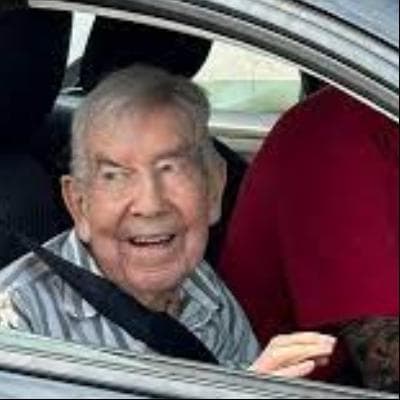

“Why can't I just stay with you?” the old man asked as he fumbled with the seat belt. His twisted fingers struggled to find the clasp.
“Here, let me help you,” said his son, who leaned over from the driver's seat and deftly inserted the buckle. “Dad, we've been through this before. I'm sorry. Are you sure you have everything?”
“No.”
“Well, I'll visit, so if you missed anything I can bring it later.”
“No you won't,” the old man protested. “You won't visit.”
The car pulled out of the drive and onto the road. For a while, there was silence as the two men looked straight ahead. Although it was a chilly day, with a slight wind, the sun was out and the sky was clear. The predicted rain had passed to the south and the car was pointed north, so the son predicted a pleasant drive.
As the son took the exit onto the highway, the white haired father watched trees and shrubs accelerate past. The ride was so smooth that it seemed for a while that it was the scenery moving past the car, rather than the other way around. The old man, his face leathery and parched, let the illusion linger as long as he could get away with it. It soon faded, though, and the old man's mind went blank.
“Where is your mother?” the old man asked his son.
“Dad, mom died years ago. Don't you remember?”
“Of course I do,” the old man said. “She died an eternity ago.” Of course, he did not remember. She was as alive to him now as ever, floating in his memory, her Titian colored hair gently brushing her high cheek bones, her toothy smile shining as brightly as a spring day. “I loved her very much,” the old man mumbled.
“I know you did, Dad. Mom loved you very much too.” Tears formed in the corners of the old man's eyes. He brushed them away with a bony knuckle.
“Why can't I just stay with you?” the passenger asked desperately.
“Dad,” the younger man sighed, “we've been through this. I don't really have the space for you to be comfortable. I work and I don't have time to take care of you. I travel an awful lot. I can't afford someone to come look after you every day. I'm sorry. This is the best thing.”
“It's the best thing for you,” the old man said angrily. “Toss me away like an old dog. Drive me out to a field and leave me there and hope I never find my way home.”
“Dad, it's not like that. I--” but the old man was not listening. He was hearing the echo in his mind, a deep sense of abandonment. Soon, his mind began to wander. As he gazed out at passing bales of hay, he recalled the Quonset huts from the war. His mind wandered back to the firefight. There, he was also abandoned.
The way he remembered it, his squad was ambushed. His friend Bill went down immediately, shot though the neck. With a gurgle, Bill asked for water, but died before anyone could get to him with their canteen. Squirrel, the youngest man in the group, was also hit, and the old man remembers the moment he tried to crawl to him. As he wormed his way to the screaming teenager, he felt a hard sting on his thigh. At first, he thought it was a jungle wasp, and the man swatted at it instinctively. With a hard slap, the man squashed the wasp beneath his palm and felt the warm juice ooze between his fingers. It was only when he checked his hand and saw the coating of blood that he realized that it was a bullet that had stung him--the invincible and unforgiving deadly insect of the jungle. “Please don't leave me!” Squirrel called out, and the man, wounded in the leg, inched forward until he reached the young man. Grabbing him by the collar, he pulled the whimpering youth to safety. When the fight was over, it was discovered that Squirrel was not hit at all. He was only afraid.
Although he received a medal, the man felt empty after the war, unappreciated. Squirrel, whose real name his rescuer never knew, never even offered a thank you, an apology, or any kind of acknowledgment for being saved. The rescuer--now a white-haired old man in a car--always wondered why. Perhaps, he had considered over the years, Squirrel was too embarrassed to offer any kind of thanks. After all, he had been revealed as a coward. Perhaps he was angry with himself. Perhaps, too, the knowledge that his cowardice had caused the old man to be shot in the leg was too much for him to bear, and he did not know how to approach his savior once the danger was over. Perhaps, the old man pondered, Squirrel just did not know the right words to say. Maybe Squirrel was dead.
“You know I was in the war,” the old man said to his son.
“Yes, Dad. I know.”
“You know I was shot. Right in the thigh.”
“Uh-huh. I remember you telling me when I was little. I asked you about the scar, remember? At the beach?”
“I was a hero. I saved a man's life.”
“You are still a hero, dad.”
“I came back, and no one cared. Not even the guy I saved. Never a thank you or a great job or anything. Just back to work as usual. And for what? To be tossed out like an old rag.”
“Dad!”
The old man fell silent. He watched out the window like a panting dog. He saw a pond lined with cattails. His mind wandered back to old memories of rice paddies, wading up to his hips in muddy water, picking leeches from his thighs and abdomen. Now, there were more leeches than ever, sucking the life from him. During the war he had given all he had, and he gave even more after the war. He married; he fathered a child. He worked; he paid taxes. He gave and gave and now he was being put out to pasture.
“Where is Jean? Where is your mother?” the old man asked.
“Dad,” said his son. “Mom is dead. Don't you remember?”
His memory restarted. “Why can't I just stay with you?”
“Dad, we have been through this. I travel a lot for work. I don't have the space. And, well--” the man hesitated a moment, “Dad, your memory is not what it used to be, and--”
“There is nothing wrong with my memory! You just remember that,” the old man said, wagging his bony finger in the air. “Where is Jean? Can Jean come with us?”
For a while, the two men were silent. The young man thought about the ethics of his decision. It was true, he thought, that he traveled a lot for his job. But it was not true that he could not afford a caregiver for his father while he was gone. It was also not entirely true that he did not have room in his small apartment for his father, since the man had recently signed a lease on a much larger apartment. So why, the man asked himself, had he lied?
He tried to convince himself that he had lied for the good of both his father and himself. Taking care of an elderly parent is not easy, and it becomes more challenging still when the parent's memory begins to fade. The doctor had said that his father had dementia, and that there was no cure. Eventually, the doctor declared, the old man would need round the clock care. So why not offer it now? Why not put him somewhere where he could be cared for properly. That was what was best. That was what was easiest. Indeed--and the young man had his answer. He almost turned the car around.
The old man was thinking empty thoughts. His mind had trouble forming memories. Once vivid forms were now just phantoms, ghosts that haunted him during his waking hours. At night, he no longer dreamed. Through the silence, he suffered and forced himself to think. For a while, he thought only that he was out with his son for a Sunday drive. But slowly, reality coalesced in his brain and he drifted back into the moment. He remembered where he was going, and he was afraid. He was more afraid of going away than of going to war. He was more afraid of being left with careless strangers than of being shot in the thigh. He was more afraid of being alone with his ghosts than of being with his son.
“You know,” the old man said, “I will kill myself if you send me away.” The noisy silence was shattered now, and it could no longer be recaptured. Reality was laid bare in the laps of the two men, and they each had to deal with it in the only ways that they knew how.
“Dad, come on. You know that this is for the best, for both of us. This place is nice. I checked it out and it's really good. You'll make some friends and have a great time.”
“Who are you trying to convince, me or yourself?” the old man asked. The young man wondered at the answer. “Just let me stay with you,” the old man whimpered. “I won't be a burden. I won't get in the way.”
“Here we are,” said the young man, relieved to finally be able to escape the confines of the unpleasant conversation. He pulled the car into the drive and up to the front door, where three orderlies leaped into action taking luggage from the car and loading it onto a wheeled cart. The young man helped his father from the car. When he placed his hand on the old man's arm, he was reminded of how frail the old man had become, a mere shell of the strong war hero he remembered growing up. He told himself that he was doing the right thing. He worked hard to convince himself, and it was making him tired.
The old man grabbed his thigh where he had once been shot, and painfully lifted his leg over the lip of the car and placed it carefully on the pavement. “Jean?” the old man called. “Where are you?” He looked in the back seat and thought he saw her face. But it was just a ghost.
The orderlies had finished loading the luggage, and they shuffled the old man toward a pair of big glass doors, one on each arm and one behind pushing the wheeled cart. “Come with us, Mr. Decker,” said one of the men.
“I don't want to go,” the old man cried, trying to free himself from their grip. “I have not done anything wrong. Jean?”
“Dad, these men are here to help you. They are going to help you get sorted. I will come to visit as soon as I get back from Singapore.”
“Why can't I stay with you?” the old man asked. Tears were streaming down his leathery face as he looked back at his son. “Where is your mother?”
“I love you,” said the son, and then got back in his car. In a moment, he was gone.
When the young man returned from Singapore, exhausted and jet lagged, the letter was waiting for him. It explained that they had tried to call, to get a hold of him. It explained that they had no idea how his father had gotten his hands on so many pills and managed to swallow them so quickly. It expressed condolences.