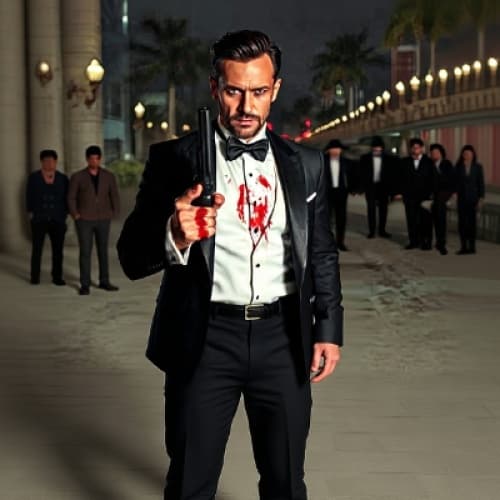
The summer heat in Miami was always oppressive, but this was different. The air was thick with more than humidity—it buzzed with tension, fear, and the unmistakable scent of blood. News anchors had stopped pretending it was under control. Whatever had started in the underbelly of Little Havana had spread like fire through a dry forest, and now, it was everywhere.
People were changing.
At first, they said it was a virus—some bloodborne pathogen causing delusions, aggression, photosensitivity. But you didn’t need a medical degree to know what it really was. They were turning into vampires.
Lucien Vega leaned against the floor-to-ceiling window of his penthouse overlooking Biscayne Bay. The sky was a deep crimson—sunset, or smoke, or both. He held a crystal tumbler in his hand, half-full with bourbon and ice that clinked like distant alarm bells.
His phone buzzed for the sixth time in as many minutes. He ignored it again.
"Sir," his assistant, Carla, said, stepping into the room. Her voice trembled. "The quarantine’s started. National Guard has blocked every major causeway. No one's getting in or out."
Lucien turned slowly, the weight of realization finally setting in. His escape jet was fueled and waiting at Opa-locka. His Bugatti had been packed hours ago. He had paid off city officials, cops, even the air traffic controllers. But none of it mattered now. The government had sealed the city like a tomb.
"You said we had until nightfall," he said, not accusing—just cold.
Carla shook her head. “They accelerated the lockdown. Too many people are changing. They're calling it an 'urban biological anomaly.’ Martial law is in effect.”
Lucien set the glass down carefully on the windowsill. He stared at the reflection of the skyline behind him. Lights flickered across the city like fireflies, but none brought comfort. Somewhere out there, people were screaming.
He had made his fortune off pharmaceuticals, bio-tech, and government contracts. Ironically, the virus spreading now had passed through labs his company once funded—black budget projects, far from public eyes. He didn’t know the details. He never asked. He signed checks and shook hands.
Now he was trapped with the rest of them.
By midnight, the city was silent.
Lucien moved through the corridors of his high-rise like a ghost. The power had gone out two hours ago. His security team was missing. Carla was dead—or worse. Her screams had echoed through the stairwell after she'd gone to check the garage.
The emergency radio crackled in his hand. “…repeat, zones 3 through 7 are lost. Stay in shelter. Do not engage. Infected exhibit advanced speed, strength, and cognitive function…”
Lucien’s breath fogged in the dark. He was sweating, but cold.
He opened the gun safe in his panic room, pulling out a matte-black Glock. It felt useless, but it was something.
The elevator dinged.
No one had pressed the button.
The security panel glitched, and the screen flickered with static before showing a distorted camera feed from the lobby. Shadows moved—tall, humanoid, fast. One of them looked up, as if seeing him through the camera.
Its eyes glowed faintly.
Lucien backed away, heart hammering. He didn’t believe in monsters. He believed in margins, liability, and non-disclosure agreements. But now, monsters believed in him.
He retreated to the balcony. Twenty stories up, the air was clearer, but no safer. The streets below were chaos—flashes of movement, sirens, gunfire. A helicopter hovered near the bay, then tilted hard and exploded in a fireball.
A voice behind him whispered: “You helped build this.”
He turned, gun raised.
A woman stood there. Pale. Eyes like obsidian. No pulse. She wore a lab coat.
“Dr. Rojas,” Lucien said, the name crawling back from memory. She had been a project lead—fired years ago for “moral objections.”
“We warned you,” she said.
Lucien raised the gun and fired. The bullet passed through her. She didn’t flinch.
She stepped forward. “You wanted to live forever. You sold it like a product. Now it’s free.”
The last thing Lucien Vega saw before the city swallowed him was the night sky turning black, and the stars blinking out one by one.
Three Weeks Later
The quarantine held. Miami was silent now—no heat, no lights, just the low hum of something ancient stirring in the ruins of neon and steel.
And sometimes, from across the water, survivors swore they could still hear music… and laughter, drifting from the towers like ghosts.
Or maybe it was feeding time.