The post-mortem report read:
Subject: Male, approximately 78 years of age
Residence: Third-floor apartment, City Centre
Cause of Death (official ruling): Accidental fall resulting in cranial trauma
Findings:
• A deep laceration at the occipital region of the skull, consistent with impact against a hard surface
• Substantial intracranial bleeding observed
• Additional superficial abrasions along the chest and shoulders. Linear scratches present across the sternum and upper torso, likely sustained during the fall
• Multiple shallow puncture wounds noted on the upper chest and shoulders. These were dismissed as incidental injuries caused by the collapse, possible contact with broken household objects
• A severe avulsion wound to the right hallux (great toe), irregular tearing of the nail bed. Believed to have occurred during the fall
Conclusion:
The subject likely lost balance, fell backwards, and sustained fatal head trauma. All secondary injuries are consistent with an accidental fall.
Manner of death: Accidental
But the report could not tell the story in full.
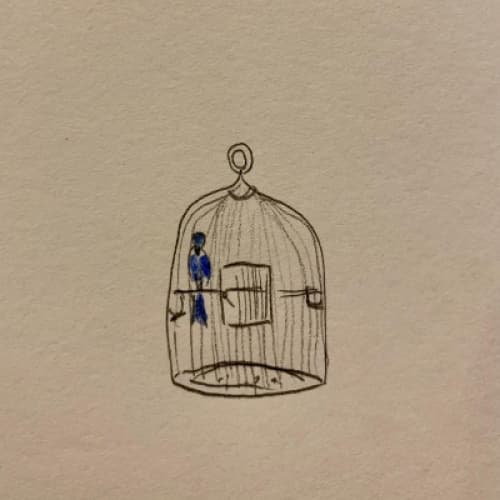
The old man had lived alone—save for his parrot, Billy. Billy had originally belonged to his ex-wife. When she passed away, she left him her pension under one strict condition: he must take care of Billy. He accepted the arrangement grudgingly, but he never loved the bird. To him, Billy was no companion, but a tormentor. Its shrill mimicry mocked his voice, turning his mutters and curses into grotesque echoes. He responded with cruelty: jabbing at the cage with a stick, kicking it when its squawks pierced the silence. Sometimes, even when Billy was quiet, he would scream at the bird. He wanted a target, something he could abuse. Silence alone was not enough—he craved the act of control.
Sometimes, Billy would whistle a song his ex-wife used to sing. The memory carried in that tune enraged him. His face would contort with fury as he lashed out, striking the cage repeatedly with his walking stick, sending poor Billy rattling helplessly inside. Other times, when the bird grew too loud or defiant, he would stuff the cage into a dark cupboard and close the door. On one occasion, he left him there for three days. The memory of that confinement made Billy’s occasional chirps even more unbearable, a constant reminder of the power struggle between man and bird.
That night, his violence set his fate in motion. His boot slammed into the cage, and the latch sprang loose. The door creaked open. Billy slipped out.
As the old man fumbled with his clothes, preparing for bed, he felt a sudden, tearing agony in his foot. Billy’s beak had sunk deep into the flesh of his toe, crunching through skin and nail. He screamed and lurched backward. His heel caught the rug, his body pitched, and his skull struck the floor with a sickening crack. Blood began to seep, thin and dark, into the carpet fibers.
Consciousness flickered. When his eyes fluttered open, Billy was there—perched on his chest. Its weight pressed against his ribs as it tilted its head, watching him with a predator’s stillness.
The torment soon began. Billy climbed up and down his chest, claws digging into fragile skin. The nails had never been trimmed; each step left angry red welts, sometimes breaking the skin so that thin lines of blood ran across his torso. Occasionally the parrot leaned forward, scraping its overgrown beak against him—sharp edges cutting into his flesh as though testing him, tasting him.
Then came the mockery. Billy shuffled to his shoulder, pressed his beak beside the old man’s ear, and began to mimic the sound of his terrified breathing. Shallow, ragged gasps, perfectly echoed. Each breath he struggled to draw was immediately repeated in that shrill, mocking rhythm. Hhhuhh… hhhuuhh… hhhuuhh… The mimicry grew louder, distorted into grotesque panting, until it drowned out his own failing lungs.
And then, just as suddenly, Billy was gone.
The old man felt the weight lift from his chest, heard the faint scratch of claws on the floorboards, and then—silence.
Had the bird left the room? Was it finished with him?
Minutes passed like hours. His ears strained into the quiet, praying for it to stay that way. A flicker of hope, absurd and desperate, crept into his thoughts: perhaps he would live through this.
Then, faint at first, he heard it again. Tap… tap… tap.
The sound of claws. Returning.
Closer.
Slower.
Until they stopped—right beside his head.
He did not dare turn his eyes, but he felt the presence there, hot breath against his ear. And then the mimicry began again, this time louder, harsher, perfectly in time with his ragged breaths. His fear had become Billy’s voice.
And then—clearer than ever—the parrot shrieked his own name between the breaths:
“Billy… Billy… Billy…”
Hours dragged on in a haze of pain and madness. His skull throbbed, his toe burned, and his chest was a map of scratches and punctures from the bird’s jagged claws. The sound of his own dying breaths twisted into ridicule, the constant scraping of claws and beak across his body, the looming threat of that snapping beak above his eyes—all of it reduced him to a trembling husk of terror.
At last, his body surrendered. His breath rattled once, then stopped. His eyes froze open, fixed on Billy—the bird that stood victorious.
By the time the authorities arrived in the morning, Billy was back inside his cage—calm, silent… and whistling the song his ex-wife used to sing.