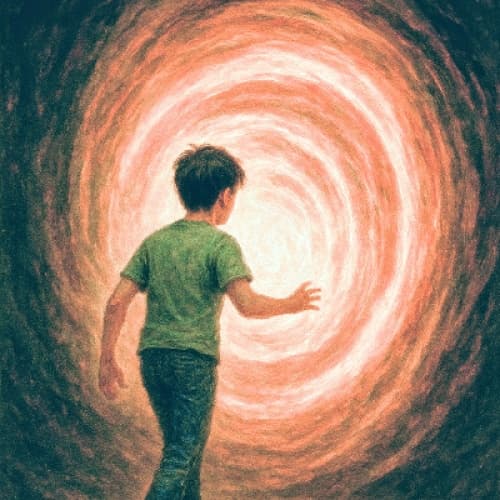
Long ago, in a quiet town, there lived a man named Arjun. He was curious by nature, always chasing the mysteries of the universe. One night, while walking home under a sky glittering with stars, the ground beneath him shivered. A strange swirl of golden light, like liquid fire, opened in the air—a wormhole. It wasn’t the first time such a phenomenon had appeared; in fact, legends said that once every ten years, for a single night, the universe tore open and created a gate to the unknown.
Arjun had heard the tales, but no one had ever dared step inside. Curiosity overtook fear. He reached out, and before he could think, the wormhole pulled him in.
Colors folded into each other, time bent, and he felt like he was both a drop of water and the ocean at once. When the spinning stopped, he stumbled onto solid ground. But this wasn’t his world.
The air smelled raw, fresh, alive. Towering forests surrounded him, and massive rivers cut through the land like silver serpents. As he wandered, Arjun realized he had traveled thousands of years into the past—the prime age of humanity, when early civilizations were rising, when man still lived close to nature, uncorrupted by machines or greed.
He saw tribes building fires, hunters moving silently through the grasslands, children laughing freely without fear of the future. He was struck by how strong, united, and pure humans once were.
Arjun had thought the past was pure, untouched, and peaceful. But as days passed, he began to see a harsher truth.
Hidden among the shadows of the forest, he observed the tribes more closely. They were strong, yes, but also cruel—territorial, violent, and merciless to outsiders. He saw them fight other clans, take captives, and even perform rituals that ended in blood.
One night, while sneaking closer to study their ways, Arjun was discovered. A group of warriors, painted with ash and fire markings, surrounded him. Before he could run, they knocked him down with a heavy blow.
He was dragged into their camp, bound by vines, and thrown before their leader. The tribe saw him as a trespasser, a strange man with clothes and speech unlike theirs. To them, he was not a guest—he was prey. They decided he would be sacrificed at dawn… and eaten in a feast of power.
Arjun’s heart pounded. He had never faced death so closely. But he wasn’t ready to surrender. He studied his surroundings carefully—the fire pit, the sharpened bones, the guards who laughed, not expecting their prisoner to resist.
When the moon was high, Arjun acted. Using a sharp rock hidden in the dirt, he cut through his binds. He waited until a guard came close, then struck hard, knocking him out. With speed born of desperation, Arjun grabbed a spear and fought his way through the camp. Warriors rushed at him, but he used their own ferocity against them, dodging and striking back.
The tribe’s cries echoed through the forest as he ran, wounded but unbroken. And then, just as his strength was fading, he felt the tremor under his feet. The wormhole was opening again.
The swirling golden light appeared between the trees. The tribesmen chased him, their roars growing louder, but Arjun hurled himself into the vortex at the last moment.
The forest vanished. The roars disappeared. He crashed onto the ground of his own time, gasping, his body aching but his spirit alive.
He had seen the truth—the past was not only noble but also savage. Humanity’s “prime time” was filled with brilliance and brutality. And every ten years, when the wormhole opened again, Arjun would remember that survival was the greatest wisdom the past had taught him.
The night was thick with smoke and drums. Arjun sat tied near the firepit, his hands raw from the vines that bound him. The tribe danced in circles, their painted faces lit by flickering flames, chanting for the feast at dawn—his feast.
He looked down at the dirt beneath him, steadying his breath. Hidden just below the surface was a sharp shard of stone he had spotted earlier. With each beat of the drums, he rubbed the rope against it, sawing desperately. The fibers began to fray.
A guard leaned over, grinning, shaking a spear in Arjun’s face. “Tomorrow… meat,” the man said in a tongue Arjun half-understood. The guard laughed, turned his back—and in that instant, the rope snapped free.
Arjun exploded into motion. He swung the broken rope around the guard’s throat, pulling him down into the firelight. The man collapsed, unconscious. Gasps rose from the dancers.
Without hesitation, Arjun seized the fallen spear and spun it in his hands. A warrior charged—Arjun sidestepped, thrusting the spear’s butt into his gut. Another came from behind; Arjun ducked, letting the warrior’s club swing past his head before slamming the spear across his jaw.
The camp erupted into chaos. Warriors shouted, rushing from every direction. Arjun ran, weaving through huts, kicking down clay pots to block their paths. A torch fell—flames licked the dry grass, spreading panic.
At the edge of the camp, three tribesmen barred his way. They snarled, weapons raised. Arjun’s mind raced. He grabbed a burning branch from the ground and swung it wide, the fire forcing them back. One lunged anyway—Arjun shoved the torch into his face, then rammed the spear into the ground, vaulting over the others like a cat.
His lungs burned. His legs screamed. But he didn’t stop. The forest opened before him—and then, the earth shuddered.
The wormhole burst into existence, a whirling storm of golden light between the trees.
The warriors behind him screamed in rage, closing in fast. Arjun sprinted, every muscle in his body fighting to carry him forward. Spears flew past him, one grazing his arm, another shattering against a tree.
He dived headlong into the swirling portal just as a warrior’s hand nearly grabbed his ankle.
The world spun. Fire became silence. Rage became emptiness. And in the blink of an eye, Arjun slammed back onto the cold ground of his own time.
Breathless, bloodied, alive.
The wormhole closed behind him with a final flash—sealing the past away.
Arjun lay there, staring at the sky, realizing he had not only survived but fought back against history itself.
The Second Cycle
Ten years passed.
Arjun’s life in the present had returned to routine—offices, streets, screens, and noise—but deep inside, he carried scars no one else could see. Some nights, he would wake in sweat, hearing the tribal chants, smelling the fire. Other nights, he dreamed of the wormhole’s light calling to him again.
He knew the truth: in every tenth year, the gate would reopen. And this time, he wouldn’t be the helpless wanderer. He would be ready.
Arjun began to train. At dawn, he ran through the forests outside his city, toughening his body. He studied martial arts, survival skills, ancient history, even primitive medicine. He collected tools and weapons, but also knowledge—because he understood that the past wasn’t just dangerous, it was unpredictable.
By the ninth year, his apartment looked less like a home and more like a war room. Maps pinned on walls. Notes on tribal languages. Drawings of their weapons and camps from memory. And in the corner, a backpack always packed: knives, rope, water, flint, herbs.
On the final night of the tenth year, Arjun stood where the wormhole had once appeared. His heart thundered as the ground trembled. The air cracked with light. And once again, the golden swirl tore open the night.
This time, he didn’t hesitate. He stepped inside.
--
-
Return to the Past
The spinning stopped, and the forest greeted him again. But it was different—the same land, the same rivers, but the tribe had grown larger, more powerful. Fires burned brighter. Their war drums thundered louder.
Arjun crouched in the shadows, watching. The memory of nearly being eaten burned in his chest. He wasn’t here to repeat the past—he was here to understand it. To survive it.
But fate wasn’t kind. Scouts discovered him within hours. Once again, he was dragged before the tribal leader. Yet this time, Arjun was not bound by fear.
When the warriors pushed him forward, Arjun smiled.
“Ten years,” he said softly, “and I came back.”
The leader’s eyes narrowed. The tribe chanted, seeing him as some immortal spirit who could vanish and return. But others saw him as a threat.
The decision was made quickly: fight for his life in their ritual combat, or die.
Arjun gripped his spear, his muscles coiled, his mind sharp. He wasn’t just fighting them—he was fighting time itself.
Arjun’s Struggle with the Wormhole
The wormhole glowed before him like salvation—a golden storm in the heart of the forest. Arjun’s chance to leave the cruel world of the tribes had finally arrived.
But they had been watching.
Dozens of warriors emerged from the shadows, spears raised, faces painted with blood and ash. They knew what the wormhole was—or at least, they feared it. To them, it was a spirit’s gate, forbidden to mortals. And they would not let Arjun enter.
He ran for the swirling light, but the tribe roared, closing in. Spears cut through the air, one grazing his leg. A warrior slammed into him, dragging him down. Others piled on, shouting, striking. Arjun fought like a cornered animal, kicking, punching, clawing at the dirt, but he was outnumbered.
The wormhole pulsed brighter—its time was almost gone. Arjun reached out with his bloodied hand, fingers brushing the air where space itself tore apart. But the warriors yanked him back, slamming him to the ground. And with a final flash, the wormhole collapsed.
It was gone.
Arjun lay there, broken, the taste of dirt and iron in his mouth. He had missed his escape.
---
The Second Attempt
Days passed in torment. The tribe locked him in a pit, feeding him scraps, mocking him. They thought they had defeated him. But Arjun never stopped watching the skies, feeling the earth. He remembered the pattern—ten years, always ten years. If the wormhole had opened once, it would open again.
And when it did, he would be ready.
He sharpened stones in secret. Strengthened his body by climbing the pit’s walls each night. Studied the guards, their shifts, their habits.
Ten years later, the ground trembled again. The tribe gathered, terrified but determined to block the “spirit gate” once more.
But this time, Arjun was no prisoner. He broke free, striking his captors with brutal precision, using every trick he had learned in a decade of survival. He set fires to scatter them, hurled stones to break their charge, fought with the fury of a man who had been caged too long.
The wormhole flared open again, brighter than ever. The warriors tried to form a wall between him and the light, but Arjun charged like a storm. He cut through them with rage and desperation, every step dragging him closer to freedom.
A spear pierced his side—he ripped it free and used it against them. A warrior leapt at him—Arjun spun, driving him into the fire.
At last, breath ragged, body broken, he reached the gate.
The last warrior lunged, but Arjun hurled the spear straight through him and dove into the wormhole.
Light swallowed him.
The forest vanished. The chants disappeared. And after twenty years of blood, fear, and struggle, Arjun fell back into his own world.
He was older. Scarred. Hardened. But he was free.