
Maithili
I don’t know why, but from the very beginning, I’ve always felt drawn to abandoned places. There’s something about them that speaks to me. I can read stories in the silence, in the chipped paint, in the forgotten corners. Maybe, in some unspoken way, I’ve felt abandoned myself—at least at some point in life. And so, I connect. I listen.
I don’t just read stories in books. I read them in places. In non-living things. Everything around us—walls, windows, broken toys—has something to say. People often say “the eyes never lie,” and that’s true. For living beings, you can glimpse the heart through the eyes. But for lifeless things, you need a heart—an open, feeling heart—to hear what they’re trying to tell you.
I recently visited a hill station. I’ve always loved mountains, their silent strength and towering presence. But I set aside a day just to wander. Not to tick off tourist spots, but to roam through the quiet lanes of the town. If you pay close attention, you'll find many buildings that are either abandoned or have been left to time. Even if not entirely deserted, they’re no longer homes—they're echoes.
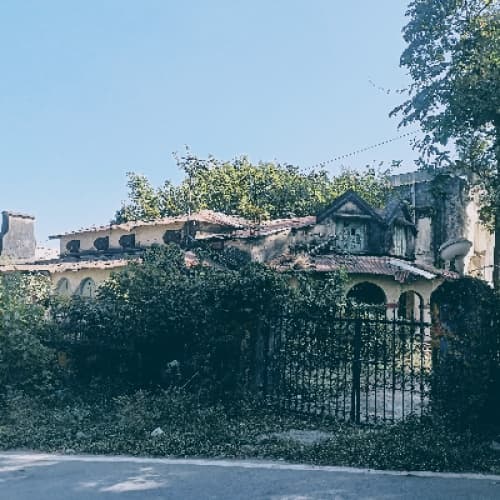
As I walked, I came across one such house. I stopped in my tracks. There was something about it that tugged at me—an inexplicable, eerie pull. It stood quietly in the midst of overgrown greenery, yet it spoke louder than anything else around.
It was a beautiful house—an old structure with distinct architecture, the kind you don’t see anymore. The red roof, faded but still proud, sloped gently down toward a small black iron gate. The house had two floors, the upper floor slightly smaller, giving the impression of a toy-block structure we used to build as children. Nature had begun claiming it—wild grass grew thick on the porch and even crept up the roof tiles, blending the house into the hills like a forgotten memory returning to earth.
The walls, once painted an elegant off-white, had darkened with age, weather, and neglect. Near the entrance, two graceful arched doorways welcomed silence and time. Vines wrapped around the columns like quiet sentinels. The small windows on the first floor were framed with chipped wood. One of them had a broken green glass pane, adding to the sense that someone, somewhere, had left in a hurry—or perhaps never returned.
I stood at the gate, trying to take in every detail. Every crack, every corner whispered a tale. That’s when I noticed a doll lying near the porch, almost hidden in the overgrown garden. It was pink, though dusty and weather-worn. A child’s doll, once beloved. Instantly, my mind began spinning a story—of a little girl who used to play right there, maybe with her grandmother watching nearby. I could almost hear her giggles echo against the stone. I imagined evenings spent on that porch, the mountains turning golden as the sun set, the child running around with that very doll in her arms.
It felt so real—so heartbreakingly real—that I began to wonder why such a happy home was now a husk. Why had it been left to fade? My eyes drifted back to the first-floor window—the one with the broken green glass—and I froze.
There she was.
A little girl. Standing there. A strange smile curved her lips, but her eyes—her eyes were empty. Like she had seen too much, felt too much, far too soon. In her hands, she held the very same pink doll, but now it looked new, untouched by time. I blinked. Jolted.
My eyes darted back to the garden. The doll was gone.
I looked up again. So was the girl.
The air turned colder. And I understood. I understood why I had felt that eerie pull the moment I laid eyes on the house. Some stories don’t just wait to be read. They reach out to you. They find you.