
Because of my endless curiosity, I stepped further into the temple. Inside, I found rows of stone statues in all shapes and forms—some looked like tigers, some resembled a traditional dakon game, others shaped like gamelan instruments, and even human figures frozen in various poses.
They felt so alive, as if once they had been breathing beings, suddenly turned to stone by lava. The details were flawless—the expressions of the figures, both human and animal, were so natural it left me amazed. I couldn’t help but think, what a brilliant artist must have crafted these works.
As I was lost in admiration, suddenly—tap!—a hand landed on my shoulder. An old man stood there and asked,
“What are you looking for, Miss?”
I froze. It took me three whole seconds before I managed to reply—three long seconds that proved my courage wasn’t as big as my curiosity.
“Sorry, Mr. I shouldn’t have barged in without permission. I thought this temple was open to the public. From a distance, I saw a crowd—beautiful dancers, I thought there was some kind of ceremony, so I came closer.”
Now it was his turn to pause, frowning as if my words confused him. “Miss… you saw dancers in this temple?”
Without hesitation, I answered, “Yes.”
He smiled faintly, then invited me to sit by the temple and share roasted corn with him. Of course, I didn’t refuse—my stomach had been craving long before he asked.
As we ate, my questions continued to spill out.
“So, was there really a ceremony earlier? Why did it end so quickly?”
The old man explained, gently, that what I had seen weren’t ordinary dancers—they were the guardians of the island. The fact that I could see them meant I was welcomed here, that they liked my presence.
My heart leapt—both with relief and a little fear. It’s nice that they like me… but please, don’t invite me to join them in the afterlife, I muttered silently.
He went on to tell me that, long ago, the temple was indeed used for ceremonies during sacred days. But now, things had changed. Young people preferred scrolling through social media over learning gamelan. They chose to pursue studies in the big cities instead of practicing traditional dances. Art was rarely preserved anymore, though it was once considered a priceless heritage. Those statues, he explained, were carved by the local people generations ago—carefully made to capture the life and moments of their time.
When I finished my roasted corn, I thanked the old man and prepared to continue my walk. Just as I reached the temple gate, a calming fragrance stopped me in my tracks. It wasn’t jasmine or tuberose in a horror movie sense—it was soft frangipani, blended with the earthy scent of petrichor after rain.
I lingered, unwilling to leave too soon. So I circled the temple once more, savoring the air and the scent. Then, at the back of the temple, something caught my eye.
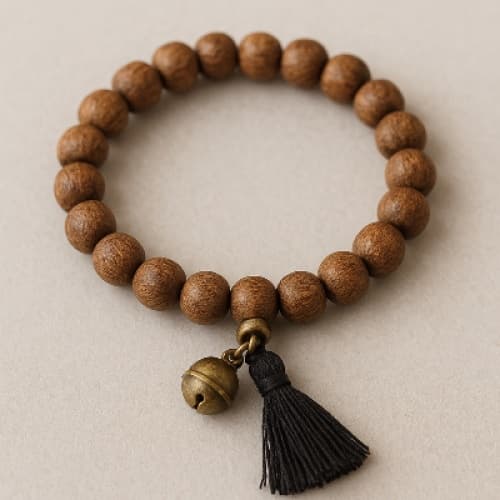
It was a bracelet. A wooden beaded bracelet, with a tiny bell and a black tassel dangling at the end. The beads were round, uneven, slightly jagged—yet their imperfection made it look strikingly unique and beautiful.
Without much thought, I picked it up and slipped it into my pocket. Then, heart racing, I hurried out of the temple and back toward the beach.
Wait, whose reader voice was that—calling me a thief? No, no, friend. I’m not stealing. I’m only safeguarding a piece of cultural heritage… one that just happened to fall into my hands.
So… do you still want me to continue with Part 3? Or shall I switch to another adventure?