I am no longer talking to my identical twin brother. He pulled the mother of all dick moves with an instant message reading: Can you get your money back on the tics? By tics, he meant the $550 return tickets I had purchased on Cambodian Airlines flying from Da Nang to Siem Reap to visit him and his Cambodian wife, Eang, in the first two weeks of September 2025.
Our mother used to call my twin brother Marshall a stinker, a derogatory word used to describe a contemptible person. As it turns out, Mars was a stinker to the bitter end. Due to his stinkiness, we are no longer speaking or writing together. The dead twins are talking no more.
I kept telling him I wanted to visit him one last time.
“I’m coming to see you,” I repeatedly promised. “I’m buying a plane ticket as soon as I can. I wanna spend some time with you before it’s too late.”
Two summers before, Mars and his wife visited Da Nang, meeting my Vietnamese wife, Lana, and stepdaughter, Hai My. We had a wonderful time. Ten days of early morning coffee runs with long talks, hanging out and playing chess, eating in and dining out, sightseeing, singing karaoke, and swimming and lounging at the local beach.
Lana expertly and lovingly made home-cooked Vietnamese dishes, including her pan-fried spring rolls filled with a yummy batter of pork, eggs, taro, and carrots. Marshall, in a jovial mood of spirited generosity, paid for pretty much everything else. We had a mostly terrific time. The best parts of their visit were our day trip with lunch at the Soul Kitchen restaurant right on An Bang Beach in Hoi An, and our half-day trip to Marble Mountain, a cluster of limestone hills filled with caves, carvings, and pagodas.
Mostly terrific means I have a conflicting and troublesome voice inside my head that never seems to go away. Silent tongue lashings of pent-up bad blood and bees in the bonnet for who and god knows what, keeping me constantly on edge. A feeling that at any given off-kilter moment in my washed-up life, something bad is going to happen. The best two words to describe the feeling are: mental illness.
Truth be told, I have always had a few bats flying psychotically around in the belfry. I was having daily thoughts of flying to Siem Reap and never coming back, of leaving my wife of nine years and striking out on my own one last time, with Marshall only a few steps away or clicks down the road. The voice wanted me to run.
Okay, I’ll fly to Siem Reap without saying anything to Lana. I’ll leave and never come back. I don’t want to be here. I’m not happy here. But I’ll miss Lana, Hai My, and our dog so much! Please don’t leave, Mitch, it’s not a bad life. You’re going to be so sad and regretful! But I have to go. I’ll be free, free from the financial burden of taking care of them, free from the petty arguments, and free to get baked on all the cannabis oil I want, to do whatever I please. You can do it, you can make it on your own. You can be happy without them!
I was strapped to the blood-and-guts seat of a jerky and jarring bumper car inside a disturbing funhouse. In or out, yea or nay, maze number one or trap number two? In the front car, The Clash, crooning Should I go or should I stay now? In the rear car, The Animals, singing we gotta get out of this place. And in the background, over the funhouse loudspeakers, the sweet, melancholy voice of Tim McIntire warbling sunshine or thunder, a man will always wander, where the fair wind blows.
At the time, I was buying weed from two shops at $10 to $20 a gram, and I was still drinking beer and soju. It was getting harder for me to manage my addictions. I could still deal with the psychological ups and downs, but the toxins and poisons in the drugs had begun to take a noticeable toll on my physical health.
Mars had promised to buy weed in Da Nang so we could slow cook it into cannabis oil, but after getting here, he changed his mind.“Eang doesn’t like it when I get high,” he explained. “No weed on this trip. Sorry, bro, no can do.”
No can do? The thoughts came barging out. But you promised! I was so looking forward to getting majorly baked with you on the beach and swimming and chilling and zoning out with that no-care-in-the-world feeling of reckless, tranquilized abandon.
My inner child, hurt and bent out of shape, wanted to give him a piece of my Mrs. Cratchit mind, but the adult in me had to let it go. His money, his choice, the voice reasoned.
Then, like all things in life, their trip came to an end. Mars and Eang flew back to Siem Reap, and my girls and I (including our Corgi, Pig) returned to our modest but mostly happy life. I was teaching English part-time at a language center, and Lana and Hai My were working at an International Kindergarten, Lana as the head chef and My as an assistant teacher.
My life was as good as it could be. Through the hangdog lens of my ever-complaining mind, life seemed a perpetual downer. Something was off, amiss, awry, a feeling of not being where I was meant to be. Life felt wrong. It was a sinking sentiment that never went away, a constant notion of bailing, fleeing, and seeking something new, different, and more exciting. To find a better place.
Mars and I kept in touch, talking almost every day for weeks that turned into months. We continued to write poems and work on our stories together, stories we knew we would never finish. Now and then, I said things that hurt his feelings, words that flew out of my mouth without thinking, and I would need to console him by saying how sorry I was and that I would try my best to think before I spoke.
At some point, Mars started fading away, no longer replying to my calls and messages right away. This hurt me to no end. I was addicted to our talks, conversations about everything and nothing at the same time, and believed that our connection, as twins, made my life more complete. I needed to feel close to him. So I gave him his space, hoping he would feel better about things, wishing we could go back to our regular calls and conversations.
But that never happened. What did happen is that Mars started slow-cooking cannabis oil again.
I had once told Marshall that weed put him in a zombie-like state, which made him angry. He let it go at first, but on our next call a day or so later, he asked me in a sulking way why I thought it was okay for me to say things like that to him.
“What’s the matter?” I asked, already knowing the reason for his grumpiness.
“I don’t like what you said about me being like a zombie on weed,” he pouted.
“But you are, Marshall,” I replied matter-of-factly. “I mean, it’s okay, I don’t mind, and I’m sorry if you were hurt by what I said, but when you’re high, it’s like your brain isn’t all there.”
“Stop judging me, bro,” Marshall said sternly. “You’re always judging me, and I’m sick and tired of it. It needs to stop.”
“I know, I’m sorry, bro,” I countered, hoping to de-escalate the situation. Then, with all the care and sincerity I could muster, I added, “Really, man, the words just come out of my mouth without thinking, and I’m so sorry when it hurts you. Hurting you is the last thing I want to do. Please forgive me, Marshall.”
The solemn, disapproving look on his face melted partially away. “Okay,” he smiled. “But please stop saying shit like that to me.”
“I will,” I promised blithely, glad to be back on his good side again. “I really will.”
Back on the THC trail, the zombie in my twin brother came back like never before. Monster Mars 2.0, more cracked and non compos mentis than ever before. Lost in pot land, the sad and defeated look in his eyes turned blank and indifferent. Then, like a lit fuse on a smoke bomb, his ability to carry on an intelligent conversation slowly fizzled out. He stopped caring, turning himself into a ticking time bomb.
But I bought the plane tickets anyway. I wanted to see Mars one last time before one of us passed away. Neither of us had reached the age of 66 in perfect health. Mars had Kissing Bug disease, called Chagas, and I had two stented coronary arteries to go along with chronic heart failure. Sadly, our days on the planet were numbered.
When I told Marshall I purchased the plane tickets, he seemed tickled pink. I told him I would be a little short on cash when I got there, but assured him that after I got my Social Security deposit on the 3rd, I could get my own room if needed. He told me not to worry, that I could stay with him in his studio apartment for as long as I wanted.
His wife also seemed happy and excited about my visit. Marshall told me she was looking forward to showing me around her hometown, the Old Market area along the Siem Reap River, including the touristy attractions and restaurants on Pub Street. She also wanted to show me the small house they had built on some land owned by her family about an hour outside the city.
Surprisingly, our last call seemed optimistic. We discussed my flight times, and Mars offered to send a driver to pick me up at the new airport 50 kilometers outside the provincial capital. We talked about the price and quality of cannabis at a new shop he had recently discovered, swimming in the pool at his apartment, going out to dinner, and visiting the city’s famous 12th-century temple complex, Angkor Wat.
We also canvassed our senior year in high school, when Marshall broke a navicular bone in his left wrist and sat out all but two games of the season. We once again considered the idea that if he had been healthy and on the court, we would have won it all that year. No doubt, no question; no team could have stopped the Lilly twins from winning the championship in 1977.
We had bandied about all of this many times before. Our conversations were a revolving door of repetitive thoughts and reflections hashed over again and again on our sunken and dilapidated greenlit dock, once a beacon of promise. We had long been born back into the past, beating ceaselessly against an overwhelming undertow of bad decisions and broken dreams. We were drowning in the wayward riptides of our own making.
Everything seemed good to go, but then the miffed and wounded looks from Mars got worse. Within days, he went from jolly and welcoming to cold-eyed and withdrawn. The high doses of THC were turning him into a dopey and bedeviled Dr. Giddy and Mr. Rage. Slowly but surely, my brother slipped into a cannabis induced psychosis, a mild form of schizophrenia. He went batshit right before my eyes.
But I had already paid for the tickets. The only thing I could do, the right thing to do, was to let it go and to forgive and not judge him. To knock on wood, cross my fingers, and hope his time bomb would never go off.
Then, it did.
Hey Mitch, can you get your money back for the tics?
What do you mean? The tickets are nonrefundable. What’s going on?
I called him on Messenger. No answer. I asked my wife about getting a refund on the tickets.
I can get my own room and pay for everything once I get my social security check on the third. Please talk to me, Marshall. Lana says we can only get $150 back on the tickets, but only if you don’t want me to come.
I called again. No answer.
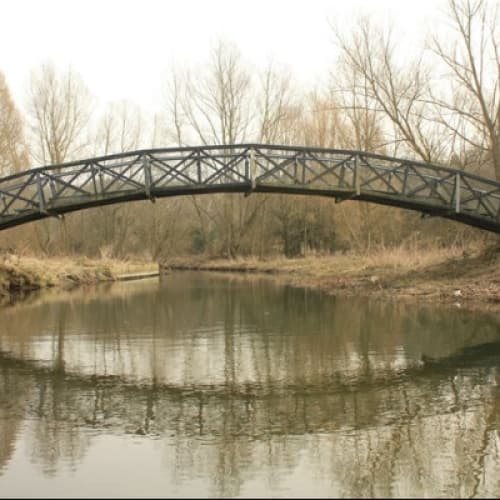
We are back on Shit Creek Bridge. Marshall has placed a noose around my neck. I stand on the railing, my head bowed, hands tied behind my back, gazing down at the polluted water below. Then, with a wry smirk, Marshall gently pushes me off the edge.
Get your money back for the tickets.
I drop down towards the creek, turning and twisting against the force of gravity, quickly pulling me to my death. I have only a second or two of slack before the rope goes taut and the noose breaks my neck. And just as I start to see my life flash before my eyes, the rope snaps in two!
I hit the water feet first, careening sideways down to the mucky and murky bottom. I open my eyes and see raw sewage all around me. My eyes burn, but I am alive! I must get out of the feces-filled water. I push up from the grotty creek bed and kick my way to the surface. Fresh air!
Getting out of the creek proves harder. Staggering and stumbling, I struggle with all my might to the nearest bank like a frantic, handcuffed Houdini. I stand up, covered in slimy shit, and look around. High up on the bridge, my brother is looking down at me in disbelief, pointing and screaming in a voice that sounds muffled and far away.
I quickly make my escape, darting away from the creek and into a California redwood forest. I am hightailing it beneath a lush canopy of Douglas-firs, madrones, tanoaks, and coast sequoias. I am bounding beneath the trees, hands tied, my shoulder blades thrusting autistically forwards and backwards like the bony pistons of a high-revving engine. I am huffing and puffing, my nostrils filled with the loamy smell of terpenes as my feet pound wildly across the moist earth of a walking trail.
I need to untie my hands. There! A massive grove of Western hemlocks with an outcropping of obsidian, volcanic rock as sharp as utility knives in a toolshed. I weave and stagger my way to the right spot, and the thick rope splits and falls like string from a thread cutter. Ha ha! My hands are free! But where to now? And to whom?
I am single-mindedly running full speed ahead now, wide-eyed and open-mouthed, arms pumping, sweat dripping from my bewildered but resolute face. I am traveling backwards in time to my twin, the brother who has just tossed me off a bridge like a worthless sack of shit. I am heading back to the halcyon days of our youth, to the Catamaran Hotel dock on Sail Bay in San Diego’s Mission Bay, when the world gave us nothing but Pacific oysters and blue skies with no limits.
I smell salty air—the ocean!—and the solid ground beneath my feet turns to sand as deep and soft as a Bora Bora beach. There he is! I can see Marshall on the dock. He is 15 years old, in the bloom of his fabulous youth, naked but for a pair of red Hang Ten board shorts. He stands in the bright early afternoon sun, arms crossed, his toned, athletic body tanned to a Coppertone tee.
He is looking at an older man standing on the dock. The man, in his late 20s, looks like a Gentlemen’s Quarterly model decked head to toe in stylish lifeguard attire. A modish California surfer coiffure and tinted, oversized Carrera sunglasses frame and adorn his sun-kissed face. The man is talking to a pretty girl.
I am trying to get to the dock, but my feet keep getting stuck in the deep sand. I am yelling now, trying to get Marshall’s attention, but he cannot hear me. I am too far away, and a moderate wind on the bay is carrying my screams in the opposite direction. I want to stop him, but then it is too late.
Suddenly, in one stupefying and head-spinning movement, my twin brother shoves the good-looking and well-dressed man off the dock. The man splashes sideways into the water, arms flailing. He goes under, but quickly resurfaces, gasping for air and frantically kicking and crawling his way back to the side of the dock. The Carreras are gone.
In a show of sinewy strength, the man uses his powerful arms and legs to propel himself up and out of the water, like a dolphin, just high enough to reach the top edge of the dock. He grabs hold, hands and fingers tightly latched, and muscles his way back up to the marine-grade wood.
Marshall is watching, frozen in fear, deciding whether to flee back down the dock to the shore or jump into the water and swim for it. I am looking on with bemused astonishment from the bayside beach, feet stuck in the sand, wondering what will happen next.
The man lands on his groin, dripping wet, then falls forward, pendulum-like, onto the weather-beaten lumber. He momentarily catches his breath, then pushes himself up with his arms and gets to one knee. He looks around. Marshall is staring at him from twenty feet away.
“You little motherfucker!” the man screams.
Marshall dives into the water.
The man looks at the pretty girl. She points towards Mars, who is crawling like mad towards the safety of our sandy front yard at 3930 Bayside Walk. I am now standing on the wet foreshore in front of our house, looking worriedly on, wondering if my brother will make it.
“He’s getting away!” the girl bellows.
“Aw, fuck,” the man wails. Grunting, he hoists himself up to a standing position, scurries to the edge of the dock, and dives back into the bay.
Marshall has at least 25 yards to go. The man is catching up to him fast. I want to swim out and help him, but I am unable to move. I can only watch anxiously from the beach as the man swiftly closes the distance between them. I want to save my twin brother. I have been trying to save him my whole life.
Swimming like mad, the man is soon upon him, like a shark catching and overpowering its prey. He reaches out with a sinewy right arm and clamps his big paw around Marshall’s right shoulder, yanking him to a full stop. He spins Marshall around and, with his left hand, firmly takes hold of Marshall’s left upper arm. They are facing each other, inches apart, and my brother is dead in the water.
“Why? the man screams. “Why did you do that?”
Marshall is still struggling, trying to wriggle himself free from the man’s deadly grip.
“Stop!” the man yells. He dunks Marshall under the water, then lifts him back to the surface. “Stop moving, you fucking brat!”
Marshall stops, sucking air, and looks into the man’s eyes. The man looks back.
“I’m sorry!” Marshall cries. “Please let me go!”
The man shakes him forcefully in the water. “Why?” he hollers one more time, “Why did you do it?”
“I don’t know! Please let me go!” Marshall pleads, his voice earnestly obstinate.
“I’d kick your ass, you little brat, but you’re just a kid,” the man growls. “A fucking little brat kid.”
Shaking his waterlogged head in disgust, the man lets go, releasing Mars from his grip and shoving him away at the same time.
“Thank you, sir.” Marshall snivels.
“Yeah, sure,” the man grumbles without looking back.
I am waiting for Mars to come to the shore. He does the breaststroke, swimming slowly in my direction before reaching the shallow part of the bay. He stands up waist high in the water, with a big smile stuck on his water-soaked face, and gives me a triumphant salute.
The man is back at the dock, climbing and crawling his way to the top for a second time. The girl is waiting for him.
Marshall moves closer, wading nonchalantly towards me into knee- and then ankle-high water. My twin brother is now an arm’s length away.
“That was a close call,” I proclaim.
“Yup, a close shave if there ever was one,” Marshall shoots back.
“It was crazy, bro.”
“Yeah, cuckoo for Cocoa Puffs,” is the last thing I hear him say.
In a startling flash of blazing white light, I am back in the Redwood forest, looking down from a fern-covered glade on a hill overlooking the Arcata Plaza. The plaza is miles away. Marshall is down there sitting on a bench, awaiting my arrival beneath a statue of William McKinley, the 25th president of the United States.
I am galloping again, desperately trying to reach Marshall before he exits stage left on a Greyhound Bus to Los Angeles. He has dropped out of Humboldt State University and is ditching our crackerjack life as twins in the Redwood Empire for a single bed in the laundry room next to the garage in the basement of our parents’ condo in Marina Del Rey.
I am racing down the hill, leaping over massive nurse and deadhead logs, trampling through flourishing herb layers and decaying deadfall like a wild beast in flight. I care not for the animals nor organisms thriving in these microenvironments. I must reach my destination at all costs!
I reach a side road, then a pedestrian bridge, and cross the highway. I speed through Arcata town, rushing past rows and blocks of historic buildings and houses that represent a patchwork of architectural eras and periods in a myriad of rundown and renovated conditions. Arcata is a gathering place for free-spirited outdoorsy types, nature-loving tree huggers, and wannabe hippies of all kinds. It is also ground zero for a new type of bohemian woman, the Humboldt Honey. Womenfolk, often lesbians, wearing Birkenstock sandals, head scarves, and layers of hemp clothing.
I am at the Arcata Plaza, a grassy and gardenesque central park and town square built in the 1850s. I slow down and stop on a sidewalk, going around the one-square block at four curbside corners. Each of the equidistant sidewalks has two cement walkways leading to the park’s circular center, where McKinley’s 8.5-foot bronze statue has been looking down, since 1906, at the wrought iron benches surrounding him.
I am standing in front of the park’s historic fountain at the mid-block entrance on H Street. Marshall is sitting alone on one of the benches, looking up at McKinley. I trot towards him. He is wearing matching bright yellow cotton sweatpants and a hoodie. He sits with his legs stretched out in front of him, ankles crossed, hands tucked inside the sweatshirt’s kangaroo pocket. He sits in one corner of the bench, looking at ease but ever so lonely.
I am standing behind him now.
“Hey, bro,” I announce with a resigned sigh. “Sorry, I’m late, but I was running far up in the forest trying to get here in time.”
I come around to the front of the bench and sit down at the other end.
“That’s okay, Mitch,” Marshall replies, staring up at the statue. “How was your run?”
“Fucking strange is all I can say.”
We sit in silence for a few moments.
“Nice sweats,” I offer. “Where’d you get them?”
“HSU bookstore,” he pensively answers. Then adds, boastfully, “Five-finger discount.”
On the front of his hooded sweatshirt is a large green and silver chest print of the HSU institutional logo. The all-caps geometric text spells "HUMBOLDT" in green lettering above and "STATE UNIVERSITY" in silver lettering below.
“Nice,” I glumly reply. “Too bad you won’t be wearing them around here.”
Marshall looks at me, and as soon as our identical blue-green eyes meet, I know he is in tremendous emotional pain.
“Yeah, too bad, too sad,” Marshall winces. He looks away, down to the cold, hard concrete beneath the park benches.
“Then why not stay?”
Silence. High above us, dark slate grey clouds sweep across the late afternoon sky like silent, shape-shifting giants of torrential doom.
“I gotta get away from this rain,” Mars answers.
“No, really, I wanna know. Why would you leave a place where we both have the world on a string?”
“It’s not my string, Mitch.”
“What about your acting?” I insist. “You can do plays in the theater department here and graduate with a degree in theater arts, then head for the city of Angels.”
Marshall closes his eyes and exhales, loudly and vexatiously, like a man torn by his decision who knows he might be making a big mistake.
“Nah, not for me. I’m done with school and done with this place.
“It’s such a waste, Marshall, such a crying fucking shame.”
“Doth protest too much,” he spats, giving me a you-are-not-the-boss-of-me look.
For the past several months, my brother has been smoking boo koo bong hits of Humboldt Kush with a group of stoners in our apartment building, the Mai Kai, a multistory complex of dinky studios with shared kitchens overlooking a big parking lot on the southern edge of the campus.
Mars began cutting classes and hanging out in the studios of his stoner friends. He picked up the guitar, sitting and practicing daily on a long, sometimes sunny wooden deck railing running lengthwise in front of the studios from one end of the southern-facing fourth floor to the other.
Waking and baking, stone-cold Mars strummed his acoustic guitar for hours on end, learning the basic chords in short order. He wrote his first song Happy Graduation Day for my girlfriend, Darci, the day she graduated from the Fredrick and Charles Beauty College in Eureka. He sang it, guitar in hand, outside the front door of the buzzing beauty school before a large and enthusiastic group of students.
Darci is a whole other story. One cold night in late December, less than a week after we had moved into the Mai Kai, the 18-year-old party girl appeared out of nowhere, stepping through the big sliding glass doorway of our warm, cozy studio with the words, “Hey dudes!” flying from her Rocker Girl lips like the frisky come-on of a seductive backstage groupie.
I looked at her from a rickety chair at the room’s lone study desk, Mars glanced from his twin bed, only a few feet opposite mine, where he sat with his back against the wall, practicing chords on the guitar.
Darci had knocked on our front glass door first, and we gladly waved her in without knowing who she was. After hey-duding us, she tiptoed in her Levi’s 501 jeans, lacy white blouse, black rock and roll jacket, and black midcalf fuck-me boots to the sole electric wall furnace heater, where she turned around and stood with her butt nearly touching the hot rusty steel. Shivering, fists clenched, she peered back and forth at us with a look of amused curiosity on her pretty face.
“Oh my gosh, you guys really are identical twins!” She flirtatiously announced, her high-pitched voice bursting with glee. “Barb said you guys looked the same, and she sure got that one right.”
Barbara lived a few doors down, in one of the studios at the top of the stairs. During our first week at the Mai Kai, Mars and I met many students living on our floor, which turned out to be the sunny side of the apartments. We had lucked out. We had landed, feet first, on the golden doorstep of a friendly and affordable haven teeming with communal camaraderie.
Darci became the icing on my fraternal cake. We met, courted, and fell in love, all in less than six months. But before the magic happened, something else happened, too: a little thing called a menage a trois.
Her threesome with Mars and me happened innocently enough, starting with a microwave popcorn and tequila party that turned into a sleepover. Lying on the thin dorm room carpet between our twin beds, the sexual encounter began with Darci, sandwiched in the middle, giving my twin brother head, and my twin squirting his man juice into one of her eyes.
It was my turn. I climbed on top, looking down at her sexy blond hair and cute face, which reminded me of Goldie Hawn. “Do you have a twin?” I playfully asked, rubbing my woody against her nicely trimmed kitty.
Darci looked up at me quizzically, tilting her head slightly to one side. “Whaddya mean?” she asked. Her large, light blue eyes glimmered sweetly in the candlelight.
“I mean, you look like Goldie Hawn.”
“Oh, yeah, dude, lots of my friends call me Goldie.”
Then, tugging gently on my member with her right hand, she seductively purred, “Come here and let me put it in.”
I lowered my groin, letting Goldie insert all six inches of me inside her. She moaned with delight, cutting an imperfect yet strikingly dishy figure. She was flat-chested and slightly long-wasted, with lopsided A cup breasts, square-shaped hips, and flaccid, rawboned legs. But the girl was fetching in every way.
Staring lustfully at her pretty eyes and face and milky white thighs, we got it on, condomless and missionary style, for several minutes. I pulled out just in time and, with a muffled groan of orgasmic pleasure, let loose onto the soft flesh of her belly. Marshall lay beside us, grinning and looking on indulgently with voyeuristic delight.
It was our first and last threesome together. By the end of the week, Darci and I were going steady; within a month, we were inseparable, a madly in love couple spending every possible moment together. As a result, time with my twin grew less and less.
Mars retreated and eventually disappeared into a defiant and insurgent haze of Mai Kai bong smoke. First came the mood swings, manic evenings of rip-roaring, pot-and-beer-infused partying, followed by muted mornings of sullen and muddleheaded soul searching. Then came the depressive, faraway look in his eyes, a spaced-out mien that read: Fuck school! Fuck convention! Fuck everything but killer green bud, the guitar, and communal love!
I was too busy spending time with Darci to save him. By the time I tried to talk him out of leaving, it was too late. He was done. He finished his only quarter at HSU and, in the early summer of 1983, packed his bags for a one-way trip back to SoCal.
Before splitting, Marshall had stuck a few cool feathers in his cap. In six months, he mastered the basics of riffing, strumming, and soloing on the guitar. He also performed in two theatrical productions, including one on the main stage as a minor speaking character in a Shakespeare play, and another with me in the studio theater as the first and second immigration officers in Arthur Miller’s A View from the Bridge.
One chilly night during rehearsals for that production, Mars and I arrived late, blazed on buds and beers, for a costume fitting in the prop room. Feeling no pain, we charged in like gangbusters to a dead silent room of castmate crickets, all standing solemnly around in the fitting area like contemplative characters in a silent film.
The moment we waltzed in, the energy in the room changed. Mars and I were on fire, smiling and laughing and kidding and flirting with everyone in the cast. It was whole-souled and unpretentious fun, the kind people have when they are lucky enough to know exactly where they belong. It was our peppy power as gregarious identical twins to openheartedly charm and seduce the pants off everyone in the room.
But we were too young and unwary to understand it. We were unconscientious bulls in a China shop, crashing and cheating our way through life without the vision and awareness needed to know exactly what we were doing and precisely why we were doing it. We were only 23 years old. We still had most of our lives ahead of us, with just enough smarts and talent to make our life together as identical twins whatever we wanted it to be.
But we had a few loose screws. We were selfish and undisciplined; we had no qualms about using others and cutting corners to get what we wanted. We did not understand the importance of nurturing and maintaining long-term relationships. We could not be trusted. We used drugs and alcohol, including speed and cocaine when we could get it, to escape the mundanity of life and cope with our fears and shortcomings. All the promise and potential in the world had been handed to us on a silver platter, but in the end, we threw it all away.
I am back in the Arcata Plaza, sitting on the bench with Marshall, who is shaking his head and talking about crabs. Not the shellfish variety, but the parasitic sort. He is telling me how he got the pubic lice from one of the sleezier girls in his circle, Priscilla, and complaining about the itching and discomfort. The sad, hard-pressed look of disappointment on my twin’s face makes me want to cry.
“Why don’t you stay?” I plead. I know he will not change his mind, but I must try. “You still have time to take that part in Matt’s play. And you can stay with me this summer in the place I’m subletting from Mark. It’s big enough for the two of us, and it even has bunk beds. You can have the top bunk, bro.”
Mars looks at me and frowns. His gaze is as bleak and stern and comfortless as Captain Ahab’s on the deck of his sinking Pequod.
“Nah, time to check out, bro. Ain’t nothin’ for me here.”
“But there is! You can get into a band here. My friend Paul, the drummer, says he can hook you up with some other musicians.”
“That’s enough of the pep talk, Mitch, don’t need it, don’t want it. My bus leaves in two hours, and I guarantee you I’ll be on it.”
I look up at McKinley, whose stiff stare is as gruff and strict and cheerless as a disgraced Pentecostal preacher. In 35 years, the Arcata City Council will vote to remove his statue from the plaza by virtue of his racist policies of expansionism towards indigenous people, including the genocide of native populations in the pursuit of Manifest Destiny.
In roughly two years, I will be gone, too. I will follow in the footsteps of my identical twin brother, moving back to my hometown of San Diego for all the wrong reasons. I will voluntarily ruin my life, going from being a big fish in a small pond to a dead fish in a giant ocean. I will unwittingly abandon my true kismet, leaving behind what should and would have been the most exceptional life I could have ever imagined.
I am a recent graduate of HSU, holding a Bachelor of Arts degree in journalism with a public relations minor. I am a part-time sports reporter for the town’s top rock radio station, and an intern as the weekend sports reporter/anchor at KVIQ-TV, cutting my teeth and first in line for the sports director’s job when the current one moves on.
I am friendly with the sports information director at HSU, a fellow graduate of the journalism department who asked me to play on his intramural C-League basketball team, which I then led, in impressive flashes of high-scoring moxie, to victory in the championship game. I am good friends with Paul, the drummer, a fellow identical twin and journalism major who will one day become the editor-in-chief of the Arcata Union newspaper. I have many friends and connections, but no soft spots for any of them.
Most importantly, I have Darci, my doting and loving wife, a beautiful young woman from the inside out who could be the dream wife of any man lucky enough to win her heart. She is only 20 years old, but she is smart, graceful, and well-grounded, and she possesses the most blissful and bubbly of dispositions. Darci’s precious heart is all mine, but I do not know how lucky I am. I have everything I will ever need to be a happy man, but I do not know what happiness is.
After our wedding, Darci and I moved into a cute and well-furnished one-bedroom apartment in a two-story fourplex in Eureka. Our first home together was new, clean, and nicely decorated. Downstairs, a comfy living room, cozy dining area, and stylish, well-equipped kitchen; upstairs, a large, modern bathroom with a big tub, and a roomy bedroom with a sizeable picture window.
But I had itchy feet. I did not see the astonishing good fortune in sharing the rest of my life on that incredible redwood coast with such a sunny, attentive, and desirable woman. I was lost, unable to grasp the dandy allure and singular promise of that amazing time and place. Then, one day, I foolishly decided to move.
“Hey, let’s move to San Diego,” I said to Darci one morning. She was in the kitchen taking out a freshly baked homemade apple pie from the oven. “That smells sooooo good,” I add, kissing her on her cheek.
“What?” Darci shrieked, setting the pie down on a wire rack with a stunned look on her comely face. She was an excellent home cook with a specialty in desserts and confections.
“I think we should move to San Diego,” I repeated.
“What are you talking about, Mitchell?“
“I’m talking about going back home.”
The incredulous look on Darci’s face told me she was not looking for greener pastures. She opened the refrigerator and took out a carton of eggs.
“But we just moved here, honey. Why would you want to move?”
“Your mom’s family is there,” I tactfully replied. “Your grandparents and your aunts and uncles and all those cousins. You’ve always talked about living in San Diego someday. Your cousin JoJo would love for you to live there.”
“JoJo, yeah, that would be fun,” she chuckled apprehensively. Darci set the carton of eggs on the kitchen counter. She looked at me and grimaced, shaking her head no.
“But not now, Michell,” she reasoned. “We just got married and this is our first apartment. I think moving right now is a baaad idea.”
“But it doesn’t have to be bad. It’s my hometown, Darci. It’s where I grew up. I think at some point, San Diego is gonna be the best move for us. And the sooner the better. It’s such a nice city, Darci. I know you’re gonna love living there.”
“But what about the sports job at Channel 6?” she asked reproachfully. “I thought you wanted to stick around long enough for that to happen.”
“Nah, Brett’s gonna be there for at least another year, maybe two, before he’s ready to move on.”
I took Darci’s modelesque hands into my own. She wore a fashionable thumb ring on her right hand and on the fourth finger of her left hand, her modest wedding ring. The silver and gold jewelry, along with the tiny sparkling diamonds, looked elegant on her long, slender, acrylic-nailed fingers.
“I don’t know, Mitchell...” she sighed.
“C’mon, take a chance with me. It’s now or never. Let’s get out of this one-horse town and hit the big city.”
“Really? Are you sure?”
“Yes, I’m sure,” I promised.
“Okay, okay, maybe we can talk to my parents about it.”
We seal the deal with a bear hug. She has no clue that saying yes to the move is the beginning of the end for us. Our perilous marriage is already adrift and off course, doomed to one day crash and burn on a hidden reef and sink to the bottom of the sea. And she does not yet know that I am the mad captain of our fate.
Back at the Arcata Plaza, Marshall is getting up from the bench. He looks fragile and defeated, like a young man who has already grown weary of the battles in life.
“Where are you going?” I ask in the most reconciliatory way possible.
“I’m going back to Val’s to get my duffel bag,” Mars replies, his voice full of resignation.
“I’ll go with you.” I offer.
“No, it’s better if we say our goodbyes now.”
“What times does your bus leave?”
Marshall glances at his Timex Marlin dive watch, the one I gave him for his birthday last year. “About two hours,” he mutters.
I get up from the bench, and we both stand in front of it, motionless, not knowing what to say or do next. My heart is breaking from a deep sadness, with the bottomless sorrow of saying goodbye.
“I guess this is it, then.”
“Yeah, this is it. For now, at least.”
We step towards each other, ready to embrace one last time before he goes. We reach out with our arms. I am nearly touching him. I can almost smell the comforting and familiar citrusy scent of the whiskery skin on his neck.
Then comes a sudden and furious flash of blinding light. I have reached the end of the rope—my neck breaks! I am dead and gone, a corpse swinging eerily and ominously beneath the bridge at Shit Creek. I am tragically lost and in the dark, eternally and unconsciously suspended in an unrelenting nightmare of unattainable destiny.