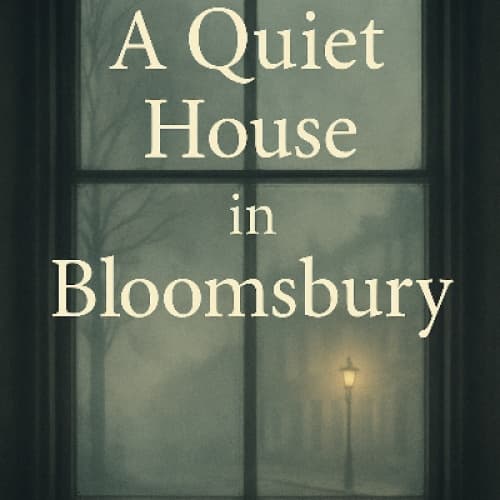
The fog had lingered in London for three days without breaking. It sat low in the alleys, clinging to the windows of boarding houses and shopfronts until everything seemed blurred and half-formed, as if the city itself had been rubbed thin.
Henry Carrow, thirty-two, sat by the window of his rented room in Bloomsbury, staring down at the glistening cobbles. The landlady’s cat had slipped outside earlier, and he traced its faint shadow moving between the puddles. He had not left his room since Wednesday.
The clock on the mantel ticked faintly, though sometimes he thought it had stopped. In truth, he could no longer tell how the hours moved. They seemed not to progress but to fold over one another, dragging him backward.
A letter lay on the desk. It had lain there for days unopened.
He knew the hand immediately, even from across the room — his sister Clara’s delicate, slanting script. She had not written to him in nearly a year. Their last exchange had ended in silence, a quarrel left unresolved. The sight of her writing filled him with a dread that grew each time he glanced at it, and still he could not summon the courage to break the seal.
It was easier to sit in his chair, watching the fog, counting the ticks of the clock.
But at night, when the streetlamps burned pale yellow through the mist, he thought of her words inside the envelope. He imagined accusations. He imagined forgiveness. Worst of all, he imagined indifference.
Henry had once been a clerk for a solicitor, a minor man with a respectable office near Chancery Lane. He had managed the ledgers, written letters to clients, balanced accounts — dull, necessary work. There had been comfort in the order of it, in the ruled lines and neat columns of numbers. But last spring he had resigned without explanation, not even to himself. He had simply stood up one afternoon, closed the ledger, and walked away.
Since then, the days had stretched, thin and without shape.
He told the landlady he was seeking new work. In truth, he spent his hours pacing the room or staring at his reflection in the warped mirror above the washstand, searching for signs of change in his face. The eyes were the same. The mouth had grown slack, perhaps. But there was something in the expression he did not recognise — a faint strangeness, as though another man were watching him from beneath the skin.
One evening, near dusk, there came a knock at the door.
Henry stiffened in his chair. No one ever came to him; the landlady left his meals on a tray at the landing. He waited, holding his breath, until the knock came again — firmer, impatient.
He rose, smoothed his waistcoat, and opened the door a crack.
A man stood in the dim hallway, tall, with a coat damp from the mist. His hat was drawn low, shadowing his eyes.
“Mr. Carrow?” the man asked.
Henry nodded slowly.
“I have a message for you. From your sister.”
The voice was measured, polite, yet there was something in it that unsettled Henry. He opened the door wider, but the man did not step inside. Instead, he withdrew a folded sheet from his pocket and offered it.
Not Clara’s hand this time, but another — bold, businesslike.
Henry took it, his fingers trembling. The stranger touched his hat in a brief gesture and disappeared down the staircase without further word.
Henry closed the door and leaned against it. The letter felt heavier than paper ought. He brought it to the desk and sat, staring at it beside the unopened envelope already lying there.
Two letters. Two voices pressing on him.
At last, with a sharp breath, he tore the second one open.
The words were few:
Mr. Carrow,
I regret to inform you that your sister, Mrs. Clara Fenton, is presently confined at Holloway Asylum for Women. Circumstances of health necessitated her removal. She calls frequently for you. You are advised to visit without delay.
Dr. E. Hargrave
Henry read it twice, then a third time, the words refusing to arrange themselves into sense. Clara — confined? The idea seemed absurd. She had been lively, certain, her laughter carrying easily in any room. She had been the one to steady him after their mother’s death. She had been the strong one.
His hands clenched until the paper crumpled. A pulse beat hard behind his eyes.
At last, with shaking fingers, he reached for the older letter — Clara’s own hand, the one he had avoided for days. He broke the seal, smoothed the creases, and began to read.
Dearest Henry,
I fear you have taken my silence as anger, and in truth I have been guilty of it. But my anger is not with you alone. The world seems lately to conspire against me. George is gone so often from the house, and when he returns, he is distant, full of business and obligation. I find myself alone more hours than I can bear.
I have tried to quiet the restlessness with prayer, with household duties, with calls upon friends, but nothing holds. At times I feel as though I am vanishing from myself, a hollow form moving through the days.
Forgive me for writing so heavily. I thought you might understand. You always have.
Clara
The words blurred as Henry read them. He pressed his palm against his brow, the air of the room tightening.
She had written weeks ago, perhaps months, and he had left the letter unopened. While she was reaching for him, he had sat staring at the fog, counting the ticks of the clock.
A sickness rose in him, bitter and cold. He rose suddenly, paced the narrow length of the room, then turned sharply back to the desk. The room felt too small, the walls too close.
Clara was in Holloway. She was alone. And she had called for him.
Henry dressed with hurried hands — coat, gloves, hat — and stepped into the hallway for the first time in weeks. The landlady started when she saw him descend, as though the dead had risen from the upper rooms.
Outside, the air was damp and raw. The lamps glowed dimly through the fog. He hailed a hansom and gave the driver the address with a voice he barely recognised as his own.
The horse clattered forward, wheels cutting through puddles, and Henry leaned back in the cab, clutching Clara’s letter in his pocket as though it might anchor him.
The hansom carried Henry northward, past dim terraces and empty squares where the fog hung low and yellow in the lamplight. The wheels rattled over cobbles slick with rain. Henry kept his gloved hand pressed against his coat pocket, feeling the shape of Clara’s letter as though it might vanish if he loosened his grip.
When the cab drew up before the gates of Holloway Asylum, he hesitated. The building rose vast and red-bricked through the mist, with narrow windows like unblinking eyes. An iron gate barred the way, its spikes catching the lamplight.
The porter took his name without expression and directed him down a long corridor. The air inside was cold, carrying a faint odor of damp stone and carbolic. The silence was worse than noise — footsteps echoed too sharply, as though the walls swallowed all other sound.
Dr. Hargrave met him in a small office lined with ledgers. A thin man, hair receding, spectacles glinting. His voice was smooth, unhurried.
“You are Mrs. Fenton’s brother?”
Henry nodded. His throat felt dry.
The doctor folded his hands. “Your sister has suffered a breakdown of mind and spirit. Hallucinations, anxiety, periods of great agitation followed by long silence. Her husband consented to her admittance here two weeks ago. She asks for you frequently.”
Henry’s lips parted, but no sound came. At last he whispered: “May I see her?”
The doctor studied him a moment before ringing for an attendant. “Prepare yourself. She is not as you remember.”
They led him through another corridor where the walls narrowed, the air heavier. Behind some of the doors came muffled cries, the scrape of chairs, a low humming like bees. Henry kept his eyes forward, his chest tight.
At last they stopped before a cell-like room. The attendant unlocked it and stepped aside.
Clara sat by the window. Her figure seemed smaller, as though diminished by weeks of confinement. Her dark hair, once carefully arranged, hung loose and uneven. She turned at the sound of the door, and Henry saw the same eyes as in childhood — but restless now, darting, rimmed with weariness.
“Henry,” she breathed.
He crossed the room in two steps and took her hand. It was thin, cold. For a long moment neither spoke.
Then she drew back slightly, her gaze unsettled. “You did not answer my letter.”
The words pierced him deeper than reproach. He bowed his head. “I was… unwell.”
She gave a soft laugh, brittle as glass. “And so we both are.”
They sat together in the silence of the room, broken only by the distant clang of a door somewhere in the asylum.
“George said I imagined it,” Clara whispered at last. “That I imagine too much. But I know… there are voices. At night, they call through the walls. Not words, but sounds. You believe me, don’t you?”
Henry swallowed. He wanted to deny, to soothe, but her eyes searched his with such desperation that he only nodded. “Yes.”
Relief flickered across her face, then faded into weariness. She leaned against the wall, her voice low. “I feared I had lost you too. Everyone drifts away.”
Something within Henry broke then — not sharply, but with the slow pressure of months. He had let her drift, unopened letter by unopened letter. And now she sat in this narrow room, clinging to a brother who had been absent even in presence.
He pressed her hand to his lips. “I will not drift away.”
For the remainder of the visit, they spoke little. Words seemed useless. When the attendant returned, Clara allowed herself to be led back to her cot. She glanced once more at Henry, a faint smile passing her lips, uncertain, like the reflection of light in water.
That night Henry did not return to his boarding room. He walked the streets instead, through Clerkenwell and into the City, where gas lamps burned against the fog. His thoughts moved in circles, ceaseless, beating against the same walls: Clara, the unopened letter, the days wasted in silence.
The city seemed a mirror of himself — streets winding without end, corners folding into corners, buildings looming close and oppressive.
When he returned at last near dawn, his landlady eyed him with suspicion. But he climbed the stairs without speaking and entered his room. The clock ticked as always, steady, indifferent.
On the desk lay the crumpled note from Dr. Hargrave. Henry picked it up, smoothed it, then folded it carefully and placed it in the drawer beside Clara’s letter. He shut the drawer softly, as though sealing something away.
Then he sat in the chair by the window, staring at the street below where the fog began to thin with morning light.
The days after blurred. He visited Clara often, though each time she seemed thinner, her words more disjointed. Sometimes she laughed brightly at nothing at all; sometimes she sat unmoving for hours, refusing to meet his eye. Each time Henry left, he carried with him both relief and dread.
He began to feel the same walls closing in on him, even outside the asylum. He heard footsteps in the boarding house at night — measured, deliberate — though when he opened his door, the corridor was empty. He felt eyes watching from mirrors.
The city itself seemed to whisper. The fog moved like breath, curling around corners, carrying faint murmurs. Henry quickened his step, but the sounds followed.
One evening he stood before the mirror above his washstand and studied his reflection until the face seemed no longer his own. The same eyes, but altered — restless, searching. Clara’s eyes, perhaps. Or some deeper echo.
“Not drift away,” he whispered, repeating the vow he had made.
But he no longer knew whether he meant her or himself.
In late November, word came. Clara had grown violent, striking an attendant during a fit of terror. Restraints had been required. Henry was advised not to visit until she calmed.
The letter burned in his hand. He felt the same sickness as before, the same pressure building inside his skull. He had promised not to drift. He had promised.
That night he left his room and walked through the city without direction. The fog closed around him, heavy and wet. He thought he heard Clara’s voice calling faintly through the streets, not words, only sound.
He followed it past shuttered shops, past the black arch of a railway bridge, past pools of lamplight that faded quickly into mist.
At last he found himself before the asylum gates once more. They were locked, iron and unyielding. He gripped the bars until the cold numbed his hands.
From within came silence. Then, faintly, the echo of a woman’s laugh.
He pressed his forehead to the iron, eyes closed.
When dawn broke, he was still there.
Henry Carrow remained in Bloomsbury another month, but his work was never resumed, nor his old life retrieved. The landlady said he left his room each evening at dusk and returned near morning, his clothes damp with fog. His face grew pale, his eyes restless.
One night he did not return at all.
Some said he had gone north, to a cousin. Others said he had followed his sister into Holloway. But the landlady, when pressed, would only shake her head.
She recalled the last time she had seen him — standing by the window, staring into the fog as though it whispered secrets only he could hear.
And perhaps it did.