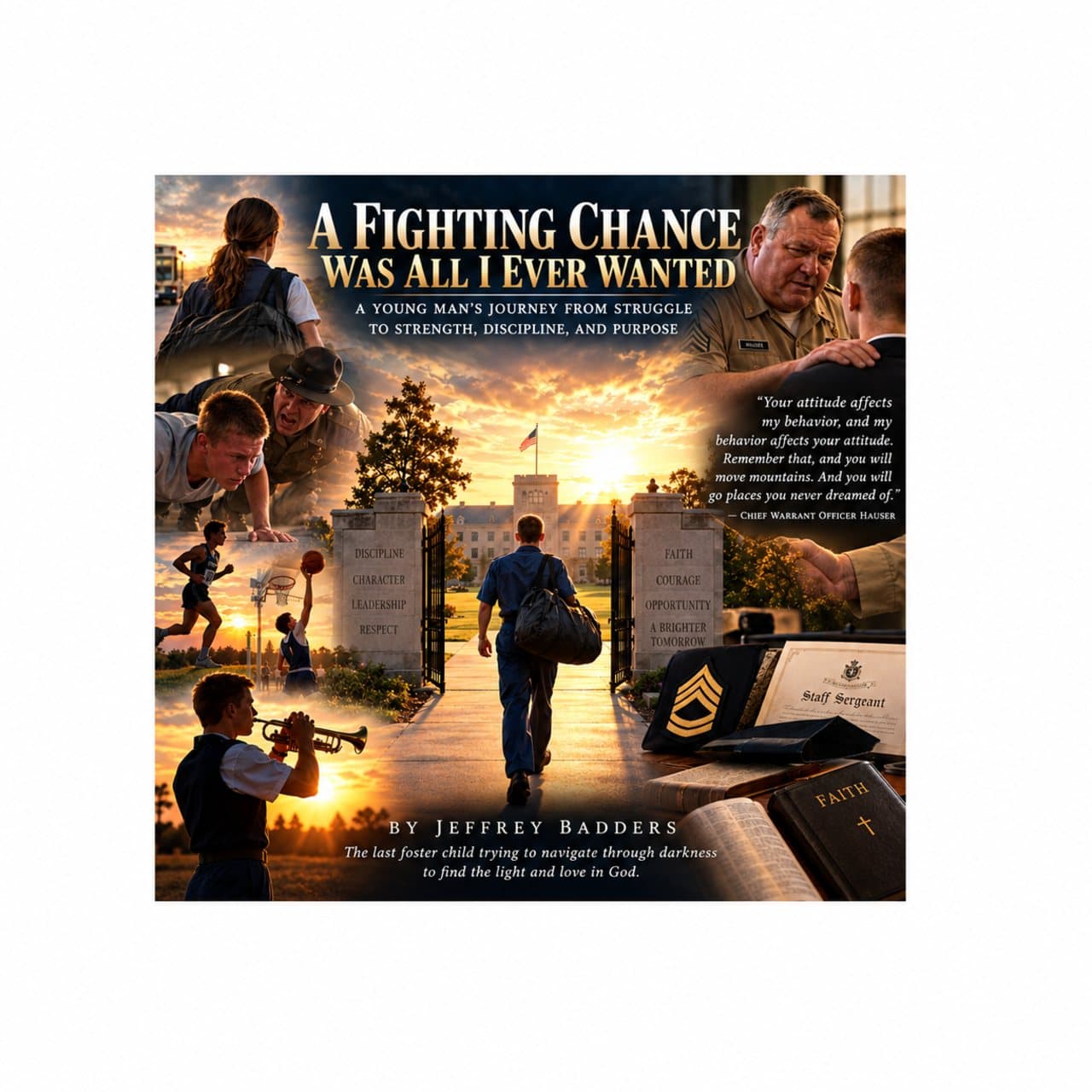

A Fighting Chance Was All I Ever Wanted
By Jeffrey Badders
I was sixteen years old when my life took another turn.
I had been living on a farm where I had already experienced a serious accident. About six months later, I found myself standing before a judge. I was given a choice. I could go to a detention center, or I could go to a military academy in Salina, Kansas.
I chose the military academy.
I didn't know much about military academies. I didn't know what I was getting myself into. But I knew I didn't want to go to a detention center.
The following week, I was on my way.
It was a hot August afternoon, around two-thirty, when I stepped off the bus carrying my duffel bag. I had long, light-brown hair tied in a ponytail that went down my back.
I looked around and thought I was in a dream.
But it wasn't a dream. It was reality.
A drill sergeant called me by my last name and told me to report to Barracks A.
When I arrived, there were about twenty cadets lined up. The commanding officer was a big, muscular man from Peru. He looked like he weighed about two hundred pounds.
He told me to get down and do ten push-ups.
I refused.
That was my first mistake.
He kicked me in the stomach and told me, "Now I own you. You will do what I tell you to do."
He also made it clear that if I didn't follow orders, the other cadets could be punished because of me.
I realized pretty quickly that this wasn't going to be anything like the life I had known.
Around four o'clock, I went to the quartermaster to get my uniforms. Then came something I didn't want to happen.
They cut off all my hair.
I had loved that ponytail. I asked if they could leave some of it, but that wasn't going to happen.
By the time they finished, I barely recognized myself.
All I could think was, I hope I can make it through this day.
That evening, we marched to the mess hall.
I learned that new cadets were called "rats." We had to walk in squares instead of going directly where we wanted to go. We also had to eat what they called a "square meal."
You sat straight, kept your eyes forward, and brought your fork up and down without looking at your plate. You had to finish within the time they gave you.
Everything had a rule.
Even walking and eating.
Later, we returned to the barracks for study hall at eight o'clock. Classes hadn't even started yet.
That first night was miserable. It was so hot in the barracks, and the air conditioning wasn't always running. I remember lying on that bed, sweating so much that the mattress felt soaked.
I wondered what I had gotten myself into.
I had arrived in August, when football practice was beginning. I decided to try out.
I weighed about 120 pounds and tried playing tight end.
One day during practice, I was running back a kick when somebody tackled me so hard it felt like I had been hit by a train. My glasses were rattling around inside my helmet.
Somebody helped me get back up.
I decided football wasn't for me.
I quit the following week.
But I wasn't finished trying things.
During the fall, I ran cross-country. In the winter, I played basketball. And in the spring, I ran track, including the mile and the half-mile.
I loved running.
When I was running, I felt free.
I could think. I felt more in tune and aligned with myself. I didn't feel chained down by all the rules and regulations.
I wasn't the best runner, but I always did the best I could.
And I always finished.
It wasn't about being number one. It was about finishing what I started. That meant more to me.
Basketball was something else I enjoyed. I played forward.
I knew there were people who were better than I was. I didn't have the talent to become some great basketball player, but I told myself, you know what, try it and see what happens.
I watched the senior cadets and learned by observing how they played.
I learned something from that experience that stayed with me.
When you're more observant, you learn more about yourself, other people, and situations in life.
I knew I probably wasn't going to be a basketball player.
But at least I tried.
I also had music in my life.
I played the trumpet, and I was assigned to play Reveille at five o'clock in the morning to wake everybody up. At ten o'clock at night, I played Taps.
I did that until my junior year.
Not everybody appreciated hearing my trumpet first thing in the morning, but I kept practicing and getting better.
There were times I wished I had spent more time learning the piano, something I had wanted to play since I was a child.
But life at the academy wasn't just sports, music, and schoolwork.
There were some difficult experiences.
My first roommate wasn't very friendly. One time, some of his friends came after me with a bar of soap stuffed inside a sock. Another time, two older cadets flipped my mattress while I was on it.
I got angry and punched one of them in the face.
I was new. They had their friends, and I didn't have anybody standing beside me.
I began realizing that if I wanted to survive there, I had to learn how things worked.
I also witnessed other cadets being treated badly. Some of the things that happened were wrong, even if people acted like they were normal back then.
The academy was gated, with somewhere around a hundred to a hundred and fifty cadets, as I remember it. Many came from families who could afford expensive tuition.
I often wondered why the state had sent somebody like me there.
Looking back, I see it differently.
It was a gift.
I learned discipline, morals, values, ethics, and most of all, respect.
But I didn't learn those things overnight.
I made plenty of mistakes.
There was a man at the academy named Chief Warrant Officer Hauser.
He was a big man, probably around 290 pounds, with many years of military experience behind him.
Mr. Hauser saw something in me that I didn't always see in myself.
He taught me something I have carried throughout my life.
"Your attitude affects my behavior, and my behavior affects your attitude."
He wanted me to understand how the things we say and do affect other people, and how their reactions can affect us.
If you aren't careful, one bad attitude can turn into another, and the whole thing starts snowballing.
He told me I had to stay in check with myself.
He also told me that advice didn't mean anything if I wasn't willing to apply it with the right mindset and attitude.
When Mr. Hauser talked to me, I felt like I had value.
I felt like somebody saw something in me.
But I didn't always listen.
When I earned good grades, I could sometimes go into town on the weekends.
One time, I went downtown with two other cadets. We went to an arcade, and some local boys didn't like seeing us in our uniforms.
We ended up getting into fights in an alley.
We came back bruised.
Mr. Hauser noticed, but I didn't tell him what had happened.
After that, some of us bought Buck knives. I hid mine in a slit in my mattress.
Eventually, the others got caught, and my name came up too.
I also had trouble when somebody stole my checkbook and wrote a bad check. I had earned around two hundred dollars working on the farm, and I ended up having to deal with that situation.
I was punished.
I had to rake and bag leaves at the commandant's yard. I also had to carry five-gallon buckets filled with sand across the football field, empty them, fill them again, and carry them back.
I repeated that punishment over three weekends.
It was miserable.
I kept thinking about how I could have avoided some of these problems if I had listened.
Mr. Hauser told me, "I see something in you, but sometimes you have to learn on your own."
He was right.
But I still had another hard lesson coming.
As I moved through the academy, I began earning rank. I went from being a rat to Private First Class, then Corporal.
But when I was a Corporal, I made another decision.
I went AWOL.
Absent without leave.
I was tired of all the rules. I was tired of somebody telling me what to do. I wanted to live my life my way.
Around eight o'clock one evening, I left through an area near the football field where the gates weren't completely enclosed.
I made my way into downtown Salina and stayed away for at least a day.
But I eventually came back.
And, of course, there were consequences.
I lost my responsibility for playing Reveille and Taps. Somebody else had to take over.
Mr. Hauser was upset.
He asked me why I had done it.
I told him, "Because I'm done with this. This is not for me."
He reminded me that there were teachers and officers there who could help me.
He told me I wasn't on my own.
I could have asked him for help, but instead, I had chosen to handle everything myself.
That stayed with me.
He was always there for me.
But I was not always there for him.
After I came back from AWOL, I started realizing something.
I had more potential than I thought I had.
And I wasn't going to have to do everything alone.
There were people out there who cared.
That's when I began changing my direction, my attitude, and my mindset.
I learned that everybody has a blueprint, but not everybody fits into the puzzle. Sometimes you have to compromise to see the whole picture.
And I learned something else.
The hardest prison to escape from is your own mind.
If you can't escape that, you'll never go anywhere in life.
I started looking at things differently.
Instead of always fighting against the people who were trying to help me, I began understanding what they were teaching me.
I worked my way up through the ranks.
I became a Sergeant.
Then one day, I was told to report to the main barracks, to the commandant's office.
I thought I was in trouble again.
When I walked in, the commandant and Chief Warrant Officer Hauser were there.
They started talking about my journey at the academy.
They remembered when I first arrived as a rat, when I became a Private First Class, and when I went AWOL.
They remembered the decisions I had made, including the poor ones.
Mr. Hauser told me that when he first met me, he saw something in me.
He said I had a strong will, but I didn't have a strong mindset.
And I had made poor decisions in my life.
I don't remember every word I said in that office, but I remember asking something that meant a lot to me.
"Have I made something of my life?"
Mr. Hauser looked at me and said, "Cadet Badders, yes, you have."
Then he told me he wanted to give me another stripe.
I was being promoted to Staff Sergeant.
The commandant presented me with my Staff Sergeant certificate.
I couldn't believe it.
I had come into that academy not knowing whether I could make it through the first day.
Now I was standing there receiving another stripe.
I never thought I had the willpower to make it that far.
But I told myself I would never give up.
I would never disguise my spirit for anyone.
As a Staff Sergeant, I had responsibility for helping make sure the younger cadets in my platoon followed the rules.
But I remembered what it felt like when I first arrived.
I remembered being frightened, being pushed around, and being treated like I didn't matter.
I didn't want to become the kind of person who used rank just to boss people around or belittle them.
I wanted to teach them.
I wanted to be a leader instead of their boss.
That mattered to me.
I also made a point of thanking Mr. Hauser.
Whenever I saw him at the mess hall, I would go up to him and say thank you.
When he walked past me, I showed him respect.
I couldn't remember every conversation we had, but I never forgot the lesson he taught me about attitude.
And I never will.
Eventually, the day came when I had to leave the academy.
I remember going into the barracks and seeing Mr. Hauser.
I thanked him for believing in me.
I thanked him for investing his time in me.
I gave him a hug and told him he had changed my life forever.
He looked at me, shook my hand, and said something I will always remember.
"Remember this. Your attitude affects my behavior, and my behavior affects your attitude. Remember that, and you will move mountains. And you will go places you never dreamed of."
Those words meant more to me than I can explain.
When I walked away from that military academy, I knew I had been on a journey.
I wasn't the same young man who had stepped off that bus on a hot August afternoon, carrying a duffel bag and wondering what was going to happen to him.
I had learned that knowledge and wisdom were important, but so were character, integrity, and earning respect.
I had learned that being the best wasn't always what mattered.
Sometimes it was about trying.
Sometimes it was about finishing what you started.
Sometimes it was about listening to somebody who believed in you before you believed in yourself.
And sometimes it was about finding the strength to change your own mind.
I felt like I went on a journey, forged in the fire and refueled by faith inside me.
It made me a stronger person.
And it made me a man.
Jeffrey Badders — The last foster child trying to navigate through darkness to find the light and love in God.