


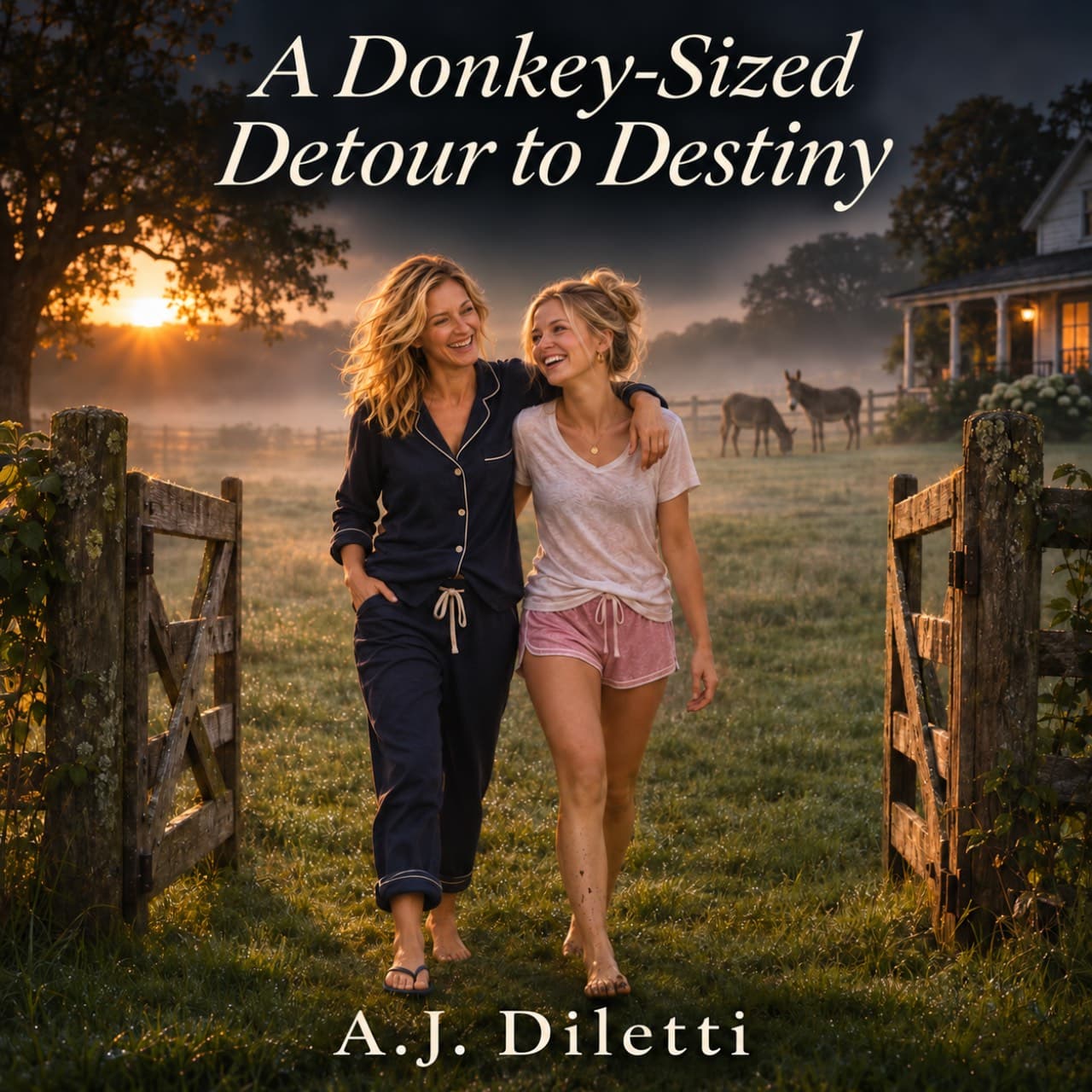

A pair of long ears floated above the fog.
They seemed to hover over the field, detached from anything that might explain them. Rabbits, perhaps, though they looked much too high off the ground. The half-awake mind could suggest only one more possibility: kangaroos, despite the fact that Charlie had never heard of a kangaroo loose in rural Georgia.
She had stepped onto the porch with a warm mug in her hands, hoping to greet the morning with a quiet prayer of thanks. The fog had blurred the fence posts and swallowed the tree line. Even the road beyond the pasture had disappeared.
Then one of the ears twitched.
The mist thinned just enough to reveal two donkeys grazing side by side, their dark backs silvered with dew. They tore at the grass in slow, steady bites. The field held no other sound. No birdsong. No barking dog. Even the highway seemed to have gone quiet.
Charlie lifted her coffee for another sip.
The donkeys raised their heads and started toward her.
Her fingers tightened around the mug. The animals were not running, not even hurrying, but their broad shoulders seemed to grow larger with every step. Charlie had never understood her fear of large animals. Cows could make her heart race from across a pasture. These two donkeys had pinned her to the porch as firmly as if their hooves were nailed to the boards.
She set her mug down so quickly that coffee sloshed over the rim.
“Faith!”
Her daughter’s bedroom door opened a crack. “If this is about a spider, I’m going back to bed.”
“There are donkeys in the field.”
Faith opened the door wider. “That’s definitely not a spider.”
“Come help me.”
Faith appeared a minute later in pajama pants and a T-shirt, her hair still tangled from sleep. Charlie grabbed her phone from the kitchen counter. She knew the neighbor who kept donkeys and had his number saved.
“Are they coming this way?” Faith asked, peering through the window.
Charlie nodded.
Faith looked at her mother’s face. “You’re scared of them, aren’t you?”
“I’m being cautious.”
“Your coffee is on the porch and you’re hiding behind the door.”
“I can be cautious from here.”
The donkeys kept coming.
Faith grabbed her phone. “Let’s go before they figure out we’re discussing them.”
They hurried outside in whatever they were wearing. Charlie had slipped into flip-flops. Faith was barefoot. By the time they reached the porch, the donkeys had passed the house and were heading toward the gate that opened onto the paved road.
Charlie called the neighbor. Her thumb slipped on the screen once before the call went through.
“Hello?” a sleepy voice answered.
“Your donkeys are out,” Charlie said. “They’re headed down our road toward the highway.”
“I’m on my way.”
Faith started after them. Charlie followed, one hand holding the phone to her ear and the other trying to keep a flip-flop from sliding off her foot.
“Slow down,” she called.
Faith slowed, but the donkeys picked up their pace. Their calm walk turned to a quick, springy trot. When Faith moved faster, they moved faster too.
“Faith, don’t run!”
“I’m not running!” Faith called back, jogging.
“You are absolutely running!”
“I’m trying to catch them!”
“They’re not going to come faster because you chase them!”
The donkeys trotted on, apparently unconcerned with the advice.
“Then they should stop running!” Faith said.
Charlie had no answer for that. She was too busy trying to keep her flip-flops on.
The animals moved away from them, tails swishing as their hooves tapped along the road. Faith ran anyway, and Charlie ran after her. The flip-flops slapped against her soles as the fog dampened her hair and the hem of her pajama pants.
The highway lay ahead, hidden around a bend. Delivery trucks traveled that stretch before the sun was fully up. Charlie pictured the donkeys reaching it, startled by headlights and the low growl of a semi.
“Lord, please,” she breathed into the phone. “Let the neighbor get here before they reach the highway.”
A red pickup appeared behind them, bouncing over the uneven road. The old truck’s engine rattled, and a cloud of dust lifted behind its tires. The neighbor drove past Charlie and Faith, then steered across the road well ahead of the donkeys, blocking their way.
The animals slowed. One tossed its head. The neighbor climbed down and called to them in a voice that carried across the road. He moved slowly, angling his body to guide them away from the highway and back the way they had come.
Charlie stopped at the roadside. Her chest rose and fell hard. One flip-flop was gone. She looked down at her bare foot, streaked with dust and wet with dew.
Faith glanced down too. “You lost a shoe.”
“I noticed.”
“Should I go back for it?”
“Not until the donkeys are safely home.”
Faith eyed the animals. “Agreed. I’m not risking my other foot for a flip-flop.”
The neighbor turned the donkeys toward home and drove behind them at a walking pace. As he passed, he leaned out the window with a broad grin.
“Thanks for helping!”
Charlie lifted a hand in reply, still trying to catch her breath. Faith stood beside her, hair falling in her face, toes muddy.
On the walk back, they talked over each other, replaying the chase and laughing at Charlie’s missing shoe. By the time Faith had washed the mud from her feet and Charlie had found her flip-flop near the gate, the morning had resumed its ordinary shape. There were lunches to pack, emails to answer, and property listings to review.
Charlie worked in land sales. Her days were usually filled with acreage maps, soil reports, phone calls, and buyers who wanted a bargain but expected a miracle. She loved the work, though lately she had begun to wonder whether she was making any real progress. A large property she had hoped to list had gone to another broker. Two promising buyers had stopped returning her calls. Her latest commission had covered the bills, but not much else.
After Faith left for school, Charlie settled at the kitchen table with her laptop and a stack of property folders. She planned to review them before heading to the office. Her phone rested beside her coffee, playing a sermon through its speaker.
As she checked her calendar, the pastor introduced the morning’s passage. Charlie paused with one hand resting on an acreage map.
The sermon was about Saul, who went looking for his father’s lost donkeys.
Charlie glanced through the kitchen window toward the field beside her house. The fog had lifted, leaving the grass bright and wet beneath the morning sun.
The pastor described how Saul and his servant searched through one region after another without finding the animals. When they were ready to give up, the servant suggested they visit Samuel, the prophet. What began as a search for lost donkeys led Saul to Samuel, who had already been told that Saul was coming. In time, Samuel would anoint him as Israel’s king.
Charlie lowered the folder.
The sermon title appeared on her phone: From Donkeys to Destiny.
A laugh escaped her, quiet and disbelieving. The fog, the strange ears in the field, Faith racing barefoot down the road, her own missing flip-flop. The details returned one by one, vivid as if the morning had left them scattered around her.
She felt warmth behind her ribs, close to laughter and close to tears.
Later that afternoon, her phone rang. It was the neighbor.
“I wanted to thank you both again,” he said. “Those two would’ve been halfway to the highway if you hadn’t spotted them.”
“I’m glad we could help.”
He paused. “You’re still working in land sales, right?”
Charlie sat straighter at her desk. “Yes. I am.”
“My sister and I have been talking about selling our family’s farm. It’s a big piece of ground, about two hundred acres. The agent we tried before didn’t seem to know much about agricultural property.” He cleared his throat. “Would you come take a look and tell us what you think?”
Charlie glanced at the maps spread across her desk. Two hundred acres. A creek crossing the eastern boundary. A farmhouse and barns. Tillable fields. Timberland. The kind of listing she had been hoping to land.
“I’d be glad to,” she said, careful not to let her excitement outrun her voice. “Let’s set a time.”
The farm belonged to his sister’s family. When Charlie visited, she walked the property with them beneath a sky scrubbed clear by the morning fog. She listened as they told stories about the house, the old well, and the field where their father had taught them to drive a tractor. She asked about drainage, access roads, timber rights, and the boundaries they weren’t sure of. She took notes while the sister pointed toward a low place where water collected after heavy rain.
Charlie did not rush them. She knew the land would mean more to them than a number on a closing statement.
When she returned to the office, she prepared a careful valuation and a marketing plan. She photographed the creek in the late-afternoon light and mapped the fields with a drone. She found a local farmer looking to expand, and an out-of-state family searching for land where they could build a home and raise cattle. The sale took months. There were surveys, negotiations, a septic inspection, and one tense week when the buyers considered walking away.
Charlie stayed with it.
The day the papers were signed, the sister reached across the table and clasped Charlie’s hand.
“You treated this place like it mattered,” she said. “That meant a lot to us.”
Charlie smiled, though the words caught somewhere in her throat. The commission from the sale was the largest she had ever earned. It opened doors she had been knocking on for years. More than the money, though, she carried away the memory of how the opportunity had begun: not with a polished presentation or a perfect sales pitch, but with two loose donkeys, a phone call, and a road that needed watching.
She thought again of Saul. He had gone looking for what was lost, not knowing that the search would lead him to a prophet and change the direction of his life.
Charlie thought of Mrs. Olga, the elderly woman who had watched her after school when she was little. When Charlie complained about making her bed or washing dishes, Mrs. Olga would tell her to do each task with her whole heart, as though she were doing it for the Lord.
As a child, Charlie had taken the instruction literally. She had tucked the blanket tight as if Jesus might sleep there that night. She had rinsed every plate as if He might sit down to supper.
Now she understood the lesson differently. The small work was not a delay before the important work. Sometimes it was the way to it. The ordinary task could teach patience, reveal character, or bring a person into the path of someone who needed their help. Jesus had served without treating any person or task as beneath Him. And Scripture reminded Charlie that faithfulness in little things mattered.
She thought of the fog lifting over the field. She thought of her bare foot on the dusty road, and the two donkeys trotting toward a future she could not see.
Then she wondered about the people reading her story.
How much more effort would you put into the task in front of you if you were doing it for Jesus?
And what if the thing you have to do right now looks as simple, inconvenient, or downright foolish as running after donkeys? What if, while you are faithfully doing that small thing, you meet the opportunity that leads you toward your own destiny?