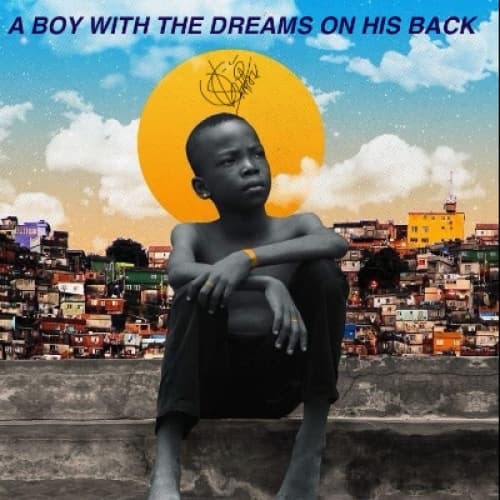
A boy named John lived in the heart of Kakuma., Kenya, amidst the cacophony of honking horns and reckless boda-boda riders. He was twelve, but his eyes held the wisdom of an old man. His world is starkly contrasted with a city of shadows where hope resides in tents that sway with every passing tide, which is what he calls home. John’s day began with the first light, as he helped his aunt sell mandazi on the street corner. The aroma of fried beans mingled with the exhaust fumes, creating a peculiar symphony of his life. While his peers chased dogs or played football, John’s mind was occupied by a different game: escape.
Escape from the cramped, mud-walled hut. Escape from the endless cycle of poverty. Escape from the camp that both nurtured and strangled him. He carried the family's hopes on his back, not in physical form, but in the weight of its dreams and its disappointments.
At night, under the watchful eyes of the stars that seemed closer in the camp smog, John would lose himself in books. They were his portals to other worlds, to lives beyond the concrete jungle. He read of doctors, scientists, and leaders, whose stories fuelled his aspirations. He wanted to be more than a street vendor. He wanted to build, to create, to change the world.
But life in the camp was a harsh teacher. It offered dreams but demanded sacrifices. It promised opportunities but set countless traps. John knew that education was his ticket out, but fees were a luxury his auntie couldn't afford. The weight of success, once an intangible burden, began to manifest physically. His shoulders ached with the unspoken pressures, his spirit felt bruised by the constant hustle.
It’s every child's wish to be something in the coming future. Some want to be doctors, some want to be engineers, some want to be pilots, some want to be politicians, some want to be businessmen, some want to be teachers; I don’t know about thieves but I think it’s all the same dream. “It was my dream to be a doctor when I grew up. This wasn’t just a dream, it was a grudge against death.
My mother died of haemorrhage (excessive bleeding) during childbirth, had my mother delivered her baby in a hospital at that time she could have been alive or she could have lived a bit longer than she did. She delivered us all at home with no complications whatsoever but this time it was different. From that day my mother was laid to rest I promised her to be a doctor when I grow up and help all women fight haemorrhage so that no child will ever have to grow up without a mother, it’s not fair for any child to grow up motherless. But life is not like a movie; if I was the director of this movie, I could have featured in it as a great wizard with great powers of bringing mothers back to life, sad enough this is life at its worst.”
“This was a promise of a bitter son who would do anything to have his mother by his side. I wouldn’t have crossed to an unknown land if she was alive. I couldn’t have gone all those Christmas nights without buying my favourite clothes. I couldn’t have gone several nights without food, or sleeping in the cold nights of May, or I couldn’t have endured all those suffering of not knowing whom to turn to, or what to hold onto, or going to sleep without fear of what tomorrow might bring. She missed so many great moments and also the worst days ever. But death robbed me of joy, love and happiness and it became personal, personal in a way that I wanted to make a better world for mothers. I had fantasies of what it could’ve looked like and the only way was to be a doctor. I didn’t know how but I knew I had to.
I started dissecting rats and birds as I prepared for my job at the hospital. I was a small boy who wanted to do good or be useful, and the way I knew was to be a doctor. Dr John Ng’achida is a big name, right? That’s how big my burdens are. No one believed me that I could be a doctor, I remember my aunt saying “You’ll leave a blade inside that innocent rat.” And so, I did when I was tired and clueless about how doctors do the job.