
Long before the glass house on the hill…
Before airport lounges became waiting rooms instead of dreams.
Before passports gathered stamps from countries that once existed only on classroom maps.
Before the boardrooms, tailored suits, morning runs, businesses, books, and the quiet confidence that only comes from surviving your own storms…
There was Manu.
He wasn’t born into wealth.
He wasn’t born into opportunity.
He was born into a single-room mabati house tucked deep inside a settlement where houses stood so close together they seemed to borrow strength from one another.
You see…
Calling them neighbours almost understates the relationship.
They lived inside each other’s lives.
If someone sneezed next door, the woman in the next house whispered, “Bless you,” before remembering the wall between them belonged to another family.
If a baby cried three houses away, every mother listened.
If one father came home drunk, no invitation was needed. The argument travelled from one iron sheet to another until the entire village knew whose evening had gone wrong.
Privacy wasn’t poor.
It simply didn’t exist.
The walls were iron sheets.
Thin enough to pass voices.
Thin enough to pass laughter.
Thin enough to pass pain.
Morning arrived before the sun.
Roosters argued with barking dogs.
Women swept the narrow footpaths with homemade brooms, raising little clouds of red dust that danced in the first light.
The aroma of boiling tea escaped through half-open doors.
Somewhere, a radio crackled with yesterday’s news.
A child cried because school had come too quickly.
Another laughed because childhood always finds a reason.
The village stretched itself awake.
And somehow…
So did hope.
When rain came, conversations surrendered.
The drops landed on the mabati roofs with military precision.
Click.
Click.
Click.
Then faster.
Click-click-click-click-click…
Until the sky became a drummer with unfinished business.
Nobody complained.
Rain was loud.
But rain also meant tomorrow might be green.
Sounds like hardship?
Maybe.
But that little village understood something expensive neighbourhoods sometimes forget.
People survived because they belonged to one another.
Evening belonged to Manu’s mother.
Not because she rested then.
Because that was when everyone else’s work became visible, while hers quietly continued.
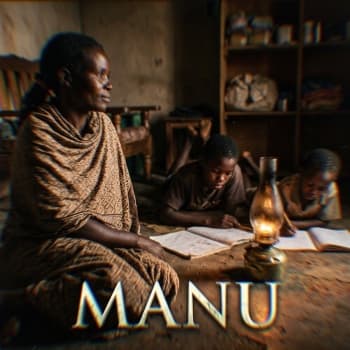
As the last strands of daylight slipped behind rows of rusted rooftops, she reached for the kerosene lamp.
It had lived in the family longer than anyone remembered.
Its glass chimney carried years of stubborn smoke, stained brown by flames that refused to surrender.
The little metal body leaned slightly to one side.
It smelled permanently of paraffin, even when it wasn’t burning.
She removed the chimney carefully.
Pinched the blackened ndambi between her fingers.
Raised it just enough to breathe.
If the tip had curled into charcoal, she trimmed it gently with the same razor blade she had protected for months.
Then came the match.
A scratch.
A pause.
The flame caught.
Smoke arrived first.
It always did.
Only then did the light follow.
Not enough to brighten the room.
Just enough to persuade darkness to wait a little longer.
The children gathered around it instinctively.
Exercise books spread across the floor.
Mathematics.
English compositions.
Science notes.
Untidy handwriting.
Big dreams squeezed into ruled exercise books.
Not because the lamp was bright.
Because it was all the light they had.
Every few minutes someone shifted after casting a shadow across another child’s homework.
The little flame danced.
So did their dreams.
Behind them, supper simmered in a blackened sufuria balanced carefully over a charcoal stove.
Steam rose.
The smell of onions browning in cooking oil slowly filled the room.
The smoke from the lamp reached Manu’s mother before it reached anyone else.
Perhaps she no longer noticed.
Or perhaps mothers simply become experts at standing where the smoke is thickest so their children can breathe easier.
You see…
Long before the children learned sacrifice…
She had already mastered it.
Once upon a time she had wanted to become a doctor.
Not because someone told her it was respectable.
Because healing fascinated her.
She possessed the kind of mind that solved problems before others had finished explaining them.
Teachers noticed.
Neighbours noticed.
Anyone who spent five minutes speaking with her noticed.
Life noticed too.
Unfortunately…
Life arrived before opportunity.
School became a luxury.
Responsibility became permanent.
The dream never died.
It simply changed owners.
She never spoke about what could have been.
Never complained.
Never blamed yesterday for stealing tomorrow.
Instead, every conversation became about her children.
“They’ll study.”
“They’ll go further.”
“They’ll have choices.”
Every dream she quietly folded away became another brick beneath their future.
Before sunrise she was already at work.
Not in an office.
Not behind polished glass.
Her business occupied a tiny timber kiosk standing beside the dusty footpath that cut through the settlement.
Its faded blue wooden shutters opened outward every morning, becoming little windows that welcomed customers.
The paint had surrendered years ago.
Thin curls peeled away from the timber, revealing weathered wood beneath.
Inside…
Yellow jerrycans.
Everywhere.
Tall ones.
Short ones.
Twenty litres.
Ten litres.
Some scratched by years of use.
Some faded almost white by the unforgiving sun.
Some stood full.
Most waited patiently for water.
Black plastic pipes twisted through the tiny room like vines searching for somewhere to belong.
Whenever one cracked, she never threw it away.
She reached for strips cut from old vehicle tyres.
Wrapped them tightly around the leak.
Then secured everything with stretched black rubber bands cut from worn-out inner tubes.
Nothing matched.
Everything worked.
She knew every valve by touch.
Every leak by sound.
Every customer by name.
Children arrived carrying little containers.
Women balanced jerrycans on their hips.
Old men stopped to exchange stories while waiting their turn.
She filled each container carefully.
Never spilling more than a few precious drops.
Because water was expensive.
So was tomorrow.
By evening her hands told stories her face never mentioned.
The fingers had thickened.
Tiny scars decorated her knuckles.
Fine wrinkles crossed her palms long before old age had permission to arrive.
Those hands had carried water.
Cooked meals.
Washed school uniforms until the fabric became soft with time.
Held frightened children through fever.
Wiped tears.
Folded dreams.
Then unfolded hope again the following morning.
They were not the hands of a woman defeated by life.
They were the hands of an architect.
She wasn’t building houses.
She was building people.
Then there was Kala.
The youngest.
Small enough to believe the kerosene lamp possessed magic.
Every few evenings, just as everyone settled around its trembling glow, their mother lifted the lamp and gave it a gentle shake.
Silence.
The children looked up.
Kala looked away.
She already knew.
“Mafuta imeisha.”
Her little shoulders fell before her feet moved.
“Mama… mbona ni mimi tena?”
She protested with the seriousness only the youngest child can summon.
The complaint continued all the way to the door.
She dragged her slippers along the dusty footpath as though every step deserved an appeal.
Halfway there she negotiated with invisible judges.
Explained why older siblings should have inherited this responsibility.
Argued with the wind.
Questioned fairness itself.
Mama Njeri never interrupted.
She had watched Kala perform this little drama too many times.
Without a word, she reached beneath the wooden counter and lifted a cloudy bottle filled with kerosene.
A dented tin funnel disappeared into an empty soda bottle.
Then she poured.
Slowly.
Click…
Click…
Click…
Tiny drops echoed against the plastic.
Ordinary sounds.
Extraordinary value.
Every drop meant another evening of homework.
Another meal shared together.
Another night where dreams refused to surrender.
Kala held the bottle with both hands on the journey home.
Careful.
Not because she wanted to.
Because spilling even a little meant darkness arrived early.
Back home, the ndambi drank once more.
The flame stretched itself awake.
Homework continued.
Supper simmered.
The smoke rose.
Dreams survived another night.
Years later, people would admire Manu’s life.
The beautiful home.
The warm dining table lit by soft electric lights.
The successful businesses.
The boardrooms.
The books.
The marathons.
The passport.
The family gathered without worrying whether the lights would stay on.
They would call him fortunate.
They would speak of discipline.
Talent.
Timing.
They would never know that once upon a time, the brightest thing in his world was a smoking kerosene lamp fighting against the darkness.
And perhaps…
That is why success never changed him.
Because the little boy who learned to dream beneath a trembling flame never forgot that light is not measured by how brightly it shines.
It is measured by what it refuses to let the darkness steal.