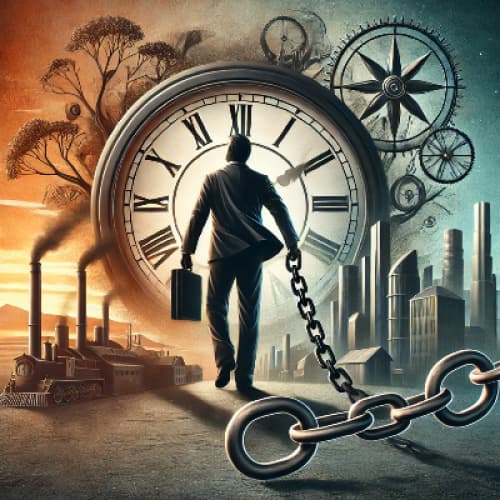
Since the dawn of time, the pursuit of livelihood has been humanity’s primary goal, while freedom remained the elusive dream. Between these two poles, mankind has been locked in an eternal struggle. How did livelihood, a natural right, become a tool of enslavement? How did life systems evolve into chains that bind humanity without it realizing? This book is a journey through the history of mankind’s relationship with livelihood, exploring a central question: Are we truly free, or merely slaves in a new guise?
---
In the earliest days, humans sought their sustenance freely, living off the bounty of nature without laws or restrictions. Life was simple, devoid of unnecessary complexity. However, as societies evolved, systems emerged to organize human life, yet they also began to constrain it. The pursuit of livelihood became part of a social system controlled by the powerful, and soft chains gradually crept into human existence under the guise of progress and organization.
---
With the rise of ancient civilizations, these constraints evolved from mere organization to outright enslavement. In ancient Egypt and Babylon, slaves toiled to build palaces and temples, dedicating their lives to serve their masters. Even free farmers of that era were trapped in a cycle of taxes and feudalism, their livelihoods tied to the whims of rulers. Civilization, which was supposed to be the wellspring of freedom, became the architect of humanity’s first prisons.
---
The Industrial Revolution arrived, promising liberation from the drudgery of physical labor. Yet, it forged new chains for humanity. Workers were reduced to cogs in an unrelenting machine, laboring for long hours in harsh conditions just to survive. During this period, the pursuit of livelihood grew even more intense, as people traded their freedom for meager wages that barely afforded them a decent life.
---
Today, the chains are no longer as visible as they once were. Prestigious jobs, bank loans, and advertisements selling dreams of luxury have become the new tools of enslavement. People have become prisoners to their desks, chasing after lavish homes or modern cars while living perpetually in debt.
Livelihood is no longer merely a necessity for survival—it has transformed into an endless race driven by false ambitions and societal pressures.
---
The global economic system is the greatest prison humanity inhabits without realizing it. Large corporations exploit labor in developing countries, technology monitors our lives and influences our choices, and capitalism imposes its rules on everyone. We are trapped within a system that appears to have no alternative, where the pursuit of livelihood serves the few at the expense of the many.
---
Can we break free from these chains?
This chapter discusses the stories of those who have chosen to withdraw from the system, opting for a simple life with minimal needs. The book emphasizes the importance of awareness as the first step toward liberation and how individuals can define their own understanding of livelihood, free from the chains imposed by these systems.
---
In the end, we are the ones who forge our own chains, whether by accepting the systems that govern us or by chasing after illusory dreams. Freedom does not mean abandoning the pursuit of livelihood; rather, it lies in realizing that livelihood is a means to live, not a goal that consumes our lives.
The question this book leaves open: Can you break the chains, or have you chosen to be part of them?
---
Conclusion
This is not a call to abandon work or the pursuit of livelihood. It is an invitation to reflect on our lives. How do we spend them? And what is the price we pay for our sustenance? It is a reminder that true life begins when we recognize that we are free to choose our own path.
---