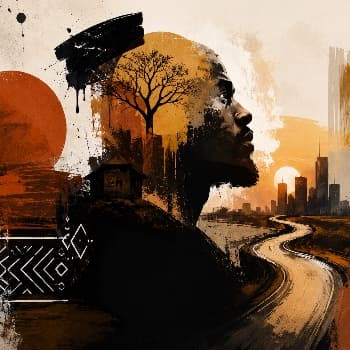

Nobody in Kubuji Land ever hurried.
Not because life was perfect.
But because honestly… where exactly were people rushing to?
The goats knew everybody. The river knew everybody. Even the gossip somehow arrived before the actual news itself.
Kubuji sat hidden between endless hills and giant baobab trees. The soil was red enough to stain your feet for three days, and the sunsets? Aaah. The sunsets looked like Magic.
Every morning smelled of charcoal smoke, boiling tea leaves, wet soil, and somebody somewhere overcooking cassava.
Children chased chickens with the confidence of warriors. Grandmothers shouted everybody’s full government names before sunrise. And the village radio only worked when somebody slapped it correctly.
That was Kubuji.
A village so small that if you sneezed near the market, someone in the next hill would say: “Pole sana, are you getting malaria?”
And right there lived Kazu and Juki.
Now Juki… eeeh.
Juki was dangerous.
Not dangerous like a thief. Dangerous like a woman who laughs at your jokes even when they’re bad. That kind.
Her smile alone could make a grown farmer forget why he came to the market. Men would walk to buy onions and somehow return home holding tomatoes, sugarcane and emotional damage.
Kazu on the other hand was built differently.
Quiet.
Strong.
The kind of man who could carry a whole sack of maize with one hand but still apologize to a chicken for stepping near it.
People trusted Kazu because he never spoke unnecessarily. In Kubuji, that alone qualified you to become either a village elder… or suspicious.
He built stools, repaired roofs, carved doors, and once fixed old Mama Kala's broken bed so well she started telling people: “This boy has blessed hands.”
That statement unfortunately spread faster than intended.
But what Juki loved most about Kazu was simple.
The man showed up.
Always.
If rain destroyed somebody’s roof? Kazu.
Cow missing? Kazu somehow finds it.
Need help carrying bananas? Kazu already lifting them before you finish the sentence.
One evening by the river, Juki told him: “If someone wrote a story about us, I’d call it Life with Superman.”
Kazu nearly choked on roasted maize laughing.
“Superman? Me? Juki, yesterday I lost an argument to a goat.”
“Yes,” she smiled. “But a dependable goat.”
That became their thing.
She called him Superman. He called her Trouble.
And honestly… they were happy.
Not rich. Not famous. But the kind of happy city people keep posting motivational quotes about.
Then one night everything changed.
It began with thunder.
Not normal thunder.
The kind that shakes cooking pots and makes old people start praying immediately without even knowing the reason.
The villagers rushed outside their huts as something roared across the night sky.
A streak of fire tore through the darkness above Kubuji hills.
Then,
BOOM.
The ground shook.
Goats screamed. Children cried. Somebody fainted dramatically even before seeing anything.
“A spirit!” “No, war!” “No, must be the gods, they are angry!”
Kazu grabbed his lantern.
“I’m going.”
“Absolutely not,” Juki snapped. “People who say ‘I’m going’ in situations like this usually die in stories.”
But Kazu was already moving.
Of course she followed him anyway.
Because love is beautiful but also apparently very stressful.
Deep beyond the hills they found wreckage burning across the forest.
Metal twisted like cooked cassava leaves.
Smoke everywhere.
And inside…
A man.
Alive.
Barely.
White skin. Grey hair. Expensive clothes now covered in mud and blood.
Juki froze.
“Kazu… is this even a person?”
The old man groaned.
“Oh thank God,” Kazu sighed. “For a second I thought he was dead.”
The old man opened one eye weakly.
“I… am alive…”
Kazu blinked.
“Ah. My apologies then.”
Somehow, against all logic, they carried him all the way back to Kubuji.
The villagers stared.
Children followed them screaming: “MZUNGU! MZUNGU!”
Old Mama Kala even fainted properly this time.
For weeks, Kazu and Juki cared for the stranger inside their tiny home near the river.
Juki fed him soup slowly while complaining: “This man is thinner than village WiFi signal.”
Kazu cleaned wounds, changed bandages, and listened carefully as the stranger slowly recovered enough to speak.
His name was Jack Buff.
Turns out… Mr. Buff was not just some random old tourist who got lost.
The man was rich-rich.
The kind of rich where even his wristwatch probably had a savings account.
He owned one of the largest media stations abroad. Television. Radio. Newspapers. The whole thing.
Yet somehow, despite all his money, he had nobody around him during the crash.
Except strangers from a tiny forgotten village.
One evening Jack sat outside watching the sunset over Kubuji.
“I’ve traveled the world,” he said quietly, “but I’ve never seen people love like this.”
Juki laughed.
“That’s because in our village if someone annoys you, you still see them tomorrow. We don’t have enough roads for avoiding each other.”
Jack laughed harder than expected.
And slowly… he fell in love with Kubuji too.
Recovery had not been easy.
The first few days, Jack could barely sit without wincing. Walking from one end of Kazu’s compound to the other felt like climbing a mountain. Every movement reminded him of the crash.
The village, however, never rushed him.
Each morning Kazu helped him to the old healer everyone simply called Baba Mkosi.
From the outside, Baba Mkosi’s home looked like any other mud house.
Inside…
It was an entire hospital disguised as tradition.
Wooden shelves stretched from floor to ceiling, filled with dried roots, herbs hanging from the rafters, clay pots bubbling over slow fires, tiny bottles of handmade oils, woven baskets of medicinal leaves, and powders whose names Jack could neither pronounce nor remember.
The air carried the scent of eucalyptus, Moringa, lemongrass, smoke and something wonderfully bitter.
Every treatment came with confidence.
Every medicine came from the earth.
Some mornings Baba Mkosi crushed fresh leaves into thick green paste and spread it across Jack’s wounds before wrapping them with clean cloth.
Other days he brewed dark herbal drinks that tasted so unbelievably bitter Jack questioned whether they were medicine or punishment.
The first sip nearly made him spit it back out.
The children watching burst into laughter.
Baba Mkosi simply smiled.
“If it tastes terrible…”
“…it probably works?” Jack guessed.
The old man nodded proudly.
“Now you’re learning.”
Week after week, the pain slowly loosened its grip.
Soon Jack could walk without support.
Then he wandered farther from Kazu’s home.
Before long…
He wasn’t simply staying in Kubuji.
He was living in it.
The village children became his teachers.
They laughed every time he mispronounced a word.
The grandmothers insisted he eat more.
The men saved him a place beneath the giant baobab every evening, where stories lasted longer than the sunset itself.
One afternoon Juki appeared carrying a neatly folded red and black leso.
“No more looking like a lost tourist,” she declared.
Within minutes the villagers had wrapped Jack in traditional attire.
The silence lasted exactly three seconds.
Then everyone burst into laughter.
The leso somehow managed to make one of the richest men in the world look like he had lost a fight with a curtain.
Even Jack couldn’t stop laughing.
“I look ridiculous, don’t I?”
Kazu nodded immediately.
“Very.”
“But… respectable ridiculous.”
From that day on, the outfit became his favourite.
Not because it suited him.
It absolutely did not.
But because every time he wore it, someone smiled.
As his strength returned, the village boys invited him to help take the cattle out to graze.
At first Jack thought they were teasing him.
Back home he chaired board meetings worth millions.
Here…
He was learning how to whistle at cows.
To everyone’s surprise…
He loved it.
He walked barefoot through dew-covered grass.
Learned the names of every stubborn cow.
Sat beneath acacia trees listening to stories from boys who had never seen a skyscraper.
No ringing phones.
No assistants.
No security guards.
No endless meetings.
Only wind.
Birdsong.
Laughter.
For a man who had spent decades building an empire…
This simple life felt richer than anything money had ever bought.
Meanwhile…
The rest of the world was descending into panic.
BREAKING NEWS.
MEDIA MOGUL JACK BUFF STILL MISSING.
Every television station carried his photograph.
Newspapers printed special editions.
Helicopters searched forests.
Governments coordinated rescue efforts.
Investigators reconstructed flight paths.
Rewards for information grew larger every day.
Ironically…
Many of those reports aired on television stations Jack himself owned.
He knew people would be searching.
He knew his disappearance had become global news.
But each morning, when the sun rose over Kubuji and children ran past laughing…
He found one more reason not to leave.
Hundreds of miles away, inside Buff Media Headquarters, one person refused to accept defeat.
His daughter.
Amara Buff.
She had barely slept since the accident.
Coffee cups covered her office.
Maps, search reports and photographs filled entire conference tables.
She ignored investors.
Postponed interviews.
Walked out of board meetings whenever another update arrived.
The confident executive the world admired had quietly disappeared.
In her place stood nothing more than a daughter desperately trying to bring her father home.
Every evening she replayed their final conversation, searching for words she might have missed.
She told herself tomorrow would be different.
Tomorrow…
Someone would find him.
She had no idea that while the world searched desperately for Jack Buff…
He had already found exactly what he’d been missing.
Peace.
When he fully recovered, the entire village gathered to say goodbye.
Even people who originally thought he was a forest spirit now cried.
Before entering the vehicle sent to retrieve him, Jack turned to Kazu and Juki.
“You saved my life,” he said. “Come with me abroad. Both of you.”
Silence.
Even birds paused.
Juki blinked.
“Abroad abroad?”
“Yes.”
Kazu scratched his head.
“You mean… beyond Kaffi?”
Jack smiled.
“Much further.”
For the first time in their lives, Kazu and Juki considered leaving Kubuji.
Honestly the village was more excited than them.
People started giving useless advice immediately.
“Don’t trust their food.” “White people eat salad voluntarily.” “If you see snow just come back.”
The day the bus arrived was historic.
Because the bus only passed through Kubuji once every week and usually nobody cared.
This time the entire village waited like royalty was arriving.
Children climbed trees. Grandmothers cried. Somebody brought a chicken as a gift for absolutely no reason.
As the old bus rattled toward the city, Kazu sat by the window stunned.
For hours they passed villages almost identical to theirs.
Red soil. Small markets. Women carrying baskets on their heads.
Then slowly…
Things changed.
Roads widened.
Buildings grew taller.
Cars multiplied like mosquitoes near stagnant water.
Electric lights glowed everywhere.
Kazu nearly lost his mind seeing escalators.
“The stairs are moving themselves?!”
Then came the hotel.
Edward, Jack's assistant, had booked them into a luxury hotel before their flight abroad.
Juki entered the bathroom first.
Then screamed.
“KAZU!”
He ran inside panicking.
“What happened?!”
She pointed at the toilet.
“It swallowed the water.”
Kazu stared silently after flushing it again.
The toilet flushed.
He stepped backward slowly.
“This place has dangerous technology.”
Their first flight nearly finished him completely.
Kazu held the seat so tightly during takeoff the man beside him started praying too.
Clouds below them. Cities like stars beneath the sky. Food arriving inside the air somehow.
Nothing made sense anymore.
When they finally arrived abroad, the world became bigger than either of them imagined.
Buildings touched clouds. Trains moved underground. Screens covered entire walls.
Kazu stood frozen outside Jack's media headquarters staring upward.
“You’re telling me people WORK inside all this?”
Jack laughed.
“You’ll get used to it.”
But the biggest surprise waited at Mr Buff's mansion.
His daughter.
Amara Buff.
Beautiful. Sharp-minded. Confident.
The kind of woman who walked into rooms like she owned gravity itself.
And from the very first moment she saw Kazu…
She noticed him.
Not because of his clothes. Not because of where he came from.
But because somehow, in a world full of loud people trying desperately to be seen…
Kazu carried peace with him.
And peace is rare.
That night, standing beside giant glass windows overlooking a city that never slept, Kazu whispered to Juki:
“You know something?”
“What?”
“If I tell people back home toilets flush themselves here…”
“They’ll think you joined a cult.”
Kazu laughed softly, staring at endless lights stretching across the horizon.
A boy from Kubuji Land.
Standing inside a world he never knew existed.
And somewhere deep inside him…
Something had begun to change.