


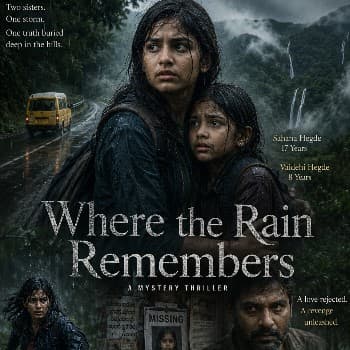

She told Inspector Nagaraj everything that evening — the proposal, the refusal, the small strange question about Amoolya's school timing that she had not thought twice about until now. He wrote it all down without comment, his expression giving away nothing, though Chandrika saw him glance once, briefly, at a constable standing near the door, and understood that a name had just entered the inquiry that had not been there an hour before.
"We will not act on a feeling alone," the inspector said. "But we will not ignore one either. Give me tonight."
The night that followed was the longest of Chandrika's life. The rain did not let up even once, drumming against the tin roof of their small house with a steadiness that felt, to her, almost cruel — as though the sky itself did not understand what was happening beneath it, or did not care enough to pause. Her mother sat by the window with Amoolya's school uniform still folded on her lap, the one she had ironed that very morning, and did not sleep. Chandrika sat beside her, holding one corner of the same uniform, as if by touching what her sister had touched only hours ago, she might somehow keep the distance between them from growing any wider.
By early morning, word reached the inspector that a white jeep matching the description had been seen the previous evening at a small lodge on the outskirts of Nagara town, twenty kilometres down the ghat road — a place with a poor reputation, known to the local police for more than one reason over the years. The lodge's register showed a name that meant nothing to Chandrika, but the man who owned it, when questioned, described his guest well enough: an outsider, unfamiliar to the town, who had arrived two days earlier and had been overheard on a phone call discussing an arrangement to move "the goods" onward by the morning bus — cold, businesslike language that turned Chandrika's stomach the moment Inspector Nagaraj repeated it to her, carefully, choosing his words.
It was not, the inspector explained gently, an isolated crime. There were networks that moved through these hill roads precisely because they were quiet, poorly watched, easy to pass through unnoticed — men who arranged for children to be taken from small villages under false promises, or by simple force, and carried far from anyone who might recognise them, to be put to work in houses and shops in distant cities where no one would ever think to ask whose daughter she was.
"And Ravindra?" Chandrika asked, her voice barely holding steady. "Was it him?"
"The lodge owner did not recognise Ravindra's photograph," the inspector said carefully. "But the phone number used to book that room — we have traced it. It belongs to a man Ravindra has called eleven times in the past three weeks. A man with a prior record, from two districts over, known to us for exactly this kind of arrangement."
It was not proof, not yet, that Ravindra himself had taken her sister with his own hands. But it was enough — more than enough — to show that a rejected proposal, nursed quietly for three weeks into something far uglier than disappointment, had very likely placed the call that set a stranger's jeep outside a small stone wall at exactly the hour a trusting eight-year-old girl always sat waiting.
"Where does the morning bus go?" Chandrika asked.
"Mangaluru," the inspector said. "It leaves Nagara town at seven."
It was ten minutes past six.