


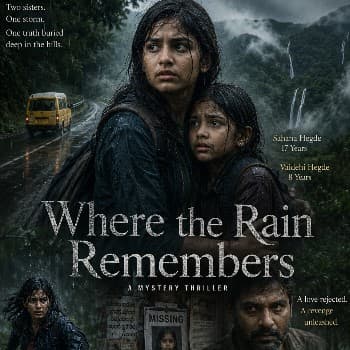

Girija Teacher confirmed what Chandrika had by then already begun to fear. Amoolya had left the school at the same time as the other children, in the same early dismissal, walking out through the same gate with two of her classmates, Meghana and Divya, before turning off, as she always did, toward the stone wall to wait.
"She was there," Meghana said, when Chandrika found her at her own house minutes later, soaked through, her voice shaking with a fear she did not yet fully understand herself. "She was sitting on the wall. I saw her when I left. And then — " the girl hesitated, twisting the hem of her wet uniform in her hands — "there was a jeep. A white one. It stopped near the wall. I did not think anything of it. Sometimes people stop there to ask directions to the peak."
"Did you see who was driving?"
"No akka. I was already walking home. I only saw the jeep stop. I did not see it leave."
By six that evening, half the village had gathered at the school gate in the rain, umbrellas and raincoats and torches, the kind of gathering that forms only around the worst kind of news, everyone talking at once and no one quite able to say the thing they were all afraid was true. Chandrika's father had come straight from the tourist office, his jeep abandoned crookedly at the crossroads. Her mother had not spoken a single word since she arrived; she stood at the stone wall with one hand pressed flat against it, as though the stone itself might still be warm from where her younger daughter had been sitting.
Inspector Nagaraj arrived from the district station within the hour, a heavyset, unhurried man whose calm, Chandrika would understand only later, was not indifference but the particular discipline of a man who had learned that panic wasted the very minutes a missing child most needed.
"Tell me everything," he said to Chandrika. "Not what you are afraid of. Only what you know."
She told him. The white jeep. The early dismissal. The stone wall where her sister always waited, and had, for the first time in three years, not been found waiting.
"Has anyone been unusually interested in your sister lately?" the inspector asked. "Anyone asking about her school timing? Her habits? Sometimes, in these hill villages, it is not a stranger who does the asking. It is someone already known to the family, testing what he can learn before he acts."
Chandrika opened her mouth to say no — and then stopped, because a small, cold memory had surfaced from somewhere she had not looked in weeks.
Three weeks earlier, at a wedding in the next village, a man named Ravindra — a distant relative of their neighbour, older than her by nearly ten years — had asked her father, quite formally, for her hand. She had said no, gently but clearly, in front of both families. He had said, at the time, that he understood, that these things were a woman's choice, that he wished her well.
But she remembered now, with a chill that had nothing to do with the rain soaking through her clothes, that he had asked her, almost in passing, only a week after that wedding, what time her little sister's school got over each day — and that she had answered him without thinking twice, because it had seemed, in that ordinary moment, like the most harmless question in the world.