


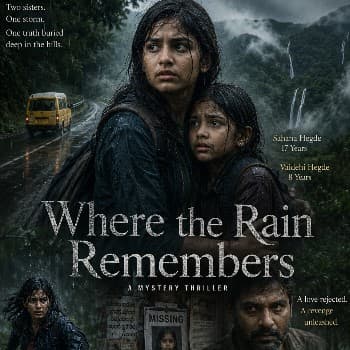

They reached Nagara town at six forty, the police jeep taking the wet ghat bends faster than Chandrika had ever seen any vehicle take them, her father in the front seat gripping the door handle, her mother beside her in the back with both hands pressed together as though already deep in prayer.
The lodge was a small, unremarkable building beside the bus stand, its board faded, its shutters still closed at that hour. Inspector Nagaraj did not wait for backup from the town station. He went in through the front with two constables, and Chandrika — against every instruction to stay in the jeep — was three steps behind him before anyone could stop her.
They found Amoolya in a back room on the ground floor, sitting on a low cot beside a stranger's bag, her school uniform still damp, her small face streaked with the particular exhausted stillness of a child who has cried for so long that she has, for the moment, stopped. A man Chandrika did not recognise was in the room with her, already reaching for the bag when the constables entered, and was on the ground with his hands behind his back before he had finished standing up.
Amoolya looked up. For one long second, she did not seem to believe what she was seeing.
Then she said her sister's name — not loudly, not even clearly, her voice cracked from a night of crying no one had been there to comfort — and Chandrika crossed the room in three steps and pulled her into an embrace so tight that neither of them could have said, afterward, where one sister ended and the other began.
"You came," Amoolya whispered into her shoulder. "I told him you would come. I told him my sister always comes for me."
"I will always come," Chandrika said, and found that she could not say anything else for a long while, because there was nothing else in her that was not entirely given over to holding her sister as though letting go, even for a moment, might undo the last twelve hours.
Ravindra was arrested two days later, at his own house, calmly eating breakfast, as though he had believed — as men like him often do — that distance and time and a stranger's hands were enough to keep his own untouched. The phone records told the rest of the story that words could not: the calls, the dates, the arrangement made and paid for in the same quiet, businesslike tone the lodge owner had overheard through a thin wall. A rejected proposal, three weeks of silent anger, and a decision that a family's happiness could be punished through the one person in it who had never done him any harm at all.
He would spend a long time, the inspector told them, in a place far from any hill road.
It rained again on the evening they brought Amoolya home — softer this time, an ordinary evening monsoon shower, the kind the valley saw a hundred times each season and forgot by morning. Chandrika sat with her sister on the veranda, a shared umbrella forgotten and folded beside them, both of them simply watching the rain fall the way it always had, as though it had never once tried to take anything from them at all.
"Akka," Amoolya said quietly, watching the water run off the tin roof in a steady silver line. "Does the rain know what happened?"
Chandrika thought about this for a long moment before she answered.
"I think the rain knows everything that happens under it," she said. "That is why it always comes back. It is checking that everyone is still where they belong."
Amoolya leaned her head against her sister's shoulder, and for the first time since the second Thursday of July, both of them, at the same moment, without any words at all, felt entirely safe.
They had come from the same sky, these two sisters —
and no matter how far the wind carried one of them,
the rain, patient and certain, always found a way to bring her home.