


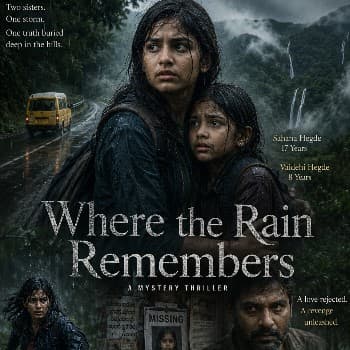

The rain came early to Kodachadri that year, settling over the hills by the first week of June the way it always did, turning the narrow forest path between the village and the small Kannada-medium school into a river of soft red mud that every child in the school had learned, by some age or another, to walk without slipping.
Chandrika had walked that same path every single day of her own childhood, and now, at nineteen, she walked it twice a day again — once in the morning to drop her sister at the gate, once in the evening to bring her home — because their mother worked long hours at the areca plantation and their father drove a jeep for tourists coming up to see the peak, and someone, in a family of four, had to be the one who was always there.
Amoolya was eight. She had been born on a day of unusually heavy rain, and their grandmother had said, half in jest, that the sky had wept with happiness at her arrival, and the name had followed from there — Amoolya, meaning priceless, because their mother had said, quite simply, that nothing about this small squalling person could be measured in ordinary terms.
The two sisters were close in the particular, unshowy way of siblings raised mostly by each other. Chandrika braided Amoolya's hair every morning. Amoolya waited for her every evening at the school gate, sitting on the low stone wall with her bag between her knees, watching the road the way small children watch roads when they trust, completely and without question, that the person they are waiting for will always come.
On the second Thursday of July, the rain had been heavier than usual since morning — the kind of rain that turned the whole valley the colour of wet slate, that made the temple bell at the crossroads sound muffled and far away, that pressed down on the tin roof of the little school so hard that Girija Teacher had let the children out ten minutes early, before the last bus from the district town could get stuck on the flooding lower road.
Chandrika reached the school gate at four that evening, exactly as she always did, her umbrella turned nearly inside out by the wind coming up from the valley.
The low stone wall was empty.
She told herself, in the first calm minute, that Amoolya had simply gone inside to wait out the worst of the downpour. She told herself this again in the second minute, walking quickly through the gate, calling her sister's name into the empty, rain-loud courtyard. By the fifth minute, she was no longer telling herself anything at all. She was only running.