


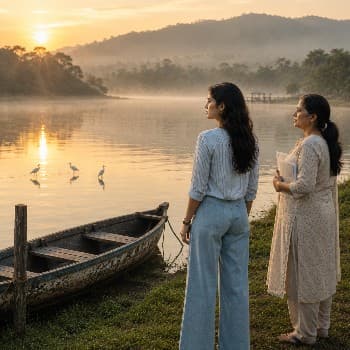

Three days later, a jeep with the "Kadu Retreat" painted on its door pulled up outside Vasanthi's gate.
Meghana was on her own veranda when it arrived, and she watched a man step out — well-dressed, unhurried, carrying himself with the particular ease of someone accustomed to being listened to. Ravikiran, the resort's manager. She had seen him before, at village functions the resort occasionally sponsored, always smiling, always generous with small gifts and larger promises.
He did not smile that afternoon.
Meghana could not hear the conversation from where she sat, only its shape — Vasanthi standing very still at her gate, arms folded, not inviting him in; Ravikiran speaking for a long while, his tone even and reasonable, the tone of a man delivering bad news as though it were good advice.
She caught only a handful of words as the wind shifted."...understand your grief... but after eight years... nothing to be gained... for your own peace..."And then, more clearly, in a voice that had dropped its earlier warmth entirely:"...I would advise you to think of what you still have left to lose, Vasanthi akka."
He left without raising his voice. He left without a single overtly threatening word that could ever be repeated to a police officer. And that, Meghana understood with a chill, was precisely the kind of visit that was designed to be difficult to describe as a threat at all — and impossible to forget as one.
She crossed the compound wall that evening and found Vasanthi sitting very still on her veranda, the rescued papers now in a plastic folder on her lap, dry at last.
"He wants me to stop," Vasanthi said, before Meghana could ask. "He did not say it in those words. He never does. But I have understood men like him for eight years now. He wants me to be a grieving mother, quietly, forever, in a small house by the water — not a witness with a register in her hand."
"Are you afraid?"
"Yes," Vasanthi said simply. "But I was more afraid, for eight years, of the day I might die without anyone ever knowing what really happened to my daughter. That fear is larger than this one."
Meghana sat down beside her.
"Then let's not let it stay only in your hands," she said. "A ledger from an assistant boatman is one man's word, easy to make disappear. But if there is a copy of the original resort register somewhere — the real one, the one that had all fourteen names before it was changed — that is not a story anymore. That is evidence."
"Where would such a thing exist, after eight years?"
Meghana thought of Chikkanna, who remembered everything; of the forest department post near the buffer zone, which logged every boat that entered protected water on the night of an incident, quite separately from anything the resort itself controlled; of the particular, stubborn habit of small government offices to keep old files far longer than anyone expects, in cupboards nobody has opened in years.
"There is one place," she said slowly, "that would have logged the water traffic that night — a place that has no reason to protect the resort, and every reason, if it exists, to still have the paper somewhere in a dusty file. I think I know where we should look next."