


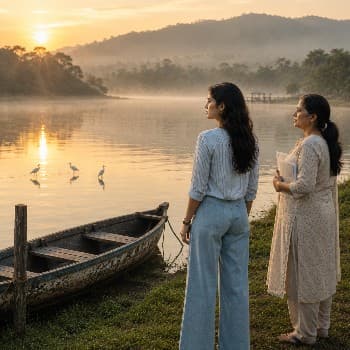

It happened by accident, the way most real discoveries do.
A storm blew in early one evening, sudden and hard, the kind the backwaters produced without warning in that season, and Vasanthi's washing — sarees pinned along a line strung between two trees — was caught in it before she could reach the garden. Meghana ran over to help gather it, the rain already soaking both of them, and in the scramble, a folded cloth bag that had been sitting on the low garden wall, weighed down against the wind by a stone, was knocked open by a sudden gust.
Papers spilled onto the wet grass.
Meghana knelt at once to gather them before the rain ruined them completely — an old habit, quick hands, no thought behind it — and it was only as she pressed them back together, shielding them with her own body from the worst of the rain, that she understood what she was holding.
Photocopies. A photocopy of a passenger register from the resort, dated the night of the accident, listing eleven names. A separate, handwritten list — in a different hand, clearly copied from somewhere else, or remembered and written down later — with fourteen names on it. A newspaper clipping, brittle with age, reporting the inquiry's conclusion: accidental drowning, no negligence found. And a single photograph, this one not turned away — Chaitra, laughing, standing in shallow water, her hair wet, exactly as Meghana had glimpsed weeks before.
Vasanthi appeared at her side before Meghana could fully process what she was looking at. She did not shout. She simply knelt down across from her, in the rain, and gathered the papers from Meghana's hands with a stillness that felt, somehow, more frightening than anger would have been.
"You should not have seen these," she said quietly.
"Is this why you moved here?" Meghana asked. The rain ran down both their faces; it was impossible, by then, to tell what was rain and what was not. "This house looks straight across the water toward the resort's boat jetty. You can see it from your own garden."
Vasanthi did not answer for a long moment.
"For eight years," she said finally, "I have been trying to find someone who was on the resort's staff that night — someone with a conscience, or a debt to me, or simply a reason to finally tell the truth. Two months ago, I finally did. A boy who worked there then, as a boatman's assistant. He is grown now, working elsewhere, ashamed of what he saw and never said. He gave me this register. Fourteen names got onto that boat, Meghana. Only eleven are recorded. The resort erased three names from its own records after the accident — three children who were never supposed to have been on that boat at all, because the boat was already over its licensed number without them."
"I moved here because from this garden, for the first time in eight years, I could watch that jetty every single morning without anyone in the village asking me why I was watching it. I am not hiding from my grief, Meghana. I moved closer to it. There is a difference, though I did not expect anyone to understand it so quickly."
Meghana looked at the papers in Vasanthi's hands, soaked through, the ink already beginning to run.
"What are you going to do with this?"
Vasanthi's eyes, for the first time since Meghana had known her, filled with something that was not quite grief and not quite hope, but stood somewhere uncertainly between the two.
"I do not yet know," she said. "I am only one woman. And they are a resort with lawyers who are paid more in a month than I have earned in ten years."