


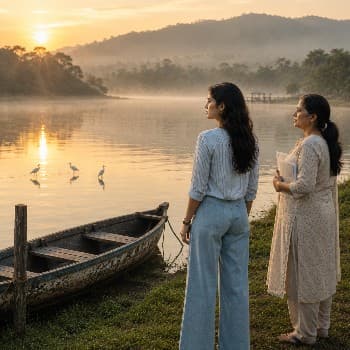

The forest department's outpost near the buffer zone was a small, sun-faded building that most tourists never noticed, tucked behind a screen of bamboo a kilometre upstream from the resort. Meghana had been there once as a schoolgirl, on an excursion, and remembered a heavyset ranger who had shown their class a logbook of elephant sightings with visible pride.
That same ranger, older now, greeted her with mild surprise and, once she explained — carefully, respectfully, with Vasanthi standing quietly beside her — grew very serious indeed.
"Water traffic through the buffer channel is logged every night," he said. "It has always been logged, resort or no resort, because of the elephant corridor. If a boat crossed that channel eight years ago, past midnight, there will be an entry. Whether anyone has looked at it in eight years is a different question."
It took him the better part of an hour, and a stepladder, and a great deal of dust, to find the register from that year. Meghana's heart had begun to beat very fast by the time he set it, finally, on the counter and turned to the date Vasanthi gave him in a voice that did not waver, though her hands, Meghana noticed, were pressed flat against the counter as though she needed it to remain standing.
The entry was there. A single line, in a young ranger's careful hand, logged at 11:52 that night:one resort vessel, "Kadu Retreat," entered buffer channel; passenger count declared to entry post — fourteen.
"Fourteen".
Not "eleven".
The resort's own boat, on the resort's own night, had declared fourteen passengers to a government post that had no reason on earth to falsify a record about elephant corridors — and had then, afterward, when it mattered to their license and their liability, quietly reduced that number to eleven in every document that was theirs alone to control.
Vasanthi did not speak for a long moment. She only reached out, very slowly, and placed one finger against the number fourteen, as though she were finally, after eight years, allowed to touch something that had always been true.
"This is not a grieving mother's story anymore," the ranger said quietly, closing the register with great care. "This is a government record showing a discrepancy against a company's own submitted safety documents. I will have to report this upward. I do not think, Vasanthi akka, that anyone will be able to make this disappear a second time."
He was right. The inquiry that reopened, three months later, moved slowly, the way such things do — but it moved. The resort's licence was suspended pending review. Two names, quietly, resigned from their positions before they could be formally questioned. Ravikiran was not among the first two, but Meghana heard, some months after she had returned to college in Mysuru, that he had not been either.
It did not bring Chaitra back. Nothing, Vasanthi told Meghana plainly, the evening before Meghana left for college, could ever do that.
"But for eight years," she said, "I have been a woman the village quietly pitied and quietly avoided, because grief that does not end makes people uncomfortable. Now, at least, I am a woman whose daughter's name sits correctly in a government record instead of a falsified one. That is not everything. But it is not nothing, either."
Meghana left for Mysuru three days later. She wrote to Vasanthi more often than she had ever written to anyone — real letters, in her own hand, because Vasanthi, she had learned, still preferred them to any phone.
And every time she came home for the holidays after that, the first thing she did, before even unpacking her bag, was cross the compound wall to the small house with the blue window frames, where a woman now sat on her veranda in the mornings not merely watching the water, but sometimes, finally, simply enjoying the sight of it.