


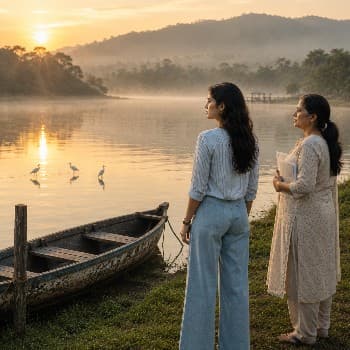

Chikkanna had rowed a coracle on these backwaters for as long as anyone in the village could remember, ferrying tourists across to the elephant camp on quiet mornings and fishermen out to the deeper channels at dusk. He knew the water the way other men knew their own signatures — every bend of it, every season's mood.
He also, Meghana had learned over the years, remembered everything that had ever happened near it.
She found him mending a net near the jetty on a Sunday afternoon and sat down beside him, the way she had done as a child, and asked him — carefully, without quite explaining why she wanted to know — whether he remembered a woman named Vasanthi, who used to live near the old ferry point.
Chikkanna's hands stopped moving over the net.
"Vasanthakka," he said slowly. "Yes. I remember her very well. Everyone in this village remembers her, though most will not speak of it in front of you."
"Why not?"
He was quiet for a long moment, choosing his words the way a man chooses stones to cross a river, testing each one before he puts his weight on it.
"She had a daughter," he said finally. "Chaitra. A good girl, always laughing, always in the water — she swam better than most of the boys her age. Eight years ago, there was a night boat programme at the resort on the far bank — lanterns on the water, tourists, music. Chaitra had gone along with some other village children who had been allowed to help serve refreshments on the boats, to earn a little money."
"The boat she was on capsized in the dark, past midnight, in the deep channel near the forest edge. Three children were pulled out. Chaitra was not among them. They found her two days later, further down the backwaters, near the buffer zone."
Meghana felt something cold settle in her chest.
"The resort said it was an accident. Sudden wind, they said. Overloaded boat, some said, though nobody proved it. There was an inquiry. It did not last long. The resort is powerful in this district, Meghana — it brings tourists, it brings money, it brings people to the market who buy fish and vegetables and rice. Nobody wanted to be the one who closed it down."
"And Vasanthi?"
"Vasanthi did not accept it was an accident. She said the boat had been carrying twice the number of passengers it was built for, that the life jackets given to the children were old and torn, that someone must have known and let it happen anyway to save money on a second boat. She went to the police. She went to the forest department, since the crash happened close to the protected buffer. Nobody listened for very long. Grief, they told her gently, sometimes needs someone to blame."
"After some years, she stopped talking about it in front of people. We thought she had made her peace. Perhaps," Chikkanna said, looking toward the water, "she had not made peace at all. Perhaps she had only stopped telling us what she was still doing."
Meghana walked home slowly that evening, past the wooden boat that never moved, past the compound wall she had thrown stones over as a child, and understood, for the first time, that she was no longer merely curious about her neighbour.
She was afraid for her.