


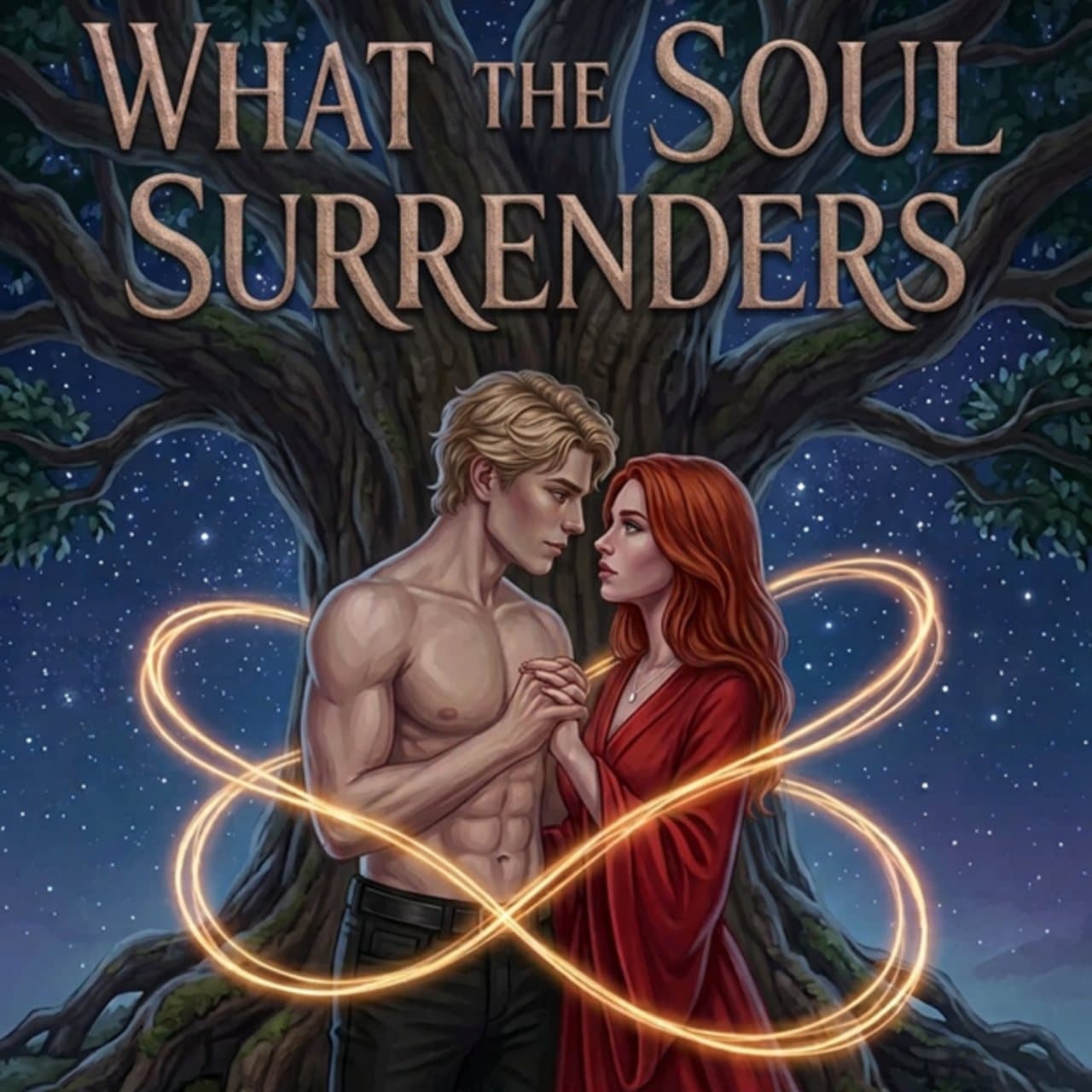

He came at me like a thrown spear.
I had trained for nine nights with Ingrid on a roof terrace, and it was nothing. The roar of the wind was in my ears before I’d seen him move, and his hand closed in the front of my jacket and flung me across the ring of candles like a rag. I hit the roots of the tree and the breath went out of me. I was on my feet again, somehow, with the ring blazing, and I flung up a ward, a flat silver wall of light, and he went through it as though it were water.
I felt it break. I felt every strand of it tear, a hot bright pain behind my eyes, and then he was on me, and the world became a blur of grey and silver and speed.
Damian!
Can’t stop, said the thread of a voice, from very far away. Can’t stop my hands, Sarah, can’t, run...
I couldn’t run. The candles stood in their great silent circle all round us, tall and white and burning straight, and beyond them was only the dark. I threw myself sideways and the flagstone where I’d been standing cracked beneath his boot. I flung up another ward and he shattered it. I tried to think. I had spent two weeks learning to turn a blade and break a grip and be where the blow was not, and all of it was for a man who could not be hit, a man five hundred years old, whose hands, I understood with a sick clarity, had been the gentlest I had ever known.
“Stone him,” called Verrall. He was standing at the foot of the tree with the cup held in both hands, watching like a man at the theatre. “That is what you did to Silas, surely? One word. It would be very easy.”
“Shut up,” I gasped.
“It would end it.”
“Shut up!“
“But you won’t.” He smiled. “Of course you won’t. And so I think we both know how this goes.”
A hand closed round my throat.
It lifted me clean off the ground. It was colder than I remembered, and impossibly strong, and the face above me was not Damian’s at all, the eyes flat silver, the mouth drawn back from long white teeth, a stranger’s face wearing the man I loved. The edges of my vision went dark. I clawed at his wrist. I could not breathe.
“I should explain, Mrs Calloway,” said Verrall, quite gently, “what you are watching. I should hate you to think it wasteful.”
I couldn’t answer.
“This cup holds what is left of Antonia’s potion. My family has kept it for five hundred years. It is only waiting for the bond to break, and for you to become the vessel and drink it. Antonia wished it to have a heart, of course. A pure heart, and it had to be the heart of the boy who brewed it, to make the working clean and turn the whole of the vampire race to stone. No other heart will serve. Alas, his was lost on the night, and the potion cannot be made again. That is why my family has guarded this ruined thing for five hundred years. It is all there will ever be.” He tilted his head. “We have never wished to turn them to stone, Mrs Calloway. A world without vampires is only a world. What my family wanted is a great deal more useful. Leave out the heart, and the working does not destroy them. It commands them. Every vampire on earth, answering to a single hand.”
“And you want the heart’s place filled,” I whispered, with no voice at all.
“I want it finished. Your Mr Ashworth carries the First’s blood in his veins, purer than any creature alive. Antonia put it there herself. It will do very well in the heart’s stead. When the thread between you is cut, and you have drunk, I shall drain him into the cup, and the binding will be whole.” He smiled. “The ultimate weapon, Mrs Calloway. An army that cannot be killed and cannot refuse, and serves whoever holds the cup.”
“But a bond cannot be broken by force, and it cannot be broken by magic. Only by doubt. I do not need him to kill you. I need you to believe, for a single heartbeat, that he wants to. Trust is a thread, and doubt is a very sharp knife.”
The hand tightened.
“Ask yourself what he is,” said Verrall. His voice was low and reasonable and merciless. “A creature of five hundred years. A thing that fed on a girl of nineteen until there was nothing left of her to feed on. That left her in a hospital. That took a woman in an alley, in front of your own eyes, and drank her down like water. Do you think he has ever, in all that time, been anything other than a predator? Do you think there is any part of him that is not, even now, enjoying this?”
No, I thought. No, it’s not...
Sarah.
But I felt it. God help me, I felt it go through me: a small cold thread of doubt, thin as a hair. It slid between my ribs like a needle. A picture came up of an alley and a woman pinned against a wall, her back arched, her mouth open, and a mouth at her throat that was not afraid. I had seen it. I had seen it.
And in the centre of my chest, where the second warmth lived, something went crack.
It was a tiny sound. It was the first line in a sheet of ice. Cold ran out from it in every direction, down my arms, into my belly, and Damian’s voice, from the other side of the silver, faltered, Sarah, don’t, don’t... going out of me one syllable at a time.
“There,” said Verrall softly. “There it is.”
I could see how it would go. In a moment the bond would shatter, and I would be an empty vessel, with the ring on my finger and the soul in my breast, and the work would run, and every vampire on earth would kneel to a man in a grey suit. Ingrid. Lucien. Damian, with his hands round my throat.
I thought of Noah’s face on the screen, the tuft of his hair, the gap in his teeth.
I thought: No.
And I did the one thing in the whole of that terrible night that Verrall had never imagined. I stopped fighting the man who was strangling me. I let my arms go slack. I let my head fall back against his hand, and I looked up into the flat silver eyes, and I said, hoarsely, aloud, through a throat that was almost closed:
“I trust you.”
The hand did not loosen.
“I trust you,” I said again. “I know who you are. I know what you’ve done, all of it, and it doesn’t matter. I’ve seen you hold a deer like it was sleeping. I’ve seen you sit all night in the cold outside a house to be sure a boy was safe. I know you.” I felt tears running into my ears. “I’m not going to doubt you. Not for him. Not for anyone. You’re in there, Damian. I’m coming in.”
I let go of everything. I let go of the ring, and the ward, and my own body, and I went down through the bond like a woman diving into black water.
It was dark.
It was dark and cold, and it smelled of earth and wax and herbs. I was standing on a floor of rough flagstones in a stone cellar with a low roof, and shelves crowded with jars, and a small fire burning low in the hearth, and on the other side of it, hunched over a copper pot, a boy was stirring.
He was seventeen. His sleeves were rolled to the elbow. His hair was fair and untidy and fell across his forehead, flax-coloured, his mother’s, and his hands, ink-stained, shaking, were wrapped around a long wooden spoon.
“Damian,” I said.
He didn’t look up. His shoulders were rigid. “I can’t stop,” he whispered. “I know you’re here. I can hear you. But there’s something standing behind me, and it keeps telling me to put down the spoon and pick up the knife.” His voice cracked. “I don’t want to hurt you. I don’t want to hurt anyone. I only wanted to make something good.”
I looked. Behind him, tall and dark and faceless, stood a shape like a man made of smoke. It had one hand on his shoulder. It was whispering into his ear, over and over, in a language older than Rome. And where its fingers touched, the boy’s skin was black.
I came round the fire and took his ink-stained hand in both of mine. It was warm, for the first time since I’d known him, warm and human, with a pulse in it.
“It’s in my blood,” he said. “It’s what she poured into me. I can’t get it out. It’s me.“
“Then it needs something of me,” I said. I didn’t know how I knew it. It came up out of me from the place where the second warmth lived, simple and certain, the way a hand knows how to find a light switch in the dark. What’s in one of you is in both of you, Nana Flo had said, at a library table, over a single candle. If you know how to open the door.
There was a small knife lying on the table beside the pot, a plain thing with a worn wooden handle. I took it up. I drew the blade across my own palm, deep and clean, and the blood came up black and bright. Then I took his hand, the shaking ink-stained one, and I turned it over, and I cut that too, one quick stroke, and he didn’t flinch. He only looked at me.
I pressed my palm to his.
For a moment nothing happened. Then the blood, ours, mixed, ran down our joined wrists and dripped into the copper pot, and the pot began to glow.
It glowed gold. It was not the purple of the potion he had stirred five hundred years ago. It was the pure bright gold of the bond itself, rising in the pot like a sun, and the light of it went out through the cellar and found the faceless shape behind him, and the shape screamed. It had no mouth, but it screamed. It writhed, and pulled at him, and the boy’s hand tightened round mine, and I felt him straighten. The smoke came apart in long black rags. The gold took it, and burned it, and the cellar was quiet.
“Oh,” said the boy. He was looking at his hands. “Oh, I can feel them. I can feel my hands.”
“I know.”
“Sarah.” His voice broke. “Thank you.”
I came back into my body with a gasp.
The world of the flagstones swung back around me, the candles and the sky and the vast silver tree, and my feet were on the ground. The hand on my throat was gone. My palm was pressed against another palm, slick and warm and red, and I had no memory of the cuts but they were real, and the blood was real, joined between us. The golden thread in the middle of my chest, which had split, was knitting itself back together with a feeling like a slow deep sigh, the crack closing line by line until it was only a bright seam.
Damian swayed.
He drew a breath. It was the longest breath I have ever heard a man take, a huge, ragged, shuddering inhalation, as though he had been underwater for five hundred years. His knees gave. I caught him, with both arms, and the weight of him nearly took me down, and we stood there in the ring of candles holding each other up, with our bleeding hands locked between us.
“Sarah,” he whispered, into my hair. His eyes, when I drew back, were blue. Only blue. They were wet and wild and entirely his own.
“I’m here.”
“I was in there. I could hear you. I could feel everything I was doing and I couldn’t...”
“I know. It’s over.”
“Impossible,“ said Julian Verrall.
He had lowered the cup an inch. His long pleasant face had gone very still. I saw, for the first time, something that was not amusement cross it, and then I saw it harden.
“Well,” he said. “If you will not be reasonable, Mrs Calloway, I shall have to be thorough.” He glanced, almost kindly, at the man in my arms. “Do not think it has set him free, Mr Ashworth. A cup cannot call a river, and the cup is only a cup. It is your mother’s locket that remembers. It was round your neck, you see, on the night Antonia poured the First’s blood into your wound, and it drank every drop that splashed. The First’s own blood, and all its power, lives in that little piece of silver. Five hundred years it sat in my family’s strongbox, and every working we knew was laid upon it: a leash for whoever wears it, and, through the blood, a leash for every creature of his line. You have broken my hold on you. There are a great many more of you.” He smiled. “Come.”
He did not raise his voice. He said it quite softly, in the language that was older than Rome, and at Damian’s chest the locket flared through his shirt, a bright, hungry crimson.
They came.
They came from the stair and over the broken walls, out of the dark behind the tree and down from the fallen masonry, one by one and then by dozens: vampires. Rome’s vampires, every one of them, the old and the young, the grey and the ragged, the ones who had been sleeping in cellars and crypts and the lofts of ruined churches. Their eyes were silver. Their faces were slack and blank. They did not run. They simply walked, in silence, out of every shadow of that hollow, until they had made a wide silent ring around the ring of candles, row on row, two deep, then three, hundreds of them, pale faces in the moonlight, standing quite still.
I saw Ingrid. She stood in the front rank, ragged and half-dead, her coat black with her own blood, her axe hanging from her hand. Beside her, Lucien, one arm limp, his fine suit in ribbons. Neither looked at me. Both were weeping, very quietly, without moving a muscle.
“All of them,” said Verrall, with satisfaction. “Every drop of the First’s blood, within a day’s walk, and a great deal of it was very glad to come.”
“Let them go,” I whispered.
“I think not.” He stepped closer to the candles. “Do you know what I find touching, Mrs Calloway? That you believed yourself the last of the Mother’s blood. That you thought you were the only vessel. How very solitary.” His smile was gentle. “The line runs through daughters, my dear, yes. But the Mother’s gift does not read genealogies. There is a boy on an island in the north with a steady heart, and a small light that came on in his palm the size of a pea.”
I stopped breathing.
“Hallowmere’s walls turn back the dark arts,” said Verrall. “They do not turn back a solicitor with a letter of introduction, nor a boatman who owes me money. A vessel is a vessel. If you will not serve, I am quite certain a boy of eight will do.”
Something broke in me.
It was not the bond. The bond held. It was something older, a thing very deep in me, a thing I had not known was there until that moment. I did not scream. I did not curse. I stood in the circle of the candles with a man’s blood on my hand and a ring of silver-eyed dead looking on, and I said, in a voice so quiet that I scarcely knew it was mine:
“No.”
I looked up at the open sky, at the great white moon, at the vast and silent tree.
“I don’t know who you are,” I said. “I don’t know if anybody’s listening. But I’m asking. Whatever you are, whoever you were, Mother, Antonia, anyone. I’m asking for the power to break this. All of it. Every one of them.” My voice shook. “I’ll do anything you want. But I’m asking.“
The tree answered.
I felt it in the soles of my feet. A long, slow, deep, warm shudder ran up out of the roots and through the stones and into me, and the ring on my finger blazed up white, and every leaf on every branch above me turned over in a wind I couldn’t feel. And with it came a memory that was not mine.
A cellar, on a red moon. A woman on her knees on a stone floor, with a boy lying dead in her arms. Her bare hand, wrapped round the hilt of a knife. The blood running from her torn palm into the wound. The words, low and heavy and without mercy for the one who spoke them.
I knew the words.
I had never learned them. I knew them the way I knew my own name. I took Damian’s bleeding hand in mine, palm to palm, and pressed our joined hands flat against his chest, over the little locket that burned there through his shirt, and I began, in a voice that was not entirely my own, to chant.
It was a low, rolling, ancient cadence, rising and falling like the sea. I did not understand a word of it. It poured out of me like water out of a broken jar, and where it fell, the air began to move. The candles bowed. The leaves of the tree stirred and sang. And through the bond, through our joined hands, I felt my own power go out of me and into him, a great golden tide, the way Nana Flo had taught us at the long library table, what’s in one is in both, and I felt him take it.
“Damian,” I whispered. “It’s yours. Use it.”
He closed his eyes.
I felt him go down into himself. I felt him reach for the deepest, oldest place in his blood, the place where the First still lived, the place that was nearer to the source than any creature alive, and I felt him take hold of it. He was not afraid. He had spent five hundred years afraid of it, and he took it in both hands. My magic went into him like fire into a lamp. And all round the ring of candles, in the still white moonlight, I saw what he was holding.
They were threads. Hundreds of thin silver lines, fine as spider silk, running from the locket at his chest to the throat of every vampire in the hollow, strung through the moonlight like the web of some enormous spider. The leash. I had never seen them until that moment. They hummed. They pulled. And at the other end of each of them was a silver-eyed face I knew or did not know.
Sarah, said Damian, inside. More.
I gave him everything.
The chant rose in my throat like a sob. The ring on my finger sang. And Damian, with my magic in his hands and the First’s blood in his veins, took all the threads at once, every one, and pulled.
They snapped.
They snapped together, with a noise like a thousand plucked strings, and the recoil took Damian off his feet. He was flung backward across the ring like a doll, over the candles and through them, and crashed down on the flagstones twenty feet away. The locket blazed white-hot through his shirt, so bright that the whole hollow leapt out of the dark in a single flash, every face in the silent ring turned stark as bone. Then it dimmed. It went red, and then dull, and then only the grey of tarnished silver. The chain broke. The little thing slid off him and lay glinting among the weeds.
And all around us, the vampires of Rome blinked.
The silver ran out of their eyes like frost in sunlight. They stood where they were, with their hands half raised, and began, one by one, to look about them, like men woken from a long dream.
“No,” said Verrall. “No. It was... five hundred years...”
He stumbled back against the tree. For a moment I thought he would fall. But something held him up: something faint and glassy and quite invisible, that rippled in the moonlight around him like heat above a road.
“You made me watch it again,” said Ingrid.
She had stepped out of the front rank. Her silver eyes were gone. They were grey now, and bright, and streaming, and she was walking toward him through the guttering candles with her axe hanging from her hand and a look on her scarred face that I would not wish on any living creature.
“I...” said Verrall.
“My mother’s face. My brothers. My sister.” She took a step. “I have lived seven hundred years with that, and I had made my peace. I had made it with the earth and the sky and the grave. And you pulled it out of me like a tooth, and you made me look.” She took another step. “And then you made me put my axe in the only man in this world who ever made me laugh.”
“Please,” said Verrall.
Lucien had come up beside her. He had picked up his sword with his shattered hand. All around us, the vampires of Rome had begun to move, slowly, silently, closing in behind her. They did not speak. They did not need to. Hundreds of faces turned toward the man in the grey suit, pale in the moonlight, and I saw him understand, quite clearly, that he had called every one of them here himself.
“Please,” Verrall said again, with his back against the trunk of the ancient tree. “I did it for the Mother. I did it for the work...“
“No,” said Ingrid. “You did it for you.”
She swung.
The axe stopped a foot from his throat. It rang like a hammer on an anvil, a great flat clang that echoed off the broken walls, and a shower of white sparks leapt from the empty air. Ingrid reeled back. She struck again, with both hands, and the blow rebounded in her arms. Lucien’s sword snapped off at the hilt. Vampires pressed in from every side, tearing, clawing, and every one of them stopped short of the invisible thing, as though they had struck a pane of glass.
Verrall began to laugh. It was a thin, cracked, breathless sound.
“This ring on my hand was the Mother’s own,” he said. “Taken from her temple before your Rome was built, and worn by every man of my family since. While it is on my finger, no hand can touch me. Not yours. Not his. Not any of theirs.” His shoulders shook. “You may break my hold on your people, Mrs Calloway. You may not break that.“
Damian had dragged himself to his hands and knees. He crawled across the stones to the edge of the shimmer and struck it, once, with his bare fist, and it threw him back as though he were made of straw.
I looked at Verrall’s hand.
The plain silver ring gleamed there, small and bright, the relic his father had worn, and his father’s father. The clan had no magic. It had only what it could steal. I thought of everything Nana Flo had ever taught me. A thief is only as strong as the thing he is holding.
Ask, said a voice in my head, old and dry and smelling of rosemary. Don’t will it. Ask it.
I turned my palm up. I held out my hand.
“Come home,” I said, to the ring. “Come to me.”
Verrall’s ring moved.
It slid up over his knuckle, quite slowly. He stared at it, and clutched at it with his other hand, and it slid out from under his fingers as though it had never been his at all. It rose like a bird. It crossed the hollow in a long glittering arc and came to rest in my open palm, warm, and humming, and so light I could barely feel it. On my own finger, Nana Flo’s ring woke, and the two of them sang together.
The shimmer around Verrall broke.
It broke like a window, with a sound like a long sigh, and the whole shining shell of it fell away in a rain of tiny sparks. Verrall’s mouth opened. He put out his hands, as though he could catch it. The stolen strength ran out of him like water from a broken jug, and he was only a man, a soft, grey-suited man with his back against a tree and his own death a few feet away.
Ingrid raised the axe.
“Ingrid.”
It was Damian. He had risen, somehow, and come up beside her, grey-faced and swaying, and he laid his hand very gently over hers on the haft. “This one’s mine.”
She looked at him for a long moment. Something passed between them that I will never fully understand, five hundred years and seven hundred, a soldier and a soldier. Then she lowered the axe.
“Then do it properly,” said Ingrid.
“Mr Ashworth,” said Verrall. His voice had gone high and thin and quick. “Mr Ashworth, I beg you. Whatever else, I can still give you what you want. You could still be mortal. The cup, the circle, a little time, I swear it on the Mother...”
“No,” said Damian. “You can’t. You never could. There was never anything in that cup for a vampire but a leash.” He walked toward him, across the thyme and the broken stones, and the vampires of Rome parted to let him through. “That’s the worst of what you did. You found the one thing in the world I would have walked into hell for, and you sold it to me as a lie.”
“Please...”
“I’d have given it all up for her,” said Damian, quietly. “Everything. I’d have given you whatever you asked. But not like this.”
“I...”
“That’s for the boy in the cave.”
His hand went into Verrall’s chest.
It went in like a blade into silk, with the wet crack of ribs parting, and Verrall’s mouth opened on a sound that never came. His eyes went very wide. I saw them find Damian’s face, and I saw him understand, in the last moment of his life, that he had never in all his careful planning imagined that anyone could be so quiet. Damian’s arm drew back. And in his fist, red and shining in the candlelight, still beating, once, twice, a third small time, was Julian Verrall’s heart.
He let it fall.
It dropped among the roots of the tree, and the roots closed over it, and the man in the grey suit slid down the trunk and lay still, with his small startled face turned toward the moon.
Damian stood over him with his hand dripping. He said nothing at all. After a moment Ingrid came and laid her own hand on his shoulder, and Lucien on the other, and neither of them spoke. All round the ring of candles, in the still white moonlight, the vampires of Rome stood with their heads bowed, like mourners at a grave.
I closed my hand round the Mother’s ring. Somewhere in the weeds the little tarnished locket lay where it had fallen, quite ordinary now. After a while Damian bent, very slowly, and picked it up, and held it in his closed fist, and did not say anything at all.
Sarah.
I turned.
Damian had put his hand to the ground. He was on one knee again, swaying. But his eyes were clear and blue, and he was looking at me, and at the ring on my finger, and I saw him understand.
It’s still in the cup.
I looked down.
The silver cup had slipped from Verrall’s fingers as he fell. It lay on its side among the roots, cracked from lip to base, and the last of the dark liquid inside it had run out across the flagstones in a long, shining thread and sunk into the earth, and the great tree had drunk it. All but a single drop. It clung to the rim of the cup, black and bright and quivering like a star.
The ring was singing on my finger.
One drop, said a voice, as plainly as if a woman had spoken, and it was not Nana Flo’s. It was lighter and warmer and quite unhurried. One drop remains. Take it.
“I can’t,” I whispered. “I don’t know what it will do.”
It isn’t his. It was never his. It is yours.
“Sarah,” said Damian, aloud. He had dragged himself across the stones and caught my wrist with a shaking hand. “No. Don’t. We don’t know.”
I looked at him. I looked at the face I had kissed in a firelit room in October, in a cottage at the bottom of the world, five hundred years of love and patience looking back at me out of a wreck of blood and ash.
I know, I said. I know. I’ll come back.
You don’t know that.
I do. I smiled at him across the dark. I promise.
I knelt. I bent my head. And I touched my tongue to the drop.
It tasted of earth, and rain, and very old honey. It tasted of leaves. It tasted of a woman’s breath on a cold morning, and the warmth of a hand in mine, and a name, and a door opening somewhere I had never been.
The light came.
It was not gold. It was not the soft warm light of the bond. It was white, pure and enormous and utterly without edge, a light that did not come from any source, that simply was, and it swept up out of the tree and down out of the sky and I felt the whole hollow disappear. The candles and the ash, Ingrid and Lucien, the silent ring of faces, the broken cup, the moon. I could not see the cellar. I could not see anything. I could only stand in the heart of it, wrapped round, held, as though I had been taken up into the palm of a great and gentle hand.
Damian!
I reached for him through the bond, the way I had reached a thousand times, and found nothing. A wall. A smooth, shining, impenetrable wall of light, and beyond it, faint, a thread of his voice going on and on, calling my name, and I could not hear a word.
I’m here! I cried. I’m here, I’m all right...
The light did not let it through.
And down out of the heart of it, slowly, from the great round eye of the sky above the tree, a figure was descending. Pale, and upright, and quite unhurried, with dark hair loose over her shoulders and a thin white gown that moved around her like water, as though the air itself were holding her up. Her feet did not touch the ground. Her skin was warm as almond wood, her eyes dark and deep and wide, her face the most beautiful I had ever seen, and it was not mine at all. There was nothing of me in it. And yet, looking at her, I knew her at once, the way you know your own handwriting on a page you do not remember writing, the way a hand knows the other hand. It was as though a single soul had been looking out through two faces for five hundred years and had finally, in the light, met its own eyes.
“Hello, little one,” said Antonia. “I’ve been waiting such a very long time.”