



“You are not coming,” said Damian.
He said it for the sixth time that morning. He was standing at the far end of the library with his arms folded, in the pale light of a long window, and he had not sat down once since breakfast. The rest of us were gathered round the table with a map of the Palatine’s lower slope spread out under four coffee cups, beside a rough sketch of a tower that Damian had drawn at dawn and could not bring himself to look at.
“He asked for me,” I said. “Do bring Mrs Calloway. In so many words.”
“That is exactly why.”
“He wants me there. So he’ll have me there, either way, whether I come with you or he comes for me later, alone, somewhere worse.” I laid both hands flat on the table. “I’d rather walk in with my eyes open and the three of you beside me. I’d rather choose the night.”
“Sarah.”
“You can’t go by yourself. You know that. You’d walk down those steps for your mother’s locket and a promise, and he knows it, and that’s the whole bait. I’m not going to let you do it alone.”
He closed his eyes. I felt it through the bond, the long slow ache of a man who wants something so badly that he can’t trust himself to want it, and underneath it, the thing I had begun to know better than my own name: a gratitude so fierce it frightened him.
“I want it,” he said, at last, in a low voice. “All of it. The weeks. And the other thing, to be mortal, Sarah. I have wished for it for five hundred years. I know it’s a lie, and I want it anyway. That’s what he’s counting on.”
“Of course you want it,” I said. “You’re not a fool for wanting it. You’d be a fool to want it and walk in blind.”
“Then tell me how we don’t.”
It was Ingrid who answered. She had her axe across her knees and a whetstone in one fist, and she did not look up from it.
“He is human,” she said. “That is what you must remember. He has no magic. Everything he has, he has stolen, from the Mother’s temples and her stones and whatever relics his family has hoarded. His father wore a silver ring of hers. I would wager the son does. A thief is only as strong as what he is holding.” The whetstone rasped. “So we find out what he is holding. And we take it.”
“And he will be gloating,” Lucien said, from the window, “because he will have what he wants. Damian, standing in front of him, begging for a promise.”
“I wouldn’t beg.”
“You would, my friend. A little. It is all right. It is only for the performance.”
I looked at the map. I looked at the long black line of the stair. “Damian stands in front of him and lets him talk,” I said. “I stay at his shoulder. The bond is the one thing Verrall’s family has never been able to steal, and as long as it holds, there’s nothing they can do to either of us that the other can’t feel coming. Ingrid and Lucien go in through the ruins above. When we’ve seen what he has, they come through the arch.”
“They’ll take whatever guards he’s left,” said Damian, slowly.
“There may be none.”
“There will be some. A man like that always keeps a few.” He opened his eyes. “And if it goes wrong?”
“Then we adapt,” said Lucien, with a faint smile. “It is the whole art of the restaurant trade.”
“If it goes wrong,” I said, “you stay in my head. I stay in yours. That’s all we need.”
He crossed the library. He stopped in front of me, and put both hands on either side of my face, and looked at me for a long moment, as though memorising something.
“I won’t lose you,” he said.
“No.”
“I mean it.”
“I know you do.” I turned my cheek into his palm. “Ten seconds. That’s all it ever takes. We do it together.”
I wrote to Noah once more, while the sun went down. A single paragraph. I told him that I loved him and that I would see him very soon and that the secret to the gravy was marmalade. I folded it into Lucien’s coat pocket myself.
“It will not be needed,” he said.
“I know.”
“I say it again anyway.”
“Thank you,” I said.
We left a little after eleven.
Ingrid drove, in a battered old Alfa Romeo she had borrowed from a friend whose name she refused to give, with her axe across the back seat and her braid pinned flat beneath a black cap. Lucien sat beside her with his sword between his knees. Damian and I sat in the back, my hand locked in his, my coat pulled tight against the night air. Nobody spoke. Damian had hung the locket round his neck that morning, under his shirt, and I could see the thin chain at his collar. Rome slid past the windows, the lit domes and the sleeping piazzas and the last of the late-night trattorias, and after a little while the streets opened out into the long dark oval of the Circus Maximus, nothing but grass and moonlight now where chariots had once run, with the black bulk of the Palatine rising on our left.
The moon was enormous. It hung low and white above the hill, perfectly full, so bright that every pine and every fallen column stood out silver against the dark, and the shadows it threw were as black as ink.
Damian had gone very quiet beside me.
“Stop here,” he said at last.
Ingrid stopped. He got out of the car and stood on the pavement in the moonlight, looking up the slope, and I followed him. Halfway up the hill, a little way back from the road, stood a ruined tower: a broken stump of old brick and older stone, swallowed by ivy and wild fig, with a single dark archway at its foot and a rusted iron gate hanging off one hinge. There were no lights. No guards. The night air smelled of dust and warm leaves.
“Via dei Cerchi,” Damian said. His voice was not quite steady. “I’ve walked this street on the same night every year for five hundred years. Do you know that? I never once looked up. I told myself it was only a ruin.” He drew a long breath he didn’t need. “That’s the cellar, Sarah. That’s where I died.”
I’m here, I said.
I know. His hand found mine. That’s the only reason I can stand it.
The card had said where it began. I understood now that it had been the cruellest sentence in the whole letter.
We went in through the gate together, the four of us, into a ruined yard open to the sky. Fallen stones lay in heaps among the weeds. A dry well stood in the centre, half choked with ivy, and beyond it the black mouth of a stairway went down into the hill. The moon filled the place with a ghostly, bone-white light. The cicadas, somewhere in the fig trees, were singing.
We had gone perhaps ten paces when a voice spoke from above.
“Good evening.”
I looked up. On the broken parapet of the tower, thirty feet over the yard, a slim figure stood against the moon: a good grey suit, a wine-coloured tie, a plain silver ring on his left hand. In the other, held up like a lamp, he carried a small silver cup. The liquid inside it glowed a deep, slow, living red.
“Mrs Calloway,” said Julian Verrall, warmly. “I did say you might bring whomever you liked. I confess I hoped you would.”
Ingrid’s axe came up. “Come down here,” she said, in a voice like a closing door, “and I will split you from your collar to your belt.”
“I’m afraid I shan’t.” He smiled. “May I tell you what’s in the cup?”
Nobody answered him.
“The blood of the First,” he said. “Lucifer. The first of your kind, the one the Mother’s enemies feared. My family has kept it for five hundred years. And do you know, I have always thought it the most remarkable thing about your people? Every vampire on earth is made of that blood. Thinned and thinned down the centuries, carried from one throat to the next, a river passed along in a thousand buckets. But a river, my friends, always remembers its source.”
He lowered the cup. He spoke three words, quietly, in a language older than Rome.
Something rang.
It was a single, deep note, like a bell struck far underground, and I felt it in my teeth and in the bones of my face. The cicadas fell silent. Ingrid’s head snapped round. Lucien made a small startled sound. And in the space of a breath, the colour went out of their eyes, grey and brown alike, and left behind a flat, glittering, metallic silver.
Damian!
He had dropped to one knee in the weeds. His hands were clawed into the earth, and black veins were crawling up his throat and across his jaw like ink in water. His whole body shook. “No,” he gasped, aloud, through his teeth. “No. Not...“
I’m here, I told him, and flung every part of myself across the bond. I’m here. Hold on to me. Hold on.
For a long, dreadful moment nothing happened. Then, slowly, shuddering, the black stopped climbing. His head came up. His eyes were still blue. They were wild, and bright, and terrified, but they were his. And at his chest, through the cloth of his shirt, something glowed a dull ember-red.
“Oh, how touching,“ said Verrall, from the parapet, and for the first time I heard real interest in his voice. “The bond. Of course. It’s the one thing I could never buy.” He tilted his head. “No matter. He will come to me, and the nearer he comes to the blood, the less he will be able to resist. Ingrid, my dear. Lucien. I think you have earned a little amusement.”
“Go,” said Ingrid.
It was hardly a voice at all. She was standing rigid in the weeds, her silver eyes fixed on something I couldn’t see, and tears were running down her scarred face, and her lips were barely moving. “Go. Take him down. I can hold it... a few moments... Go!“
Then her eyes slid, slowly, toward Lucien, and her axe came round.
“Kill each other,” said Verrall, pleasantly, and turned from the parapet, and was gone.
I have never in my life wanted so badly to look away from anything. I couldn’t. I stood in that moonlit yard with my hand locked in Damian’s and watched two of the oldest friends either of them had ever had begin to murder each other.
Ingrid struck first. The axe came down in a flat, whistling arc and took Lucien in the shoulder with a sound like a butcher splitting a joint. He cried out, and his sword was already moving, a bright silver flicker, and it went through the meat of her thigh and out the other side. She didn’t even flinch. She wrenched the axe free and swung again, and he ducked, and the blade bit into a fig tree and stuck. His sword came round in a long cut that opened her side. They went at each other with the full speed of five hundred years of fighting, with a skill born of a thousand sparring matches on the roof terrace of a Roman hotel, and it was horrible, because they knew each other’s every move.
“Ingrid,“ Lucien sobbed, in a high, broken voice, as the sword went in. “Ingrid, I cannot stop, I cannot, forgive me, forgive me...“
“I know,” she said, bleeding, her teeth red, her silver eyes streaming. “I know. Do it quickly, you fool. Do it quickly.“
Sarah. Damian’s voice was a rasp in my head. His hand had closed round my arm like iron. We have to go. I can’t hold it long. If I stay, I’ll be the one to...
I can’t leave them.
You have to. The bond shook with the effort of him. If I’m taken, all of this is for nothing. If I’m taken near them, they die. Please.
So much for the plan, I said, bitterly.
Yes.
I let him drag me toward the stair. Behind us I heard Ingrid’s axe come out of the fig tree, and Lucien’s sword ring on it, and the long cruel music of two friends beginning again. I went down into the hill with the sound in my ears, and it followed me all the way.
It was a long way down. The steps were worn into hollows by feet that had been dust for centuries, and the air grew colder and then, strangely, warmer, and smelled of earth and green leaf and something sweet. Damian was walking like a man wading against a river. Sweat stood on his forehead. The black veins crept up his neck, and receded, and crept again, and every few steps I felt the command come down on him like a hand on a leash, and felt him throw it off by sheer stubborn refusal, and felt what it cost.
Sarah, he said, once. The shelves were here. And the fire there. His voice cracked. I’m standing on the spot. I can feel the floor.
I put my hand back without turning, and his fingers closed round mine, cold and shaking.
Ahead of us the passage ended in a ragged arch, and beyond it, light.
The cellar had no roof. Time had taken it, and the walls too, on the western side, so that what had been a cramped stone room was now an open hollow in the hill, ringed with broken masonry, with the whole night sky pouring down into it. Rotted shelves leaned against the east wall. Shards of old jars glittered in the weeds. And in the middle of the floor, its roots buckling the ancient flags and its trunk climbing up and up out of sight, stood the tree.
It was the tree from the dream.
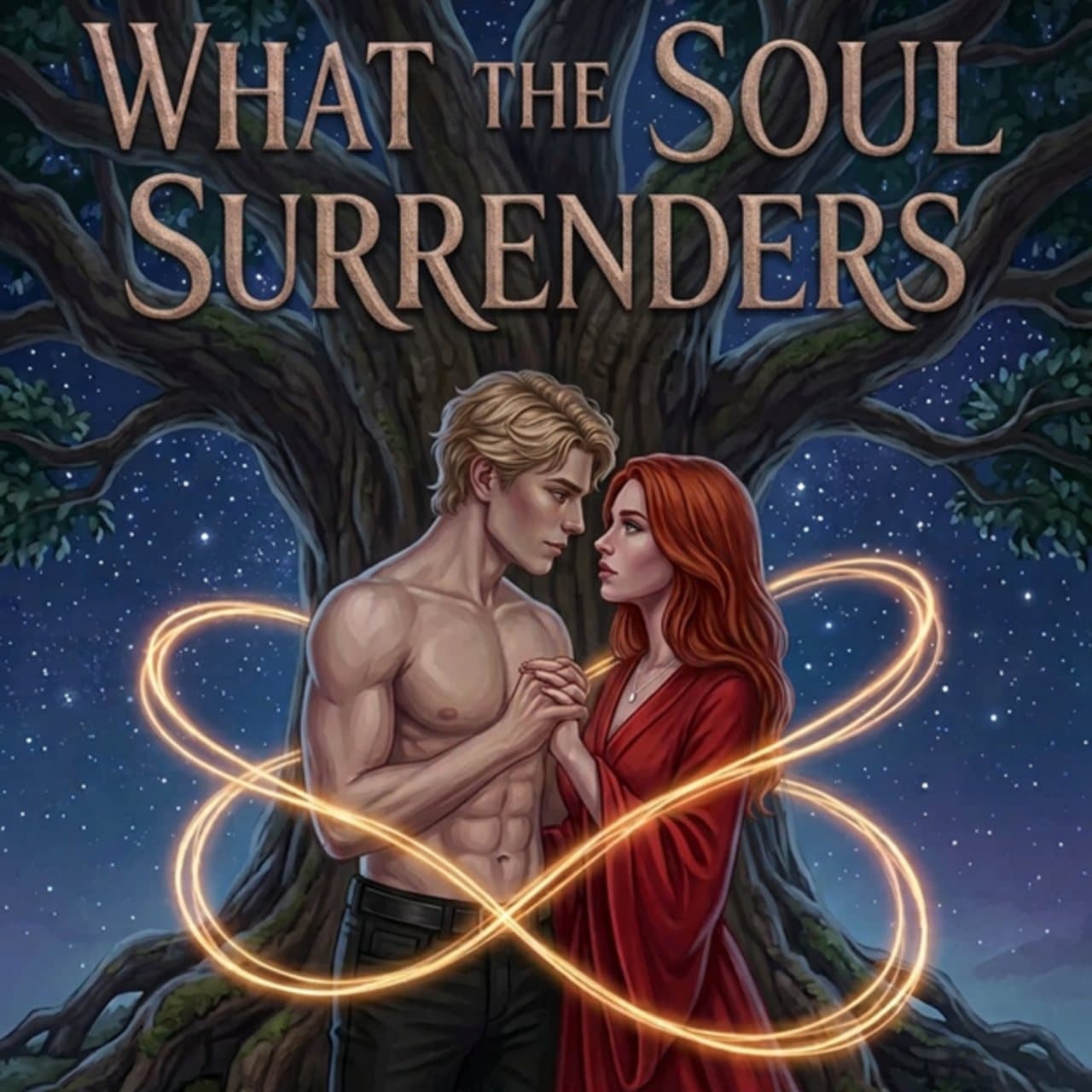
It was broader than any tree had a right to be, a great grey-silver trunk twisting up into a crown of branches that spread out across the sky like a roof, and every leaf glittered faintly in the moonlight as though it had been dipped in frost. The air around it hummed. When I looked at it I felt something deep in my own chest answer, slow and warm, and for a moment I could not breathe.
Eternal, I thought. The word arrived in me whole, as it had in the dream.
Around the tree, on the flagstones, stood a wide ring of white candles, hundreds of them, burning straight and still. And within the ring, among the roots, with a silver cup held lightly in both hands, stood Julian Verrall.
“There is a shorter way down,” he said, “for those who know the house.” He smiled at me, and then, slowly, at the man beside me. “Mrs Calloway. Mr Ashworth. You’re early. I did hope you would bring your friends.” His eyes went, with faint regret, to the stair behind us. “I’m afraid they are rather occupied.”
“Where is it?” said Damian. His voice was a thread. “The record. What did they do to me? And the other thing. What you promised...”
“I did. And you shall have it, Mr Ashworth. I am a man of my word, in a manner of speaking.” He raised the cup. “Do forgive me. I did not intend to be unkind. It was only that I wanted all of you here. Every one of you who carries the First’s blood. A river, you see, needs a good deal of listening to.”
Damian made a sound I had never heard from him. A low, animal moan. I felt the command come down on him, not like a hand, now, but like the whole weight of a mountain, and I felt the last of his strength go out of him in a single breath. His head dropped. The black rose through his skin like a tide. When he lifted his face, his eyes were silver, flat and glittering as coins.
Sarah, said a thread of a voice, from very far away, inside me. Sarah, I’m sorry, I’m sorry, I’m...
“Mr Ashworth,” said Verrall, softly. “Do step into the circle.”
He went. He walked across the flagstones and over the line of candles as though pulled on a string, and I went after him, because I could not do anything else, my hand reaching for his sleeve and finding only air. The candles did not so much as flicker. I stood inside the ring beside him, in the open, with the great silver tree above us and the moon in the sky and nothing at all between us and Julian Verrall but a few yards of thyme and stone.
“Your guest has arrived,” said Verrall, gently. “Kill her.”