



Snow had come early to Hallowmere.
It lay thick along the shore and soft on the roofs of the long grey school, and the lake beyond the wall, which Noah had written to us was the colour of tea, had gone the colour of pewter under a sky heavy with more. From the deck of the little black boat I could see lanterns strung along the water’s edge, hundreds of them, gold against the blue dusk, swaying in the wind like a low bright tide. Somewhere behind the stone wall a bell was ringing.
“You’re doing it again,” said Damian, beside me.
“What?”
“Going somewhere I can’t follow.”
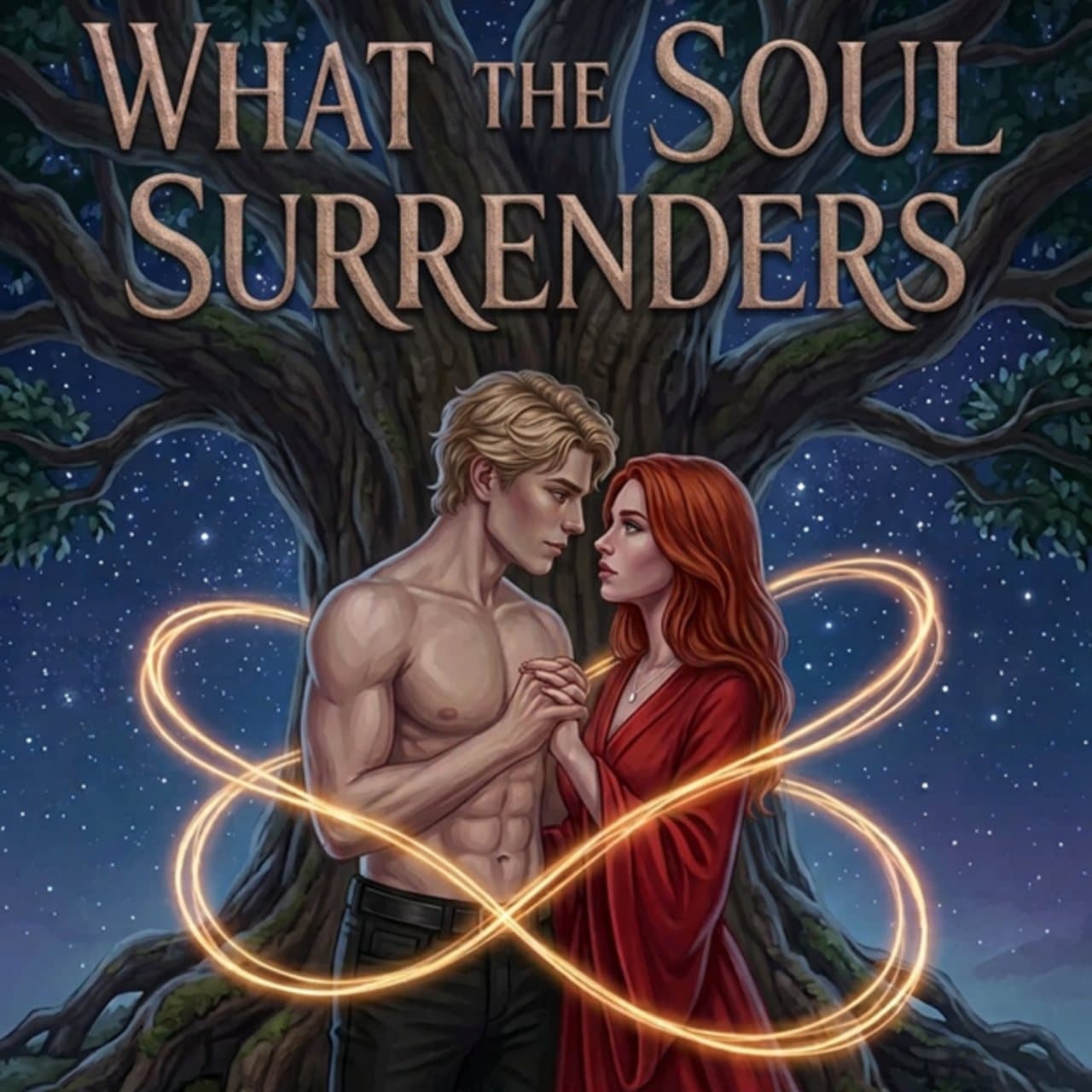
I turned my face from the lanterns. He was standing very close, in a long dark coat with the collar turned up against the wind, his hands in his pockets, his hair already frosted white at the tips. In the grey light his eyes were a clear, patient, careful blue. They had been careful with me for more than two months.
“I’m here,” I said.
“I know you are.” He smiled, a little crookedly. “Only it’s the third time since London.”
I leaned against his shoulder, and he put an arm around me, and for a while we said nothing, and the boat rocked over the dark water toward the shore.
It had been eleven weeks since the night of the full moon.
I had come back, as I’d promised. I don’t remember the moment of it. I remember the white light thinning, like mist off a river, and the sound of my own name said over and over in a voice I knew better than my own, and then the cold flagstones under my cheek and the smell of burnt wax and a pair of arms around me, shaking, bloody, impossibly gentle. Damian had crawled to me across the broken floor. He had lifted my head into his lap and was saying Sarah, Sarah, Sarah in a cracked, scraped whisper, as though he’d been saying it for hours.
“How long?” I’d managed.
“Four minutes.” His voice broke on it. “It was four minutes, and it was the longest of my life.”
Ingrid and Lucien were already beside us by then, on their knees in the ruin of the hollow, ragged and bleeding and alive. Lucien’s hands were wrapped in strips torn from his own shirt. Ingrid had a long gash down one cheek that would scar. She looked at the tree and the broken cup and what was left of Julian Verrall, and said, flatly, in a voice that shook only a little, “Well. I suppose it is over.”
It was. I had not understood how completely until the morning.
The tree, when the sun came up, had dropped every leaf. They lay across the ancient floor in a silver drift, soft as ash, and the great trunk stood bare and quiet against the sky. It looked, Damian said, like something that had finally been allowed to sleep.
He had asked me about it, of course. He had asked in the car, and in the castello, and in the long dark hours of the night when neither of us could sleep. He had asked on the plane, and on the train, and on the long cold crossing from the mainland. What did she say? What happened in there? What did she do to you?
I had never managed to answer.
It wasn’t that I didn’t want to. It was only that when I opened my mouth, the words fell apart like wet paper. What I could say, at the very most, and what I had said, over and over, was this: She gave me her power. She gave it up, Damian. Willingly. She said I was meant to have it.
It was true. It was true, and it was nothing like the whole of it. The whole of it did not fit into words.
I think I could only tell it to myself.
***
It had not felt like falling, in the light.
It had felt like standing at the edge of a very great warm sea, with the water to my knees and the sky all around me, and no sound, and no time. The white light stood on every side. It did not hurt my eyes. And in front of me, a little above the ground, with her bare feet hanging in the air and her loose dark hair stirring in a wind I couldn’t feel, stood a woman I had last seen weeping on a cellar floor.
She was older than I had thought. Not in years, but in some other way, in the long, patient quality of her eyes. They were dark and wide and very tired, nothing at all like mine, and yet I could not look at them without feeling the floor of myself shift. They were the eyes of someone who had been waiting a very long time, and had finally stopped being afraid of the ending.
“Hello, little one,” she said again. “Don’t be frightened.”
“I’m not,” I said. And, to my surprise, it was true.
She smiled. It was a rueful, tender, crooked smile, nothing like any smile of mine, and I knew it the way I knew my own heartbeat.
“I wanted to say sorry,” said Antonia. “That’s the first thing. I have had five hundred years to think what I would say to you, and I find it comes to that. I am sorry. For what was done to the women who came before. For what was done to you.”
“It wasn’t you.”
“It was my work.” She lifted her hand, and I saw, in the light, a long white scar across her palm, the scar of a knife drawn once through the flesh in a cellar on a red moon. “I made something terrible, and then I loved something I could not bear to use it on, and between those two things the whole world went wrong. It is the oldest story there is. I should have known it from the beginning.”
I said nothing. The white light moved gently around us.
“I thought it would be mercy,” she said, at last. “The stone. I thought if I turned them all to quiet, every one, the ones that tore and the ones that hunted, there would be an end to it. The war. The graves.” She shook her head. “My mother was the Mother herself, Sarah. She does not age and she does not die, and immortality was a power too great for any creature to hold. It leaked out of her hands down the centuries, like water running downhill, and it flowed into monsters, into every hungry thing that could take it. The vampires should never have existed. That is still true. But I was raised among things that do not end, and I never learned what an ending costs. I believed that you can end a thing by destroying it. I did not understand that the world is full of the strange, and that it has always been full of the strange, and that cruelty does not live in fangs or in spells. It lives in whoever decides that they alone have the right to say who is allowed to live.”
“Marcus.”
“Marcus. His fathers. All the ones who held the truth in their hands, and the power, and called it a duty.” Her mouth twisted. “They were never the Mother’s servants. They were only men who had found a door and decided they were the only ones entitled to walk through it. Of all the monsters I have ever known, they were the worst. They did not even have hunger for an excuse.”
“And they found a way to make my work serve them,” she said, more quietly. “That is the part I cannot forgive myself. I made it to end monsters, with a pure heart and a pure intention, and I thought that if it were ever stolen, it would only fail. I never dreamed that anyone could take what I had made and simply leave out the heart. They did not need to change a word of it. Take the heart away, and what I built to free the world of its monsters becomes a leash to hold them. It is the cruellest thing I have ever heard. And it was my own work.”
I thought of a man dying in a ring of golden roots, smiling. I thought of a quiet grey suit and a very neat voice. I said, quietly, “I know.”
“I know you do.” Her eyes softened. “And that is why it is you.”
She came a step closer. It was not walking. It was more as if the light itself leaned toward me, bringing her with it.
“There is a thing I must tell you, Sarah, and I want you to hear it plainly. I loved him.”
My heart turned over. “Damian.”
“I loved him, in the only way I knew. As the sun loves the ground it cannot touch. He was a boy with ink on his hands who made me laugh in a house where nobody laughed, and I taught him, and I let myself believe it was only teaching. I could not bring myself to cut him. And on the night, when the others came and the knife went in his back, I knew what I had lost. And I gave everything to bring him back.” She breathed out. “But I did not give him what you gave him. I could not. I did not know how. I was not born to be loved by anything but a purpose.”
“That isn’t true.”
“It is, a little.” She smiled, gently. “I gave him a life. You gave him a home. I could never have given him that. It was never mine to give. It was always going to be yours. A woman who had been so long alone that she knew exactly what it cost, and what it was worth. It had to be you.”
I was crying. I hadn’t noticed. The tears simply ran, warm and slow, and fell into the light.
“So I give it up,” said Antonia. “All of it. My power, which you already carry, in the ring and in your blood. My life, which is in the tree. My love, which belongs to you, and always did. I give it freely. I am tired, little one. I have been a long time between worlds, and I should like to go.”
She put out her hand, and laid it, very lightly, against my chest.
I felt it. A warmth like the warmth of Nana Flo’s gift, only vaster, older, deeper, and it poured into me and settled, quite gently, like a bird folding its wings. Something that had been waiting in me for thirty-five years clicked softly into place. I felt the ring grow still and quiet. I felt the second warmth, the old one, the one that smelled of rosemary, rise up and meet the first, and the two of them twine together, and I knew that nothing, not even this, would ever take her from me.
“There,” said Antonia. “Now it is whole.”
And then she showed me the drop.
It was still on my tongue. I had not swallowed. It sat there, bright and small and humming, and I understood, without being told, that I held in my mouth the last thing she had ever made. It was a single drop of the potion she had begun five hundred years before, and in the light I could feel what it was: not the leash they had made of it, but what she had first meant it to be, clean again. There would never be another. It had needed the tree’s bark, the First’s blood, and the pure heart of the very boy who brewed it, and all three were spent. It was enough to kill every vampire in the world, in a single breath. It was enough to make every one of them stone.
It was also enough, if I chose, to make me live forever.
“It is yours,” said Antonia. “I will not tell you what it should be. That is the only thing I cannot give. I can only say that I was wrong once, and I paid for it, and I would not have you pay.”
“If I choose the stone...”
“Then it is done. Every one. The ones who were cruel, and the ones who were not. Ingrid. Lucien. The nurse, the priest, the physician, if they had lived. And Damian.” Her voice did not change. “I would never ask you to. I only want you to know that it is in your hand.”
I thought about it. I want that to be understood. I did not choose quickly, and I did not choose lightly.
I thought of the pool block. I thought of the cave. I thought of every fear I had ever had, and every night I’d lain awake with my son’s breath on my shoulder, wondering what would come out of the dark. I thought of what the vampires had done, a thousand times over, to people who had not deserved it. I let the whole weight of it settle on me.
And then I thought of Ingrid, kneeling in a dry courtyard, screaming her sister’s name. Of Lucien in the garden of a grave. Of a girl in a gym doorway, with a shawl pressed to her throat. Of an old woman dying with a joke about marmalade on her lips. Of a man who had been alone for five hundred years and had spent the whole of it refusing to become the thing he feared.
“No,” I said.
“No?”
“No. I won’t do it.” My voice was steady. “I won’t kill a world because I’m frightened of it. That’s what Marcus would have done. That’s what you did, once. I won’t.” I swallowed. “The monsters aren’t the ones with fangs. You said it yourself. They’re the ones who decide that they’re the only ones who are allowed to be.”
Antonia smiled. It lit her whole face.
“That’s the answer,” she said softly. “That is the whole of it.”
“Then there’s only the other thing.”
“Yes.”
I looked down at my hands. I looked at the ring on my finger, quiet now, like a sleeping star. I thought of Noah, and the long cold lake, and the stone grown warm in his palm. I thought of a man on a jetty at the end of the world, saying even if it’s centuries.
I thought: I will outlive everyone I love, except him. I thought: it will cost me. I thought: it’s worth it.
I thought of a man on the edge of a bed in the moonlight, with a locket in his hands, who had been ready to walk into a trap, and give up every one of his five hundred years, and be nothing but mortal, for the chance to grow old beside me. He had been willing to give up everything. How could I do less?
“I’ll live,” I said. “I’ll stay. For him. For Noah, as long as he needs me, and after that for the rest. I’ll learn how to do it properly. I’ll learn how to carry all of it.” I looked up. “And I’ll make it count.”
“Wisely chosen,” said Antonia.
She drew back, very slowly. The light began to thin around her, soft and gold at the edges, and I saw her face change, not into something else, but into something simpler: a girl with dark eyes standing at the edge of a stone cellar, with a wooden spoon in her hand, laughing.
“Tell him,” she said, and her voice was already far away. “Tell him I was proud of him. Tell him I’m sorry about the heart. And tell him...” She hesitated, and smiled. “Tell him that I’m glad it was you.”
I swallowed the drop.
And the light let me go.
***
I gave him only what I could carry out of that light in words.
I told him, that first night, in the library of the castello, with a blanket round my shoulders and my head on his chest, the three things Antonia had asked me to say. That she was proud of him. That she was sorry about the heart. That she was glad it was me. I got through the first two steadily. At the third he put his hand over his mouth, and I felt it go through the bond, a long slow collapse of something he had braced against for five hundred years, and he cried, silently, in the way of a man who has forgotten how and is doing it anyway.
“She said she was proud of me,” he whispered, finally.
“She did.”
“I wasn’t sure. I’ve been wondering for five centuries.”
“I know.”
Then I told him the rest. I told him about the drop on my tongue, and the choice that had lain in it, and what I had refused, and what I had chosen. That I had chosen to live. That I would not grow old. That I meant to stay beside him for as long as there was a beside to stay in.
He went very still. I felt it through the bond, a long, slow tide of something too large for words, and for a while he did not speak at all.
“You’re sure,” he said, at last, hoarsely.
“I’m sure.”
“You’ll outlive everything. Everyone. You know that.”
“I know.” My own throat was tight. “I’ll have to say goodbye to them. One at a time. I’ll learn how.”
“I would have understood,” he said, “if you’d chosen the other way. I want you to know that. I’d never have asked you to carry it.”
“I know you wouldn’t.”
“But I’m glad.” His voice broke. “God forgive me, Sarah, I’m so glad.”
“You’d have given it up for me,” I said. “All of it. If that card had been true.”
“In a heartbeat.”
“I know. That’s why I’m doing it the other way round.”
We agreed that night that nobody else would be told. Not yet. Not Noah, who was seven, and would be eight, and was not ready for arithmetic of that kind. Not Ingrid or Lucien, who would only look at me with that terrible gentle understanding of people who have already buried most of the world. It was ours. Damian’s and mine. A secret kept the way you keep something warm in your hands, until you are sure you are ready to open them.
***
The boat slid up alongside a small stone jetty with a soft bump, and a boy of about seventeen in a green jumper caught the rope and made it fast with great professional dignity. Beyond him, the shore was thick with people.
It was the last feast of the year. They called it the Longest Night, and it was the one night of the twelvemonth that Hallowmere came out of its walls. There were long trestle tables set up along the water’s edge, under hundreds of swaying lanterns, loaded with roast meats and steaming dishes and baskets of bread. There were bonfires. There were children everywhere, in green jumpers and ridiculous woollen hats, shrieking in the snow. And among them, standing in careful, quiet knots at a respectful distance from the wall, were their families: witches and warlocks and a great many people I could not have described at all, and one or two who, I thought, glancing at the pale gleam of their eyes in the lanterns, were not entirely living.
“Many of the children have a parent who can’t cross the gate,” Miss Hale had told me, a month ago, in a letter with a very beautiful hand. “For one night, we come out to meet them. It is the oldest custom the school has.”
I had read it three times. And then I had put it down and gone to find Damian, and I had not been able to speak.
He had stopped at the end of the jetty.
I felt it through the bond, before I saw him. A long, slow shiver of feeling, like a held breath. He was looking up at the gate in the old stone wall, a hundred yards away, and at the crowd, and at the children running, and I knew what he was looking for.
“Go on,” I said, quietly. “He’ll come.”
“I told him I’d be here.”
“You are.”
“I told him,” said Damian, in a thin voice, “that on the day he walked out of that gate for the first time, I’d be standing on this jetty. I’ve thought about it every day for four months. I thought I’d have a speech.”
“Do you?”
“No.”
“Good,” I said. “Neither do I.”
The gate opened.
I saw him before he saw us. A small figure in a dark green jumper, with a woollen hat jammed over his ears and his hair sticking out beneath it, running. Not walking. Running, the way only a seven-year-old, an eight-year-old, can run, all knees and elbows and utter, headlong, ridiculous joy. A girl with a wild black cloud of curls was pelting after him, shouting something about a goose. A very large grey bird was bringing up the rear, wings spread, honking.
“Mum!“ His voice carried over the whole shore. “Mum! Damian! DAMIAN!“
Damian made a sound I had never heard him make.
He went down the jetty like a man falling. Noah hit him at full speed, knocking the breath out of him, and Damian caught him, swung him up, held him so hard that I saw Noah’s boots leave the ground. The two of them stood there in the snow with their faces pressed together. Neither of them could speak. It didn’t matter. I was running too, then, with the snow spraying up round my boots, and I flung myself into both of them, and the three of us stood on a jetty at the end of the world and wept.
“You’re here,“ said Noah, into Damian’s collar, in a muffled voice. “You came. You said you would and you did.“
“I said I would.”
“You said even if it was centuries.”
“It was only four months.”
“It felt like centuries.“
“It did,” said Damian, and laughed, and his voice cracked clean down the middle. “It really did.”
I pulled back at last to look at my son. He had grown. It was impossible, in four months, but he had: an inch in height, a new line in his jaw, a ring of ink on his thumb. His eyes were clear and bright and very much his own. He grinned at me, with a gap where a tooth had been, and I thought my heart would simply stop.
And behind the joy, small and quiet and entirely sweet, came the other thing, the thing I had chosen and would go on choosing. One day that gap-toothed boy would be a man, and then an old one, with silver in his hair and my own eyes in a lined face, and I would still be standing beside him looking thirty-five. I would hold his hand at the very end. I would learn what it was to sit in a room after the last of him had gone out of it, and carry on. It would hurt in ways I could not yet imagine. But he would have a mother who stayed for every single day she was given, and when the days were over I would carry every one of them with me, for as long as there was anyone left to carry them. It seemed to me, kneeling in the snow, a fair price for being allowed to love him at all.
“Look,” he said. “Look what I can do.”
He held out his hand, palm up, and closed his eyes, and screwed up his whole face. For a long moment nothing happened. Then, in the centre of his palm, very small and very bright, a tiny ball of golden light appeared, the size of a pea. It wobbled. It bobbed. It lasted three whole seconds, and then went out with a soft little pop.
“I did it!” he shrieked. “I did it, I did it, I did it! That’s my first one! Miss Hale says it’s a very good first one! Wren’s still cross about it!”
“I am not,“ said the girl with the curls, from a safe distance, going slightly pink.
“It’s brilliant,” I said. My voice shook. “It’s the most brilliant thing I’ve ever seen.”
“It’s only little.”
“It’s the best little one in the world.”
He beamed. And then, from somewhere behind us, a voice said, in tones of the greatest possible dignity, “I do not wish to interrupt, but I believe somebody has forgotten his uncle.“
“Uncle Lucien!“
Noah flung himself across the snow. Lucien, who had been standing in a magnificent fur-collared coat beside a very tall woman with a scarred cheek and a battered axe slung over her shoulder, caught him with one arm and lifted him into the air. His hands, I saw, were whole again, though the tips of the fingers were pale and shiny. He was laughing, and also, quite unmistakably, trying not to cry.
“Auntie Ingrid!” Noah shouted, wriggling free.
Ingrid took one step backward.
“I am not,” she said, with immense severity, “an auntie.“
“Yes, you are.”
“I have been a great many things in seven hundred and nine years. I have not been an auntie.”
“You’re my auntie,” said Noah, firmly, and wrapped both arms around her waist.
Ingrid stood perfectly rigid for the space of three breaths, with her arms held stiffly out from her sides as though she’d been handed a live grenade. Then, slowly, as if it cost her something, she lowered one hand and set it on top of his woollen hat.
“Hm,” she said. “Very well.”
Lucien was weeping openly into his handkerchief.
They had been with us for two months, the pair of them, as constantly as a pair of loyal and very unconventional dogs. They had not gone back to their old lives right away. They had stayed at the castello through the first long weeks of healing, Ingrid sharpening, Lucien cooking, the three of us sitting in the library every night talking about nothing at all. And then, one evening at the beginning of November, they had gone, back to the restaurant on the Via Giulia, and the little northern town where Ingrid kept a boat. They telephoned every day.
“We have a plan,” Lucien had announced over the speaker, in the voice of a man unveiling a work of art. “A tour. The summer, when the boy is on holiday. We will go to the Via Giulia and eat. We will go to the fjords, so that Ingrid may show him the boats. We will go to Paris and to Athens and, if he is very good, to a place I know in Naples where they put the cheese on the outside.“
“A tour,” said Damian.
“A grand tour. The five of us.”
“Five?”
“You, the witch, the boy, Ingrid, and myself. It is a very good number. It has symmetry.” There was a pause. “Also the boy has already agreed.”
He had. Noah had written, in the margin of a letter, in enormous capitals: UNCLE LUCIEN SAYS WE CAN GO TO ITALY AND EAT CHEESE. I SAID YES. PLEASE SAY YES.
We had said yes.
***
The feast went on for hours.
I remember it as a blur of light and warmth and noise. I remember Miss Hale, silver-haired and straight-backed in her heather coat, coming across the snow to shake Damian’s hand with the grave, level courtesy of a woman who has known many things and was prepared to be surprised by a few more. I remember a great many round-eyed children, who had been told that Noah’s father was a vampire and who wished to see for themselves. I remember Ewan, a small, solemn boy with a newt in his pocket, who informed Damian that Gerald did not like strangers and then, to everybody’s surprise, allowed himself to be held. I remember a long table, and a great steaming dish of roast lamb, and, ladled over it, thick and dark and sweet, a gravy that made me stop with my fork halfway to my mouth.
“I made it,” said Noah, with enormous pride. “I got Cook to let me. It took me ages. Is it right?”
I tasted it. I couldn’t speak.
“It’s right,” I managed, at last, thickly.
“It’s got the marmalade in.”
“I know,” I said. “I can taste it.”
He grinned, and went back to his plate, and under the table Damian’s hand found mine and held on.
Over the roast lamb, Damian took a small tarnished locket from inside his coat, and without a word opened it and set it in front of Noah. Inside, under a speck of cracked glass, lay a curl of hair as pale as flax and a painted face no bigger than a thumbnail: a girl, hardly more than a child, with a small stern mouth that looked as though it were trying very hard not to laugh.
“She looks like you,” said Noah at last, with the grave attention he gave to sums. “When you’re trying not to laugh. And she’s got your hair.”
Damian had to look out at the lake for a while.
The rest of the record he had found in the pocket of Verrall’s coat before we left the hollow: a thin bound ledger in a dozen faded hands, every page of the weeks he had never been able to remember. He had read it, in the end, all of it, in the library of the castello, in the week after, with the lamps turned low and my head on his shoulder, and he had told me what it said in pieces over the days that followed, the way you carry something heavy up a stair.
It was mostly Silas. Silas, young and bitter and gloating, writing in a spiky hand to anyone who would read it, about the boy they had found on the floor of a cellar. How the Mother’s girl had been so strong that she had taken the First, Lucifer himself, the oldest of their kind, and bled him dry, every drop, until he stood in her cellar as stone. And how she had spent it all, the whole of the first vampire’s blood, on a worthless apprentice. A boy. A kitchen-boy. She poured a god into a boy. They had taken him up into a cave in the hills while he changed, and kept him seven days, and drawn his blood as he turned, measure by measure, to see what it was that she had made. He calls for his mother, Silas had written, on the fourth. We have given him nothing. It is not yet finished.
“I thought I’d feel something,” Damian told me. “Anger, perhaps. I’ve carried it for five hundred years, not knowing what it was for.” He shook his head. “I only felt very sorry for the boy.”
He hadn’t thrown the ledger away. He kept it in the drawer of the nightstand, and from time to time, in the evenings, he would take it out and read a page, and put it back. “It’s mine,” he said. “All of it. It’s the worst week of my life, and it’s the week I became who I am. I would rather have it than not.”
It was a little before midnight when the bonfires burned down and the children were gathered into sleepy heaps, and the lanterns on the shore began, one by one, to be put out. Damian touched my elbow.
“Walk with me?”
“Of course.”
We went down along the edge of the lake. The snow was thick under our feet. Out on the dark water, a single lantern floated, small and gold, drifting slowly from the shore. Far above us the sky had cleared at last, and the stars hung in it in their thousands, sharp and cold and impossibly bright.
Damian had been strange all evening. I had known it from the first moment, from the minute we stepped off the boat. It had come to me through the bond, in small flickering pieces: a nervousness, a jittery, hopeful, humming kind of dread, and underneath it, whispering, rehearsed sentences in half a dozen languages. Latin. Old French. A very old kind of Norse. I had tried, very hard, not to listen. I had failed completely.
He stopped at the end of the little stone quay.
He turned to face me. His hands were in his pockets. He took them out, put them back, took them out again, and I felt the whole bond tremble with the effort it cost him to keep his face still.
“Sarah,” he said.
“Yes?”
“I have something I’d like to say.”
“Have you?”
“I’ve been practising.” He was very pale. “I’ve been practising for three weeks. I have a speech. It’s in four languages, and I’m quite certain the Latin is perfect. I had it all worked out, the lake, the stars, the snow.” He drew a breath. “And now I can’t remember a single word of it.”
“Damian.”
“I’ll start again. Sarah, I...”
“Yes,” I said.
He stopped. “I haven’t asked yet.”
“I know.”
“I haven’t even got to the part where I kneel.”
“I know that too.” I couldn’t stop smiling. “You’ve been rehearsing it in the shower, in French. You practised the Norse on Ingrid. She told you the vowels were a disgrace. And there’s a ring in your left coat pocket, wrapped in a handkerchief, that’s been there since the airport, and you’ve been checking it every eleven minutes.”
He stared at me.
“The bond,“ he said.
“The bond.”
“You’ve known all along.”
“Since London.”
“And you let me practise.“
“You looked so earnest,” I said, and my voice broke on it. “I couldn’t bear to stop you.”
For a moment he simply stood there with his mouth open. Then he threw back his head and laughed. It was a great, helpless, wholehearted laugh, the laugh of a man who has been waiting five hundred years and has just been beaten to the post, and it rang out over the frozen lake and startled a flock of ducks off the far shore. When he had finished, he wiped his eyes, and dropped to one knee in the snow, and took a small handkerchief out of his pocket, and unwrapped it.
The ring was very old. A plain band of silver, worn thin with time, with a single pale stone set in it that caught the starlight and gave it back, soft and clear as water.
“It was my mother’s,” he said, quietly. “I kept it in a box for five hundred years, and I never once thought I’d have a reason to take it out of the box.” His hands were shaking. “I don’t have a speech. I don’t have anything, really, except...” He swallowed. “You gave me a home, Sarah. You gave me a heart. I’m not sure there’s anything left in the world that I want except to spend every day of every year of every century I’ve got with you. Will you marry me?”
“Yes,” I said.
“I’d like it noted that I did ask.”
“Noted.”
“Properly.“
“Very properly.”
He slid the ring onto my finger, beside Nana Flo’s. They sat together, the old silver and the new, a small storm and a small star. Then he rose and took me in his arms, and kissed me, and it was slow and tender and endless, with the snow coming down again, soft and white, between the stars and the dark water. I felt the bond open wide between us, the whole bright impossible length of it, and I felt his joy, and his love, and the great warm certainty beneath them that had nothing to do with fear.
Always, he said, inside.
Always, I said.
A sound reached us from the shore: a tiny, muffled, scandalised squeak. We broke apart. Twenty feet away, half hidden behind a snow-laden tree, three figures stood with their heads together: a tall woman with a scarred cheek, a slim man in a fur-collared coat, and a small boy in a woollen hat, who was jumping up and down on the spot with both fists in the air.
“She said yes!“ shrieked Noah, to the whole of the sleeping shore. “She said it before he even asked! I told you! I told you she would! Uncle Lucien, you owe me twenty pounds!”
“The boy knows his mother,” said Ingrid, with deep satisfaction.
“You were listening,“ said Damian, in a faint voice.
“We were supporting,“ said Lucien, with immense dignity. “It is entirely different.”
I started to laugh. I couldn’t help it. I laughed until I cried, and Damian laughed with me, and Noah came pelting down the snow and flung himself into the middle of us, and the lanterns went out one by one along the shore, and the longest night of the year went on around us, warm and bright and full of stars.
I stood in the snow with my family, with the ring on my finger and the second warmth in my chest and the whole long road of forever stretching out before me, and I understood, at last, what Antonia had meant.
It was not an ending. It had never been going to be one.
One day, a very long way from this shore, I would say goodbye to the small boy hopping in the snow, and it would break me, and I would go on. But that was a winter far away. Tonight there were lanterns, and a man who had waited five hundred years, and a ring that was not yet warm on my finger.
It was only the beginning of the next, very long, very beautiful thing.
The End.