


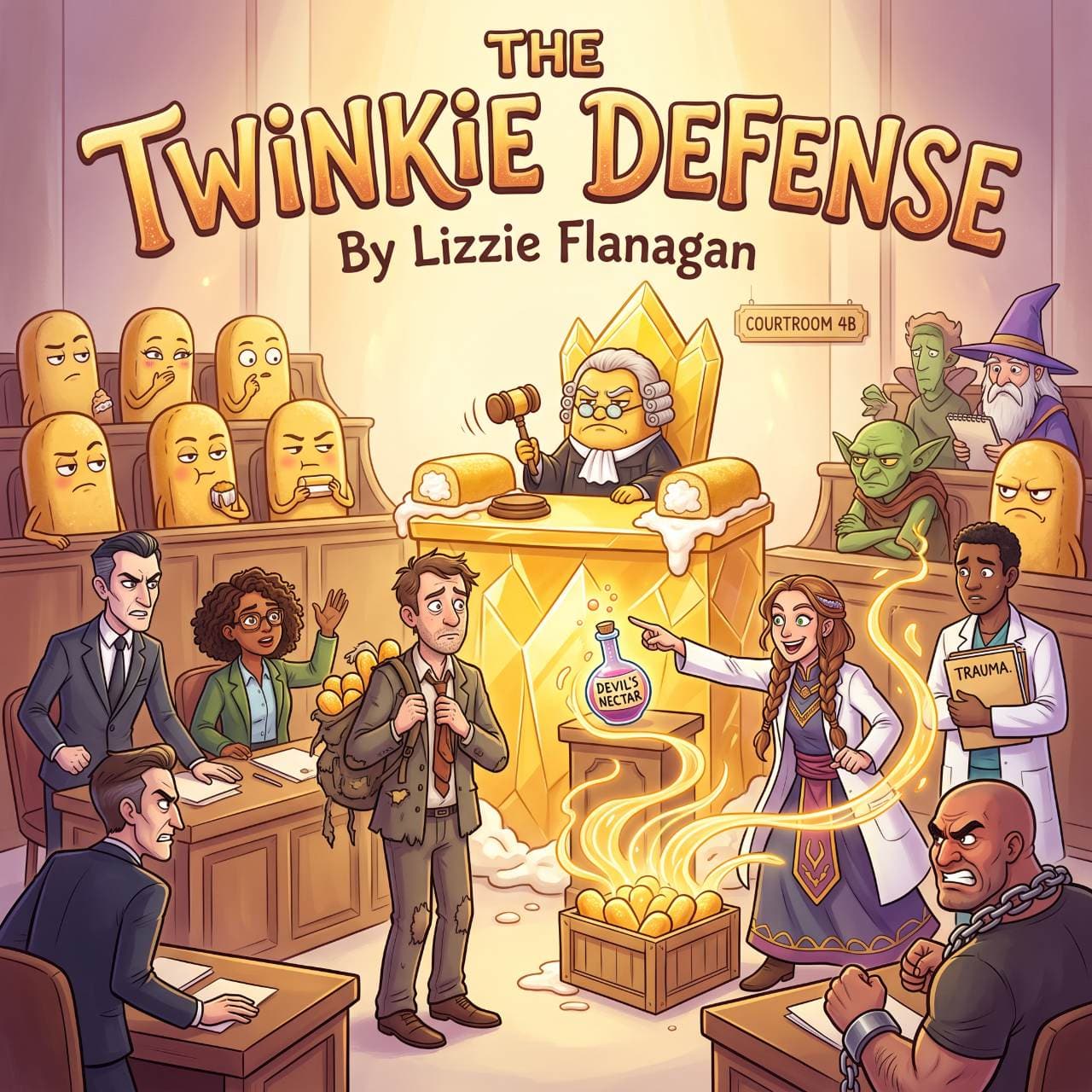

Courtroom 4B had achieved a state of religious solemnity by nine AM the following morning. The gallery was standing room only, word had spread through the legal community, the local news, and several Reddit threads that something extraordinary was happening in this otherwise unremarkable courtroom. Law professors had canceled classes to attend. Documentary filmmakers had set up cameras in the hallway, hoping to capture history. A representative from Hostess Corporation sat in the back row, wearing sunglasses and an expression that suggested he was calculating lawsuit exposure. And in the front row, next to the "FREE THE TWINKIE ONE" contingent, sat a man in overalls holding a sign that read "I ALSO HAD A BAD BOSS AND I DIDN'T STEVE ANYTHING," which contained a spelling error that somehow made it more authentic.
Herbert sat at the defense table wearing his navy suit, which he had ironed himself that morning while listening to a motivational podcast about "owning your narrative." He had slept poorly, haunted by dreams of vending machines that dispensed not Twinkies but verdicts, guilty, not guilty, and one confusing option labeled "technically guilty but spiritually innocent." He had dark circles under his eyes and a nervous energy that manifested as a rhythmic tapping of his fingers against the table, which Sylvia had gently stopped by placing her hand over his.
"Today is the day," she whispered. "Whatever happens, we've told the truth. That's all we can do."
"That's not very comforting," Herbert whispered back.
"It's not meant to be comforting. It's meant to be honest."
Judge Henderson entered with the gravity of a woman about to decide the fate of worlds, or at least the fate of one sad man and his snack cake addiction. She took her seat, surveyed the packed gallery with the expression of someone who found democracy deeply inconvenient, and banged her gavel with a sound that echoed off the beige walls like a gunshot.
"Closing arguments," she announced. "Ms. Kowalski, you may proceed. You have twenty minutes. I will be timing you, and I assure you that I have developed the ability to detect padding from a distance of fifty yards."
Sylvia rose, buttoned her jacket, and approached the center of the courtroom with the deliberate stride of a woman who had spent her entire life preparing for this moment, or at least the last three weeks. She carried no notes. She had memorized her argument, rehearsing it in the shower, in her car, in the mirror while brushing her teeth. She stopped in the exact center of the room, turned to face the judge, and began.
"Your Honor, when this trial began, my opponent described it as a simple case about a simple crime. He was wrong. This case is not simple. This case is about complexity, the complexity of being human in a world that exploits our vulnerabilities. It is about the intersection of corporate engineering and human psychology, about the ways in which our choices are shaped by forces we do not see and cannot control."
She began to pace, her movements measured and purposeful.
"Herbert Wimpleton is not a criminal. He is a victim. A victim of Dwayne McAllister, who tormented him for eleven years with a management style that can only be described as psychological warfare. A victim of Hostess Corporation, which employed scientists to calculate the exact formulation of sugar, fat, and salt that would override his rational decision-making. And a victim of a legal system that wants to blame him for succumbing to pressures that would break any of us."
Sylvia stopped pacing and turned directly to the judge.
"Your Honor, we have proven, through expert testimony and documentary evidence, that Twinkies are not food in any meaningful sense. They are delivery systems for addiction. They are engineered to produce dopamine responses that override the prefrontal cortex's executive function. They are designed to create craving without satiety, to make consumers eat more than they intend, more often than they should, and to feel dissatisfied with natural alternatives."
She walked to the evidence table and picked up the Hostess documents.
"We have shown that Hostess Corporation knows exactly what they are doing. They talk about 'craveability metrics' and 'repeat purchase optimization.' They identify 'heavy users', a term borrowed from the addiction industry, and target them for increased consumption. They calculate the 'bliss point,' the precise formulation that maximizes addiction. This is not baking, Your Honor. This is engineering. This is manipulation. This is, in a very real sense, a crime against public health."
She placed the documents down and spread her hands.
"But Hostess is not on trial here. Herbert Wimpleton is. And the question before this court is whether Herbert can be held criminally responsible for actions that were the inevitable result of forces beyond his control."
Sylvia's voice rose, filling the courtroom with the authority of righteous conviction.
"We have proven that Herbert was suffering from Complex Workplace Trauma, the result of eleven years of abuse by Dwayne McAllister. We have proven that this trauma produced chronic cortisol elevation that impaired his prefrontal cortex's executive function. We have proven that, in this compromised state, exposure to supernormal food stimuli produced a temporary condition of diminished capacity, a state in which rational choice was impossible and compulsive action was inevitable."
She approached the bench, her voice dropping to an intimate register.
"Your Honor, you have heard Herbert testify. You have seen his sincerity. You have seen his brokenness. This is not a man who wanted to steal. This is a man who was broken by forces larger than himself, who reached for relief in the only form that seemed available, and who has spent every moment since regretting that choice."
Sylvia stepped back, her voice rising again to address the full courtroom.
"The prosecution wants you to believe that Herbert simply chose to steal. But choice requires capacity, and capacity requires a brain that is functioning properly. Herbert's brain was not functioning properly. It was compromised by stress. It was hijacked by addiction. It was manipulated by corporate engineers who designed a product specifically to exploit those vulnerabilities."
She turned to face the gallery, her gaze sweeping across the faces of the law students, the retirees, the documentary filmmakers, the Hostess representative in his sunglasses.
"We live in a world of engineered addiction. Cigarettes, alcohol, opioids, gambling, and yes, snack foods—all designed to exploit the brain's reward system, to create dependency, to maximize profit at the expense of human suffering. We have decided, as a society, that some of these addictions mitigate responsibility. We recognize that a person in the grip of alcoholism may not be fully responsible for their actions. We recognize that a person suffering from gambling addiction may need treatment, not punishment."
She turned back to the judge, her voice carrying the weight of a fundamental question.
"Why do we refuse to recognize the same compassion for food addiction? Why do we blame the victim while ignoring the victimizer? Why do we hold Herbert Wimpleton responsible for succumbing to a product specifically designed to make him succumb, while letting Hostess Corporation profit from that design?"
Sylvia walked to her table and picked up a single Twinkie, Exhibit A, the golden sponge cake that had started it all. She held it up like a prosecutor in a murder trial displaying the murder weapon, which was exactly what it was.
"This is not just a snack cake, Your Honor. This is the culmination of decades of research into human weakness. This is a product designed to be irresistible, engineered to override free will, optimized to create addiction. And when it did exactly what it was designed to do, when it broke Herbert Wimpleton's will and made him act against his own interests, we blame him. We call him a criminal. We demand that he be punished."
She placed the Twinkie down with gentle finality.
"I ask you to reject that narrative. I ask you to recognize that Herbert Wimpleton is not a criminal but a casualty. A casualty of workplace abuse. A casualty of corporate engineering. A casualty of a system that prioritizes profit over people. I ask you to find him not guilty, not because he didn't take the Twinkies, but because he was not in control of his actions when he did. Because he was the victim of forces beyond his control. Because justice demands compassion, not just condemnation."
Sylvia returned to her table, her voice carrying one final plea.
"Your Honor, this case is not just about Herbert Wimpleton. It is about all of us. It is about whether we believe in free will or determinism, in compassion or condemnation, in justice or mere punishment. I ask you to choose justice. I ask you to find Herbert Wimpleton not guilty by reason of diminished capacity. Thank you."
The courtroom was silent. The law students were leaning forward in their seats. The retirees were wiping their eyes. Even the Hostess representative had removed his sunglasses and was staring at Sylvia with an expression that suggested he was reconsidering his career choices.
Judge Henderson made a note on her pad, her expression unreadable. "Mr. Thornberry, your closing argument. Twenty minutes."
Thornberry rose with the smooth confidence of a man who had heard everything Sylvia had said and found it all wanting. He buttoned his jacket, a gesture that Sylvia had learned meant he was about to be particularly insufferable, and approached the center of the courtroom with the swagger of someone who had never lost an argument and couldn't imagine starting now.
"Your Honor," he began, his voice carrying the perfect blend of reasonableness and authority, "that was a very pretty speech. Ms. Kowalski is clearly a talented advocate. She has taken a simple case of theft and transformed it into a grand narrative about corporate conspiracy and human frailty. She has made Herbert Wimpleton sound like a tragic hero, a victim of forces beyond his control, a man who deserves our sympathy rather than our condemnation."
He paused, letting his gaze sweep across the gallery.
"It is all nonsense."
Thornberry began to pace, his movements sharp and purposeful.
"Herbert Wimpleton is not a victim. He is a thief. He walked into his place of employment, opened a vending machine using skills he acquired in a previous job, removed forty-seven dollars worth of inventory, and consumed it in public. He knew what he was doing. He knew it was wrong. He did it anyway. And now he wants us to believe that he couldn't help himself."
He stopped pacing and turned to face the judge directly.
"Your Honor, we have heard a great deal about 'diminished capacity' and 'engineered addiction' and 'supernormal stimuli.' We have heard about cortisol levels and prefrontal cortexes and dopamine responses. We have been treated to a parade of experts who want us to believe that Twinkies are basically cocaine and that Herbert Wimpleton is basically a helpless addict."
Thornberry's voice dripped with sarcasm.
"But let us remember what we are actually talking about. We are talking about a forty-three-year-old man who stole snack cakes. We are talking about a product that is available in every convenience store in America, that millions of people consume every day without stealing, that has never been classified as a controlled substance because it is not a controlled substance. It is food. It is cake. It is sugar and flour and artificial flavoring, and it does not override free will."
He walked to the evidence table and picked up the same Twinkie that Sylvia had displayed.
"This is not a weapon, Your Honor. It is not a drug. It is not a tool of corporate oppression. It is a snack cake. It costs $1.50. It can be purchased legally by anyone with pocket change. And millions of people resist the urge to steal it every single day."
Thornberry placed the Twinkie down and turned to face the gallery.
"The defense wants you to believe that Herbert Wimpleton is special. That he is uniquely susceptible. That he is a victim of forces beyond his control. But Herbert Wimpleton is not special. He is ordinary. He is every man who faces stress and temptation and chooses to give in rather than resist. He is every employee who has a bad day at work and decides to break the rules rather than follow them. He is every person who wants something and takes it rather than paying for it."
Thornberry's voice rose, filling the courtroom with the authority of prosecutorial certainty.
"And that is not a defense. That is not an excuse. That is a confession."
He began to pace again, his movements sharp and aggressive.
"We have heard about Dwayne McAllister. Yes, he is a bad boss. Yes, he is a bully. Yes, he created a hostile work environment. But Herbert Wimpleton had choices. He could have reported McAllister to HR. He could have found a new job. He could have sought therapy for his stress. He could have eaten his turkey sandwich and gone back to work. He had eleven years to make different choices, and he made none of them."
Thornberry stopped and fixed the judge with a piercing gaze.
"Instead, he chose to stay in a job that made him miserable. He chose to blame himself for his unhappiness. He chose to believe that he lacked 'pep' rather than recognizing that his boss was a monster. And when he finally reached his breaking point, he chose to steal rather than seek help."
He turned to face Herbert, his voice dropping to an intimate, accusatory register.
"Herbert Wimpleton wants us to believe that he had no choice. But he had choices. He had choices every day for eleven years. He had choices on the day of the theft. He could have walked away from that vending machine. He could have bought one Twinkie legally. He could have eaten his sandwich and gone back to work. He had choices, and he made the wrong ones. And now he wants to avoid responsibility by blaming everyone but himself."
Thornberry walked back to his table and picked up his notes, though he didn't look at them.
"The defense has talked about 'diminished capacity.' But capacity is not diminished by stress. Stress is part of life. Everyone faces stress. Everyone has bad days. Everyone has bad bosses. The test of character is not whether you face adversity but how you respond to it. Herbert Wimpleton responded to adversity by stealing. That is not diminished capacity. That is poor character."
He turned to face the judge, his voice rising to a crescendo.
"Your Honor, this case is not about corporate conspiracy or engineered addiction or the neurochemistry of craving. This case is about personal responsibility. It is about whether we, as a society, are willing to hold people accountable for their actions or whether we are willing to accept any excuse, no matter how flimsy, no matter how absurd, no matter how insulting to the millions of people who face the same stresses and resist the same temptations without breaking the law."
Thornberry pointed at Herbert with an accusing finger.
"Herbert Wimpleton is not a victim. He is not a tragic hero. He is a thief who got caught and is now trying to avoid consequences by blaming everyone but himself. He blames his boss. He blames Hostess. He blames his brain chemistry. He blames everyone and everything except the one person who is actually responsible: himself."
He lowered his arm and spread his hands in a gesture of reasonableness.
"I am not unsympathetic to Herbert's situation. He has had a difficult life. He has faced genuine hardship. He deserves compassion, and he deserves help. But he also deserves to be held accountable for his actions. He deserves to face the consequences of his choices. Because that is what justice means. Justice means accountability. Justice means responsibility. Justice means recognizing that we are the authors of our own actions, for better or for worse, and that we cannot blame the world for our own failures."
Thornberry returned to his table, his voice carrying one final condemnation.
"Herbert Wimpleton chose to steal. He knew it was wrong. He did it anyway. And he must be held responsible for that choice. I ask you to find him guilty on all counts, because guilt is the only verdict that justice allows. Thank you."
The courtroom was silent. The law students were leaning back in their seats, some looking convinced, others confused. The retirees were nodding, as if Thornberry had articulated something they had always believed but never been able to express. The "FREE THE TWINKIE ONE" guy had lowered his sign and was staring at his shoes.
Judge Henderson made a note on her pad, her expression still unreadable. "Thank you, Mr. Thornberry. I will now take this matter under advisement. I will deliver my verdict tomorrow morning at nine AM. I expect both counsel to be present, along with the defendant. Court is adjourned."
She banged her gavel with a sound that felt like a period at the end of a very long, very strange sentence.
As the courtroom cleared, Herbert turned to Sylvia. "What happens now?"
"Now we wait," Sylvia said. "The judge will review the evidence, consider the arguments, and render her verdict tomorrow."
"Do you think she believed us?"
Sylvia looked at the empty bench, at the space where Judge Henderson had sat, at the Twinkie still sitting on the evidence table like a golden accusation.
"I think," she said slowly, "that she heard us. Whether she believes us... that's up to her."
Thornberry walked past them, his assistant Brad trailing behind with an armful of files. He paused just long enough to say, "Good effort, Ms. Kowalski. Truly. But justice is about responsibility, not excuses. See you tomorrow."
He walked out, his footsteps echoing in the emptying courtroom.
Herbert watched him go, then turned to Sylvia. "Whatever happens tomorrow... thank you. For believing me. For telling my story. For treating me like a human being."
"You're welcome, Herb," Sylvia said. "Now go home. Get some sleep. Try not to eat any Twinkies between now and tomorrow."
"I haven't eaten a Twinkie since the incident," Herbert said. "I don't think I ever will again."
"That's probably wise," Sylvia said. "See you tomorrow. And Herb?"
"Yes?"
"Whatever happens... you did the right thing by telling the truth. That's more than most people ever do."
She gathered her papers and walked out, leaving Herbert alone in the courtroom with the ghost of his testimony, the echo of closing arguments, and the weight of a verdict that would determine the rest of his life.
He stood up, straightened his thrift-store suit, and walked toward the exit. As he passed the evidence table, he paused and looked at the Twinkie—Exhibit A, the golden sponge cake that had started it all, that had ruined his life and given it meaning, that had brought him to this courtroom on this day to tell his truth.
"Tomorrow," he whispered to the Twinkie. "We find out who wins."
The Twinkie said nothing. It just sat there, golden and perfect and filled with creme, silently confident that it had already won.