


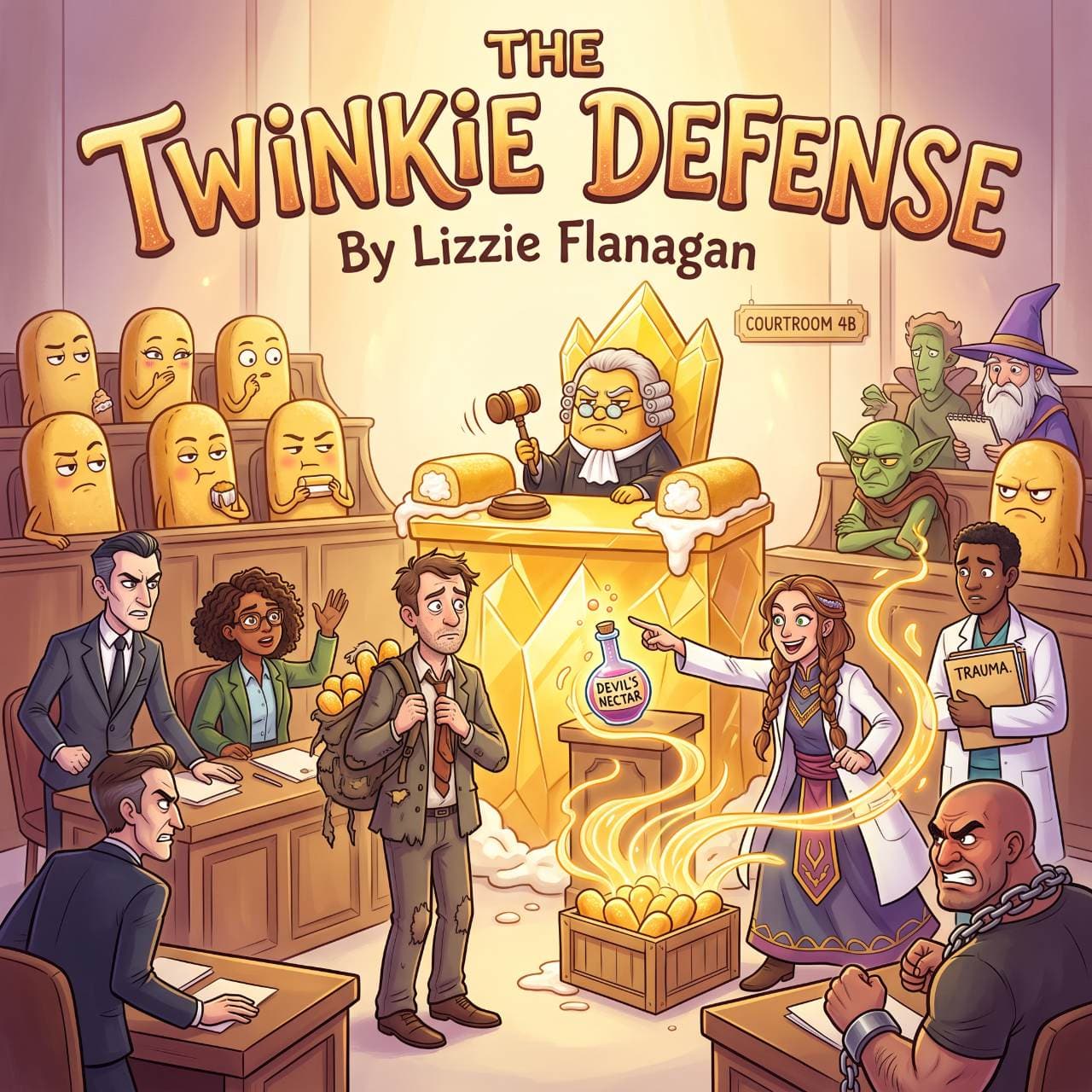

The morning of the verdict dawned gray and uncertain, as if the weather itself was undecided about Herbert Wimpleton's fate. By eight-thirty, Courtroom 4B had achieved a state of anticipatory hysteria. The gallery was packed three hours early, with people camping out on the floor like they were waiting for concert tickets. The law students had brought textbooks they weren't reading. The documentary filmmakers had set up three cameras. Someone had started a betting pool—two-to-one odds on guilty, five-to-one on not guilty, and a mysterious "vigilante justice" option at twenty-to-one that no one could explain but several people had bet on.
The "FREE THE TWINKIE ONE" contingent had grown to twelve people, all wearing matching t-shirts featuring Herbert's face superimposed on a Twinkie. They had been joined by a counter-protest group called "PERSONAL RESPONSIBILITY MATTERS" who carried signs reading "STRESS IS NOT A LICENSE TO STEAL" and "HOSTESS DIDN'T MAKE YOU DO IT—YOU DID." The two groups had engaged in heated but polite debate in the hallway, sharing coffee and donuts (not Hostess brand) while arguing about the nature of free will.
Herbert arrived at eight-forty-five, wearing his navy suit, which he had pressed again that morning despite the fact that he had not slept. He had spent the night staring at his ceiling, running through every possible outcome. If guilty: fines he couldn't pay, community service he couldn't afford to miss, a criminal record that would make finding another job impossible. If not guilty: freedom, but also the weight of having his theory validated, of becoming "the Twinkie Defense guy" for the rest of his life.
Sylvia met him in the hallway, looking professional but tired. She had spent the night reviewing case law, searching for any precedent that might sway the judge, any argument she had forgotten to make. She found nothing. They had made their case. Now it was in Judge Henderson's hands.
"How are you?" she asked.
"Terrified," Herbert admitted. "You?"
"Professionally terrified," Sylvia said. "It's a more refined form of terror. Comes with a law degree."
They entered the courtroom together, passing through the gauntlet of spectators, reporters, and concerned citizens. Herbert caught sight of Dwayne McAllister sitting in the back row, wearing a suit that suggested he had dressed for a funeral, possibly Herbert's. He caught sight of Dr. Zyx, who gave him a thumbs-up and mouthed "science is on your side." He caught sight of the Hostess representative, who was on his phone, presumably calculating how much this trial was costing the company in reputation versus how much they made from "heavy users" in a single quarter.
At nine o'clock exactly, Judge Henderson entered through her private door. The courtroom rose as one, then sat as one, the movement synchronized like a wave. The judge took her seat, arranged her papers, and surveyed the room with the expression of someone who had made a decision and was curious to see how everyone would react to it.
"Before I deliver my verdict," she began, her voice carrying the authority of finality, "I want to make something clear. This case has been described in the media, social and otherwise, as the 'Twinkie Defense case.' It has been compared to Dan White's infamous defense in 1979, where he claimed that junk food diminished his capacity for murder. It has been treated as a joke, a curiosity, a sign of the times."
She removed her glasses and cleaned them, a gesture that Herbert had learned meant she was about to say something important.
"It is not a joke. It is not a curiosity. It is a serious question about the nature of responsibility, addiction, and justice. And I have considered it seriously."
Judge Henderson put her glasses back on and began to read from her prepared ruling.
"The defendant, Herbert P. Wimpleton III, stands accused of petty theft, disorderly conduct, and public intoxication by sugar. The defense has argued that he is not guilty by reason of diminished capacity, specifically that a combination of workplace-induced trauma and exposure to engineered supernormal food stimuli compromised his ability to make rational choices."
She paused, letting the silence build.
"I find the evidence regarding workplace trauma to be compelling. The testimony regarding Dwayne McAllister's management style, corroborated by corporate documents and witness statements, establishes that Mr. Wimpleton was subjected to eleven years of psychological abuse that produced measurable trauma. Dr. Snackwell's testimony regarding Complex Workplace Trauma and its effects on executive function is credible and well-supported by the scientific literature."
Herbert felt a flicker of hope. Sylvia reached over and squeezed his hand.
"However," Judge Henderson continued, and the flicker dimmed, "I find the evidence regarding 'food addiction' and 'diminished capacity' to be less compelling. While Dr. Zyx's testimony regarding supernormal stimuli and engineered addiction was fascinating, and I use that word advisedly, I am not persuaded that exposure to snack foods, however optimized, creates a legal state of diminished capacity equivalent to intoxication or mental illness."
She picked up a document, reviewing it before continuing.
"The defense has shown that Hostess Corporation engineers its products to maximize palatability. They have shown that these products can produce strong cravings in susceptible individuals. They have shown that Mr. Wimpleton experienced a psychological break that led him to steal. What they have not shown is that Mr. Wimpleton lacked the capacity to choose."
Judge Henderson looked directly at Herbert, her gaze piercing but not unkind.
"Mr. Wimpleton knew what he was doing. He knew it was wrong. He could have stopped himself. That he did not stop himself, that he gave in to impulse and stress and craving, does not make him not responsible. It makes him human. But being human is not a defense against being responsible."
The courtroom was silent. The "FREE THE TWINKIE ONE" guy had his head in his hands.
"However," Judge Henderson said, and the silence deepened, "I am also not persuaded that traditional punishment serves the interests of justice in this case. Mr. Wimpleton is not a threat to society. He is not a career criminal. He is a man who was broken by forces larger than himself, by an abusive employer, by a system that profits from addiction, by forty-three years of disappointment, and who made a mistake."
She set down the document and folded her hands.
"Therefore, I find the defendant guilty of petty theft. I find him guilty of disorderly conduct. I find him not guilty of public intoxication by sugar, which I am not convinced is a real thing."
Thornberry smiled. The "PERSONAL RESPONSIBILITY MATTERS" group cheered quietly.
"However," Judge Henderson said for the third time, and the cheering stopped, "I suspend the sentence pending successful completion of a diversion program. Mr. Wimpleton will undergo twelve months of court-supervised therapy for workplace trauma and food addiction. He will perform two hundred hours of community service, to be completed at a food bank or similar charitable organization. He will pay restitution to SuperMart in the amount of forty-seven dollars and eighty-three cents. And he will attend weekly sessions with a vocational counselor to assist him in finding new employment."
She looked at Herbert with an expression that might have been sympathy.
"Mr. Wimpleton, you are not innocent. You stole. You knew better. But you are also a victim, of your boss, of your circumstances, of a system that exploited your weaknesses. This court cannot absolve you of responsibility, but it can recognize that justice requires healing, not just punishment. Do you understand?"
Herbert stood on shaking legs. "I understand, Your Honor. Thank you."
"Don't thank me yet," Judge Henderson said. "Therapy is hard. Community service is tedious. And you still have a criminal record, albeit a suspended one. But you have a chance to rebuild your life. I suggest you take it."
She banged her gavel. "Court is adjourned."
The courtroom exploded into noise, reporters rushing to file stories, the law students debating the legal implications, the "FREE THE TWINKIE ONE" group chanting "JUSTICE! JUSTICE!" while the "PERSONAL RESPONSIBILITY" group muttered about "soft on crime judges." Through it all, Herbert stood at the defense table, processing what had happened.
He was guilty. But he was also free.
Sylvia turned to him, her face a mixture of relief and professional assessment. "Suspended sentence. It's not a win, but it's not a loss either. It's... a draw with benefits."
"I can live with a draw," Herbert said. "I can live with anything that isn't prison."
"You have to do the therapy," Sylvia said. "And the community service. And pay back the forty-seven dollars."
"I have forty-seven dollars," Herbert said. "I think. I need to check my couch cushions."
"And you need to find a new job. One with a better boss."
Herbert looked at the back of the courtroom, where Dwayne McAllister was standing, his face red with indignation. "I think Dwayne wanted me to go to prison."
"Dwayne wanted validation," Sylvia said. "He didn't get it. The judge called his management style 'psychological abuse' in the official record. That's going to follow him."
As if summoned by their conversation, Dwayne approached the defense table, his face working through several emotions before settling on aggrieved self-righteousness. "Well," he said, "I hope you're happy. You've made a mockery of the justice system."
"I think the justice system worked exactly as it should," Herbert said, surprising himself with his own calm. "I did something wrong. I'm being held accountable. But I'm also getting help. That's fair."
"You stole from me," Dwayne said.
"I stole from SuperMart," Herbert corrected. "And you abused me for eleven years. So I guess we're both guilty of something."
Dwayne opened his mouth, closed it, and walked away, his funeral suit suddenly looking like exactly what it was: the costume of a man who had lost something he didn't know he could lose.
Thornberry approached next, his expression professionally neutral. "Ms. Kowalski," he said, nodding. "Mr. Wimpleton. I still believe you should have been sentenced to jail time. But I respect the judge's reasoning. And I hope the therapy helps."
"Thank you, Mr. Thornberry," Herbert said. "I hope your next case is easier."
"There's no such thing as an easy case," Thornberry said. "Just cases you win and cases you learn from." He paused. "This one, I learned from."
He walked out, his assistant Brad trailing behind, and Herbert realized that he had just received something like respect from a man who had tried to put him in prison.
Dr. Zyx and Dr. Snackwell approached together, looking like the world's most unlikely buddy comedy duo, the braided mad scientist and the tweed-clad psychologist.
"The science worked," Dr. Zyx said. "She acknowledged the trauma. She acknowledged the engineering. She just didn't buy the diminished capacity argument."
"She bought enough of it," Dr. Snackwell said. "Suspended sentence with therapy. That's a victory for the concept, even if not for the specific defense."
"Will you be my therapist?" Herbert asked Dr. Snackwell.
"I'm afraid I can't. I was a witness in your case. But I'll refer you to someone excellent. Someone who understands workplace trauma and food addiction. Someone who won't judge you for the Twinkies."
"I'd appreciate that," Herbert said.
The courtroom had mostly emptied by the time Herbert and Sylvia walked out together. They stood on the courthouse steps, looking out at the city, at the people walking by, at the vending machines visible through the window of the convenience store across the street.
"So what now?" Herbert asked.
"Now," Sylvia said, "you go to therapy. You do your community service. You pay your forty-seven dollars. And you rebuild your life. One day at a time. One choice at a time. Without Twinkies."
"Without Twinkies," Herbert agreed. "I think I've had enough Twinkies for one lifetime."
Sylvia laughed, a genuine, warm sound that Herbert realized he had never heard before. "You know, Herb, when you first walked into my office, you were just a sad man with chocolate on his face. Now you're... what? A precedent? A cautionary tale? The Twinkie Defense guy?"
"I'm just Herbert," Herbert said. "And that's enough."
Sylvia reached into her briefcase and pulled out a business card. "My cousin runs a nonprofit that helps people with workplace trauma find new careers. They have a job opening for an office manager. It pays less than SuperMart, but the boss is nice. Like, genuinely nice. Not 'tough love' nice. Actually nice."
Herbert took the card. "Thank you, Sylvia. For everything."
"Thank me by staying out of trouble," Sylvia said. "And by doing your therapy. And by never, ever eating another Twinkie."
"I promise," Herbert said.
They shook hands, and Sylvia walked down the courthouse steps toward her car and her next case and her succulent plant named Justice that she was still slowly killing. Herbert watched her go, then looked up at the sky, which had cleared while he was inside. The sun was shining. The world was continuing. And he was still here, still standing, still alive.
He walked down the steps, past the "FREE THE TWINKIE ONE" group who cheered as he passed, past the documentary filmmakers who asked for a comment (he gave them "Therapy helps"), past the Hostess representative who was still on his phone, presumably calculating whether to offer Herbert a settlement to keep him quiet (they never did).
He walked to the convenience store across the street and stood in front of the vending machine. It hummed its familiar hum, offering its golden wares, promising sweetness and relief and temporary oblivion.
Herbert reached into his pocket and pulled out two dollars. He looked at the Twinkies, at the golden packages, at the promise of bliss.
Then he put the money back in his pocket and walked away.
Six months later, Herbert sat in a circle of folding chairs in a church basement, surrounded by people who understood him in ways that no one else ever had. There was Margaret, who had stolen forty pounds of cheese from a dairy farm after her husband left her. There was James, who had embezzled from his company to buy rare sneakers. There was Dr. Snackwell's referral, Dr. Okonkwo, who ran the group with gentle authority and never once suggested that anyone lacked pep.
"I've been clean for six months," Herbert was saying. "No Twinkies. No Hostess. No processed sugar, really. I eat a lot of vegetables now. Linda would be proud."
"Linda?" someone asked.
"My ex-wife. She left me for a man who collects vintage tractors. I think they're still together. I hope they're happy."
"How do you feel about that?" Dr. Okonkwo asked.
"Honestly? I feel okay. I think I needed to hit bottom to start climbing back up. And I think... I think the Twinkies were never the problem. They were just the symptom. The problem was me thinking I deserved to be unhappy. That I didn't deserve better than Dwayne. That I didn't deserve better than Linda leaving me. That I didn't deserve better than a life of quiet desperation and snack cakes."
He paused, gathering his thoughts.
"I deserved better. I deserve better. And I'm working on believing that."
After the meeting, Herbert walked to his new job, a small nonprofit that helped people find meaningful work after workplace trauma. He was the office manager, which meant he ordered supplies, managed schedules, and made sure everyone had what they needed to do their important work. His boss, a woman named Sarah who smiled genuinely and never threw staplers, had told him last week that he was "a valuable member of the team."
He had cried when she said it. Happy tears, for once.
He stopped at a coffee shop on the way to work and bought a black coffee and a banana, natural sugars, natural satisfaction, no engineered bliss point. He sat by the window and watched the world go by, thinking about how far he had come and how far he still had to go.
His phone buzzed. It was a text from Sylvia: "Just won a case. Client was found not guilty by reason of being gaslit by their HOA. The Twinkie Defense lives on in spirit."
Herbert smiled and texted back: "Proud of you. Coffee soon?"
Her reply came immediately: "Your turn to buy. No vending machines."
He finished his coffee, threw away his banana peel, and walked to work with a stride that had, for the first time in forty-three years, actual pep.
Across town, in a SuperMart break room, a vending machine hummed its eternal song. A young man named Kevin, who had just been told by his supervisor that he lacked "zest," stood before it, his hands shaking, his blood sugar dropping, his soul crying out for relief.
He reached into his backpack.
He paused.
He remembered something he had read in the newspaper, about a man named Herbert Wimpleton who had stolen Twinkies and started a conversation about workplace abuse and engineered addiction and the right to be treated like a human being.
Kevin took his hand out of his backpack. He walked to the break room refrigerator and retrieved his sandwich—turkey on wheat, prepared with care that morning. He sat down and ate it slowly, tasting each bite, feeling the nourishment, knowing that he deserved this simple dignity.
The vending machine hummed on, offering its golden promises, but Kevin didn't hear it anymore. He was already thinking about updating his resume, about finding a job with a better boss, about the life he deserved to live.
And somewhere, in a church basement or a therapist's office or a nonprofit workspace, Herbert Wimpleton smiled, sensing that somewhere, someone had just chosen themselves over the Twinkies.
Justice, like a Twinkie, comes in many forms. Sometimes it's a verdict. Sometimes it's a suspended sentence. And sometimes it's just a man, on a Tuesday afternoon, deciding that he deserves better than a life of stolen snack cakes and broken dreams.
Herbert walked into his office, said good morning to Sarah, and began his day—not with a Twinkie, but with purpose. And that, finally, was enough.