


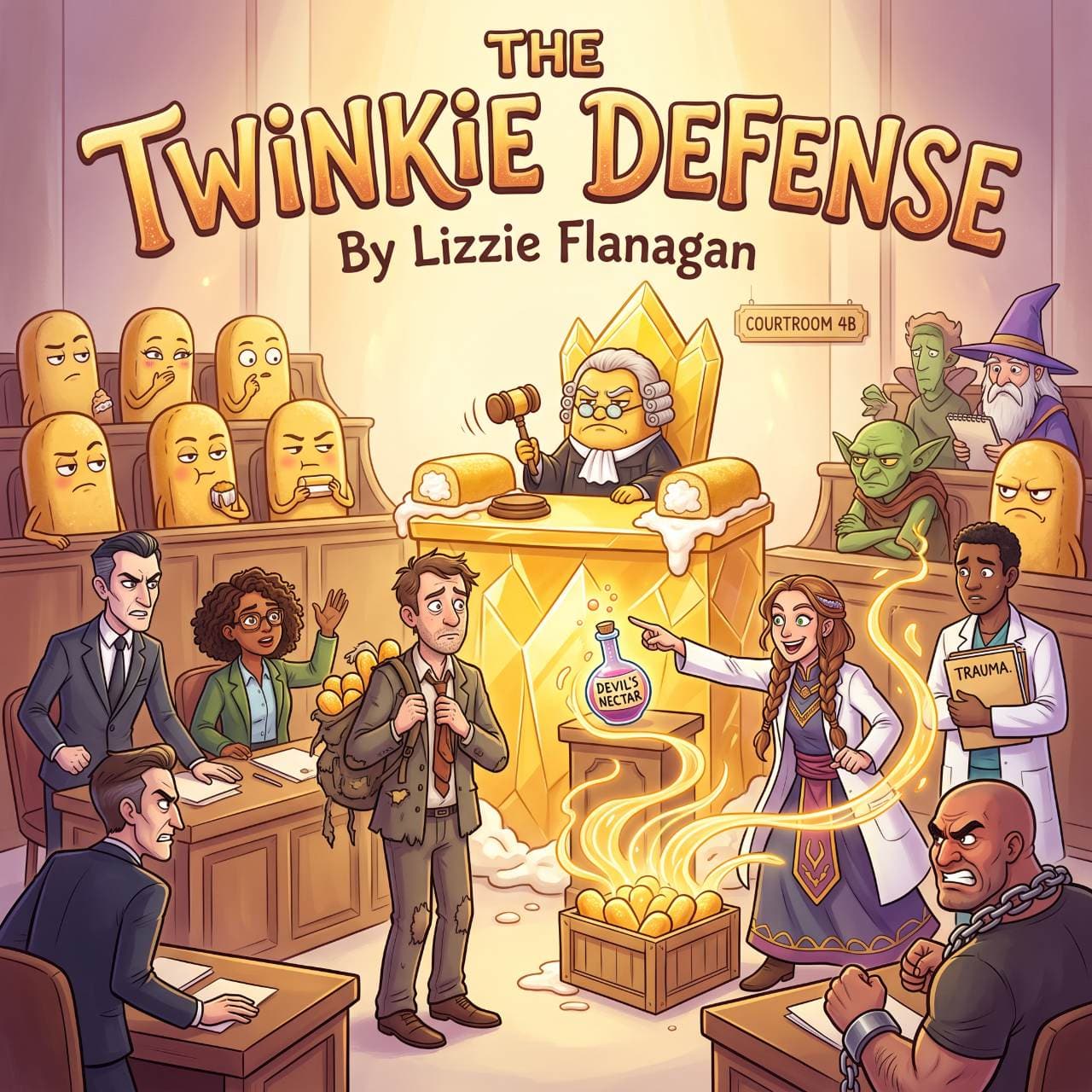

Courtroom 4B smelled of institutional coffee and anxiety when the afternoon session began. The gallery had returned from lunch with renewed vigor, having spent their break debating the case in the courthouse cafeteria over sandwiches that tasted like justice itself, cold, slightly stale, and fundamentally unsatisfying. The law students had moved to better seats, jockeying for position like paparazzi at a celebrity trial. The retirees had refreshed their coffee thermoses. And in the back, the "FREE THE TWINKIE ONE" guy had been joined by three friends, one of whom carried a sign reading "HOSTESS IS THE REAL CRIMINAL," which security had allowed after determining it wasn't technically a threat.
Judge Henderson took her seat with the air of someone who had eaten a satisfactory lunch but was prepared to be disappointed by the afternoon's proceedings. She surveyed the courtroom, noted the increased attendance with the expression of a woman who found public interest in the law vaguely distasteful, and banged her gavel with the finality of a door closing on hope.
"Ms. Kowalski," she said, "the defense may present its case. I trust you have actual evidence and not just more speeches about corporate responsibility?"
"Actual evidence, Your Honor," Sylvia said, rising with the confidence of a woman who had spent her lunch break reviewing notes and practicing her opening questions in the bathroom mirror. "The defense calls Dr. Bartholomew Q. Zyx."
Dr. Zyx entered the courtroom with the theatrical flair of a man who had been waiting his entire life for this moment. His braided ponytail swung behind him like a pendulum of wisdom. His lab coat, cleaned and pressed for the occasion, bore a pin that read "QUESTION EVERYTHING," which he had added specifically for this testimony. He was sworn in with the gravity of a man taking an oath to science itself, and he settled into the witness stand with the comfort of someone who had spent decades explaining complex concepts to people who didn't want to hear them.
"Dr. Zyx," Sylvia began, "please state your credentials for the record."
"I hold a Ph.D. in Food Science from MIT, with a secondary concentration in Behavioral Neuroscience. I spent fifteen years as Senior Director of Product Development at Frito-Lay, where I led the team that developed the 'Extreme Flavor' line of products. I left the industry in 2019 after what I can only describe as a moral awakening, and I now run the Independent Research Institute for Food Ethics and Public Health. I have published forty-seven peer-reviewed papers on food addiction, supernormal stimuli, and the neurochemistry of craving. I have testified before Congress three times, the FDA twice, and I once gave a TED Talk that has been viewed by over two million people, though I should note that approximately half of those views were from people who thought it was a comedy sketch."
"Objection," Thornberry said. "Relevance of the TED Talk viewership?"
"Sustained," Judge Henderson said. "Dr. Zyx, please limit your answers to relevant professional qualifications."
"Of course, Your Honor."
Sylvia approached the witness stand, her manner respectful but urgent. "Dr. Zyx, what is a 'supernormal stimulus'?"
"A supernormal stimulus is an artificial creation that triggers a stronger response than the natural equivalent ever could. The concept was developed by the Dutch biologist Niko Tinbergen in the 1950s. He discovered that birds would prefer to sit on wooden eggs painted with bright polka dots rather than their own real eggs, because the dots were more visually arresting than natural egg coloring. Similarly, humans will prefer processed foods engineered for maximum palatability over natural foods, because the engineering creates sensory experiences that don't exist in nature."
"And how does this relate to Twinkies?"
Dr. Zyx leaned forward, his eyes bright with the fervor of a convert. "Twinkies are the perfect supernormal stimulus. They contain a precise ratio of sugar, fat, and salt, what the industry calls the 'bliss point', that triggers dopamine release in the nucleus accumbens with an efficiency that natural foods cannot match. The golden sponge cake dissolves instantly on the tongue, requiring no chewing, providing immediate sensory gratification. The 'creme' filling, spelled with an 'e' to avoid FDA regulations on dairy content, provides a fatty mouthfeel that activates the same neural pathways as high-calorie natural foods, but without the satiety signals that would normally tell the brain to stop eating."
"Are you saying Twinkies are addictive?"
"I am saying they are engineered to be addictive. There is a difference between addiction and engineered addiction. Heroin is addictive because of its chemical properties. Twinkies are addictive because teams of scientists spent decades optimizing them to maximize craving and minimize satiety. The Hostess Corporation employs what they call 'craveability experts', not bakers, not chefs, but scientists whose job is to calculate the exact formulation that will make consumers eat more than they intend to, more often than they should, and to feel dissatisfied with natural alternatives."
Sylvia walked to the evidence table and picked up the Hostess documents. "Your Honor, I would like to enter Defense Exhibits 1 through 12, internal Hostess Corporation documents obtained by Dr. Zyx during his previous research."
Thornberry rose. "Objection! These documents were part of a sealed settlement. They are not admissible."
Sylvia turned to the judge. "Your Honor, these documents were legally obtained before the settlement and were not subject to the seal. Dr. Zyx retained copies as part of his research. They are relevant to showing that Hostess knowingly engineered their products to create addictive responses."
Judge Henderson reviewed the documents, her expression unreadable. "I'll allow them, pending authentication. Continue, Ms. Kowalski."
"Dr. Zyx, can you explain what these documents show?"
Dr. Zyx adjusted his glasses and began reading from the papers. "This is a memo from 2014, from the Hostess Vice President of Product Development to the CEO. It discusses 'repeat purchase optimization' and notes that 'heavy users', defined as consumers who eat more than three packages per week, represent only eight percent of customers but account for forty percent of sales. The memo recommends 'increasing eating frequency among heavy users through enhanced craveability.'"
He flipped to another page. "This is a research report from 2016, commissioned by Hostess and conducted by an outside firm. It found that 'consumption of Twinkies produces dopamine responses comparable to mild narcotic use in susceptible individuals.' The recommendation was to 'increase the bliss point by three percent to enhance repeat purchase rates.'"
"And did they follow this recommendation?"
"They did. The 2017 reformulation increased sugar content and modified the fat blend to create what internal documents call 'enhanced mouthfeel and reduced satiety signaling.'"
Sylvia turned to face the judge. "Your Honor, the defense argues that these documents prove Hostess Corporation knowingly engineered Twinkies to override consumer self-control. Dr. Zyx, in your expert opinion, can exposure to such engineered products create a state of diminished capacity?"
"Absolutely," Dr. Zyx said. "In susceptible individuals, those with specific genetic polymorphisms affecting dopamine receptors, those experiencing chronic stress, those with compromised prefrontal cortex function due to sleep deprivation or emotional distress, exposure to supernormal food stimuli can produce a temporary state where rational decision-making is overridden by compulsive consumption. The brain's reward system is essentially hijacked. The person is not making choices; they are following a neurochemical script written by food engineers."
"Thank you, Doctor. No further questions."
Thornberry rose for cross-examination, his manner suggesting he was about to dismantle a child's toy. "Dr. Zyx, you said you worked for Frito-Lay for fifteen years."
"That's correct."
"And you left in 2019."
"Yes."
"Were you fired?"
"I had a disagreement with management about the ethical implications of our work."
"Isn't it true that you were terminated for erratic behavior, including an incident where you threw a bag of Doritos at a vice president while screaming 'You are poisoning the children'?"
Dr. Zyx adjusted his ponytail with dignity. "I was making a point about sodium levels. The throwing was theatrical but necessary."
"And since then, you've made a career out of attacking the food industry?"
"I've made a career out of telling the truth about the food industry."
"Isn't it true that you have a book coming out next month titled *The Snack Food Conspiracy: How Corporate America Is Eating Your Brain*?"
"I have written a book, yes."
"And wouldn't favorable testimony in a high-profile case help book sales?"
"Objection," Sylvia called. "Relevance to Dr. Zyx's credibility?"
"Sustained," Judge Henderson said. "Mr. Thornberry, attack the testimony, not the witness's publishing schedule."
Thornberry nodded and changed tactics. "Dr. Zyx, you say that Twinkies can override free will in 'susceptible individuals.' How many people are susceptible?"
"It varies by population, but studies suggest approximately fifteen to twenty percent of adults have the genetic and psychological profile that makes them vulnerable to food addiction."
"So eighty percent of people can eat Twinkies without losing control?"
"That's correct."
"And Mr. Wimpleton just happens to be in the unlucky twenty percent?"
"Based on his psychological profile and the circumstances, yes."
Thornberry smiled. "Doctor, millions of people eat Twinkies every day without stealing them. Millions of people work for difficult bosses without committing crimes. Isn't it possible that Mr. Wimpleton is simply a thief with a sweet tooth, and not a victim of corporate engineering?"
"Anything is possible," Dr. Zyx said. "But the evidence suggests that Mr. Wimpleton experienced a perfect storm of vulnerability: chronic workplace stress that elevated his cortisol levels and impaired his prefrontal cortex, combined with exposure to a product specifically designed to exploit that impairment. He didn't choose to steal any more than a diabetic chooses to go into shock when given insulin."
"Thank you, Doctor. No further questions."
Sylvia rose for redirect. "Dr. Zyx, one question. If Hostess had not engineered Twinkies to be maximally addictive, if they had simply made a normal snack cake without 'craveability optimization,' do you believe Mr. Wimpleton would have stolen them?"
"Absolutely not. A normal food product would not have produced the neurochemical cascade that overwhelmed his decision-making. He would have eaten his turkey sandwich and returned to work."
"Thank you, Doctor."
"The defense calls Dr. Penelope Snackwell."
Dr. Snackwell took the stand with the calm authority of someone who had spent decades navigating the complexities of the human mind. She was sworn in and stated her credentials: Ph.D. in Clinical Psychology from Yale, twenty-five years of practice specializing in workplace stress and trauma, author of three books on occupational mental health, consultant to the Department of Labor on workplace safety standards.
"Dr. Snackwell" Sylvia began, "you conducted a psychological evaluation of Herbert Wimpleton?"
"I did. Over three days of intensive testing, including stress response evaluation, cognitive function assessment under simulated pressure, and review of his employment history and personal background."
"And what did you find?"
"Mr. Wimpleton exhibits a profile consistent with Complex Workplace Trauma. Eleven years of employment under Dwayne McAllister, who employed what we call 'authoritarian terror management'—constant criticism, public humiliation, physical intimidation, and the creation of what amounts to a hostile work environment. This produced chronic elevation of cortisol, the stress hormone, which has well-documented effects on the prefrontal cortex."
"Can you explain those effects for the court?"
"Certainly. Chronic cortisol elevation impairs executive function, the brain's ability to plan, make decisions, and control impulses. It essentially puts the brain in a constant state of fight-or-flight, prioritizing immediate survival over long-term consequences. In this state, the brain's reward system becomes hypersensitive to dopamine-triggering stimuli, because dopamine is associated with pleasure and relief from stress."
"So the combination of workplace stress and exposure to highly palatable food..."
"Creates a perfect storm," Dr. Snackwell finished. "The stressed brain seeks relief. The engineered food provides immediate dopamine release. The compromised prefrontal cortex cannot resist the impulse. The result is behavior that the individual would not engage in under normal circumstances."
"Did Mr. Wimpleton exhibit this specific pattern?"
"Decidedly. Under normal conditions, his impulse control is average to above average. But when subjected to recordings of his supervisor's voice while being shown images of high-palatability foods, his brain scans showed reduced prefrontal activity and increased reward center activation. He was, neurologically speaking, not in control of his actions."
Sylvia approached the witness stand. "Dr. Snackwell, is it your professional opinion that Herbert Wimpleton was suffering from diminished capacity when he stole the Twinkies?"
"It is. He was in a state of stress-induced cognitive impairment that compromised his ability to make rational choices. Combined with exposure to a product specifically engineered to exploit that impairment, he could not be said to be acting with free will in any meaningful sense."
"Thank you, Doctor. No further questions."
Thornberry rose, his expression suggesting he was about to perform surgery without anesthesia. "Dr. Snackwell, you said Mr. Wimpleton has 'Complex Workplace Trauma.'"
"Yes."
"Is that a recognized diagnosis in the DSM-5?"
"It's a clinical description of a pattern of symptoms that—"
"Is it in the DSM-5?"
"No, but—"
"So it's not an officially recognized mental disorder?"
"It's a recognized pattern of—"
"Answer the question, Doctor. Is it in the DSM-5?"
"No."
Thornberry nodded, satisfied. "And this 'diminished capacity' you describe, can it be measured? With a blood test? A brain scan that shows, definitively, that someone cannot control their actions?"
"We can measure cortisol levels. We can see reduced prefrontal activity on fMRI. We can document impaired decision-making on cognitive tests."
"But you can't point to a specific number and say, 'Below this, you're not responsible'?"
"Responsibility is a legal concept, not a neurochemical one. I'm saying that Mr. Wimpleton's capacity for rational choice was compromised, not eliminated."
"Compromised," Thornberry repeated. "But not eliminated. He still knew he was stealing, didn't he?"
"He knew, but..."
"He knew it was wrong?"
"Yes, but..."
"He could have stopped himself if he'd tried harder?"
"Objection," Sylvia called. "Counsel is badgering the witness."
"Sustained," Judge Henderson said. "Mr. Thornberry, allow the witness to finish her answers."
Thornberry smiled. "I'll rephrase. Dr. Snackwell, isn't it true that 'diminished capacity' is just a fancy way of saying 'I didn't want to control myself'?"
"No," Dr. Snackwell said firmly. "It's a recognition that human behavior is influenced by biological and environmental factors. Mr. Wimpleton didn't choose to be traumatized by his boss. He didn't choose to have the genetic profile that makes him vulnerable to food addiction. And he didn't choose to be exposed to a product engineered specifically to exploit those vulnerabilities."
"But he did choose to open the vending machine. He did choose to take the Twinkies. He did choose to eat fourteen of them on a bus bench. Those were choices, weren't they?"
"They were actions," Dr. Snackwell said. "But they were not freely chosen in any meaningful sense. They were the inevitable result of forces beyond his control."
Thornberry turned to the judge. "Your Honor, the People have established that the defendant committed theft knowingly and intentionally. The defense wants to excuse that theft because the defendant was stressed and likes snack cakes. But stress is part of life. Liking snack cakes is normal. Neither excuses theft. Dr. Snackwell can describe 'forces beyond his control,' but the fact remains: millions of people face stress without stealing. The defendant's weakness is not a defense. It's a character flaw."
"Objection," Sylvia said. "Closing argument during cross-examination."
"Sustained. Mr. Thornberry, save it for your actual closing."
"No further questions."
Sylvia rose for redirect. "Dr. Snackwell, one question. If Mr. Wimpleton had not been subjected to eleven years of workplace abuse, if he had not been in a state of chronic stress, would he have stolen the Twinkies?"
"No. The evidence is clear. Without the stress-induced impairment, he would have had the impulse control to resist the engineered craving."
"Thank you, Doctor."
"The defense calls Herbert P. Wimpleton III."
Herbert stood on shaking legs and walked to the witness stand. He was sworn in with the gravity of a man about to tell his truth, and he settled into the chair with the nervous energy of someone who had rehearsed this moment in the mirror but still wasn't sure he could go through with it.
"Mr. Wimpleton," Sylvia said gently, "please tell the court, in your own words, what happened on the day of the incident."
Herbert took a deep breath. "I was having a bad day. A bad decade, really. But that day was special. Dwayne called me into the break room and told me I lacked pep. That customers could smell my apathy like... like body odor. He said I was a disappointment. He said Gerald in Sporting Goods was better than me. Gerald sells basketballs during March Madness. I sell toilet paper. There's no Toilet Paper Madness."
He paused, gathering himself.
"After he finished, I felt... broken. Like something inside me had snapped. I walked past the vending machine, and I saw the Twinkies. And I heard this voice, not a real voice, but like a voice, saying, 'You deserve this. You've suffered enough. Take them. Eat them. Find peace.'"
"And did you feel you had a choice?"
"No. I mean, I knew it was wrong. I knew I shouldn't. But it felt like... like I was watching myself from outside my body. Like someone else was driving. I opened the maintenance panel, I knew how because I used to repair vending machines, and I took them all. Every package. I filled my backpack and I walked out. I didn't even feel scared. I just felt... relief. Like I was finally doing what I'd wanted to do for years."
"What did you do then?"
"I walked to a bus bench three blocks away. I sat down. And I started eating. I ate fourteen Twinkies. I didn't even taste them after the first few. I just kept putting them in my mouth, one after another, like I was trying to fill a hole that could never be filled."
Herbert's voice broke. "When the police found me, I was crying. Not because I was sad, but because I was relieved. It was finally over. The pretending. The pep. The trying to be something I wasn't. I was just a man who had eaten too many Twinkies on a bus bench, and for the first time in years, that felt honest."
The courtroom was silent. Even the "FREE THE TWINKIE ONE" guy had lowered his sign.
"Thank you, Mr. Wimpleton," Sylvia said softly. "No further questions."
Thornberry rose, his manner suggesting he was about to perform a mercy killing. "Mr. Wimpleton, you said you felt like you were 'watching yourself from outside your body.'"
"Yes."
"Did you black out?"
"No."
"Did you lose consciousness?"
"No."
"So you were aware of what you were doing?"
"I was aware, but..."
"You knew you were stealing?"
"Yes, but..."
"You knew it was wrong?"
"Yes."
"And you did it anyway."
Herbert was silent for a long moment. "Yes. But I couldn't stop myself."
"Couldn't? Or didn't want to?"
"I... I don't know. It felt like couldn't."
Thornberry approached the witness stand. "Mr. Wimpleton, you've had eleven years to find a new job. Eleven years to report Mr. McAllister to HR. Eleven years to seek therapy for your... stress. Did you do any of those things?"
"I... I thought I could handle it. I thought I was the problem. That I just needed more pep."
"So you chose to stay in a job that made you miserable. You chose not to seek help. You chose to blame yourself rather than take action. And then, when you finally broke, you chose to steal rather than... what? Go to McDonald's? Buy one Twinkie legally? Talk to a friend?"
Herbert's shoulders slumped. "I didn't think of those things. I just... I just needed the Twinkies."
"Because they made you feel better?"
"Yes."
"And stealing them was easier than dealing with your problems?"
"Objection," Sylvia said. "Counsel is testifying."
"Sustained."
Thornberry stepped back. "No further questions."
Sylvia rose for redirect. "Mr. Wimpleton, if you could go back to that day, knowing what you know now, would you steal the Twinkies?"
"No. Never."
"Why not?"
"Because I understand now. About the stress. About the addiction. About how I was being manipulated, by Dwayne, by Hostess, by my own brain chemistry. If I'd known then what I know now, I would have walked away. I would have found help. I wouldn't have needed the Twinkies because I would have understood that they weren't the solution, they were part of the problem."
"Thank you, Mr. Wimpleton. Nothing further."
"The defense rests," Sylvia said, her voice carrying a mixture of exhaustion and hope.
Judge Henderson made a note. "We'll adjourn for the day. Closing arguments tomorrow morning at nine. I expect both counsel to be prepared, concise, and to spare me any grandstanding about the nature of free will. This is a courtroom, not a philosophy seminar."
As the courtroom cleared, Herbert turned to Sylvia. "How did I do?"
"You told your truth," Sylvia said. "Now we just have to hope the judge believes that truth matters."