


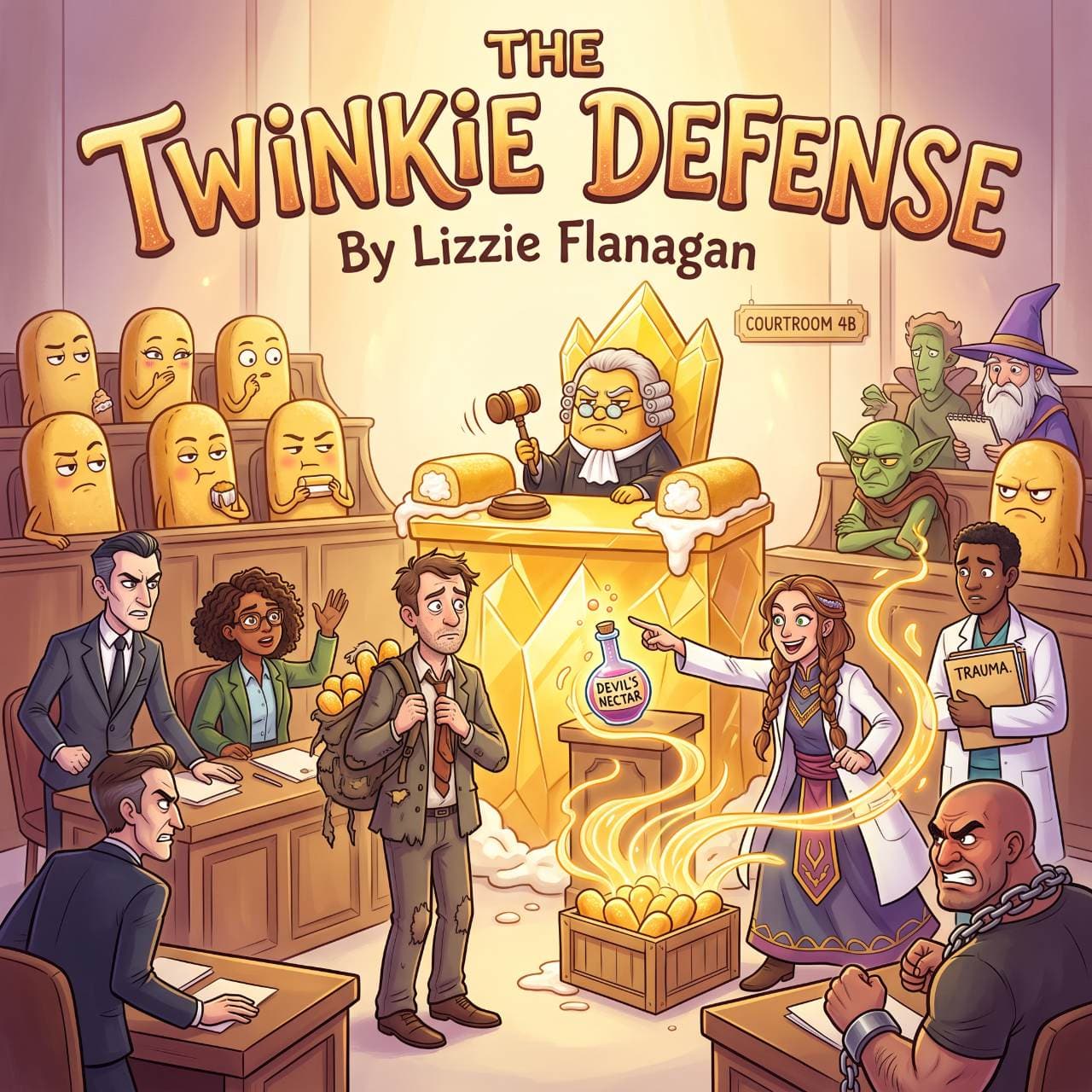

Courtroom 4B had been transformed overnight from a temple of mundane justice into a theater of the absurd. The gallery was packed, word had spread about the "Twinkie Defense" case, and the public had responded with the morbid curiosity usually reserved for meteor strikes or particularly dramatic zoo escapes. Students from the local law school occupied the front rows, taking bets on whether Sylvia could actually pull this off. Retirees filled the middle sections, drawn by the promise of entertainment and the fact that the courthouse had excellent air conditioning. In the back, a group of concerned citizens held signs reading "PERSONAL RESPONSIBILITY MATTERS" and "TWINKIES DON'T STEAL—PEOPLE DO," though one enterprising young man had brought a sign saying "FREE THE TWINKIE ONE," which he waved with the enthusiasm of someone who had never actually met Herbert but appreciated the narrative.
Herbert sat at the defense table, wearing his tailored thrift-store suit and a tie that Sylvia had lent him, which featured small golden scales of justice that, upon closer inspection, were actually shaped like snack cakes. His hands were folded on the table before him, resting on a legal pad where he had written "JUSTICE" at the top and then, beneath it, "DON'T PANIC" in increasingly shaky handwriting.
Sylvia sat beside him, her briefcase organized with the precision of a neurosurgeon's instrument tray. She wore a charcoal suit that suggested competence and a pair of reading glasses on a chain that suggested she was ready to read fine print at a moment's notice. She had spent the morning reviewing her opening statement, which she had rewritten seventeen times, finally settling on a version that she described to Herbert as "part legal argument, part TED Talk, part desperate plea for sanity."
At the plaintiff's table, though in criminal cases they called it the prosecution's table, but Herbert had decided to think of it as "the enemy's table" Marcus Thornberry sat with the relaxed posture of a man who had never lost and couldn't imagine starting now. His suit was charcoal as well, but a shade darker than Sylvia's, as if he had chosen it specifically to absorb light and hope. His assistant Brad sat beside him, arranging exhibits with the nervous energy of someone who knew that their entire career hinged on not handing the wrong document to the judge.
Judge Harriet Henderson entered through her private door with the dramatic timing of someone who had been a theater minor in college before law school had crushed her dreams. She wore her black robes like armor, and her expression suggested that she had already heard every argument both sides were about to make and found them all wanting.
"Be seated," the bailiff intoned, though everyone was already seated, having learned from previous encounters with Judge Henderson that standing when unnecessary was considered "theatrical nonsense."
The judge arranged her papers, adjusted her reading glasses, and surveyed the courtroom with the expression of a disappointed headmistress. "This is Case Number 47-2847, People versus Herbert P. Wimpleton III. The charge is petty theft, disorderly conduct, and public intoxication by sugar. This is a bench trial, which means I am the finder of fact and law. I do not suffer fools, I do not tolerate delays, and I absolutely do not find snack cakes amusing."
She paused, letting her gaze linger on Herbert with the weight of a thousand unwritten citations.
"However," she continued, "I do find the law interesting. And the defense has raised... novel... arguments about diminished capacity and corporate responsibility. We will explore these arguments with the rigor they deserve. We will not explore them with theatrics, emotional appeals, or references to snack cakes as controlled substances. Is that understood?"
"Yes, Your Honor," Sylvia and Thornberry said in unison.
"Good. Mr. Thornberry, you may deliver your opening statement. You have ten minutes. I will be timing you."
Thornberry rose with the smooth grace of a predator who had practiced his pounce. He buttoned his jacket, a gesture that Sylvia had learned meant he was about to be particularly insufferable, and approached the center of the courtroom with the confidence of a man who owned the space.
"Your Honor," he began, his voice carrying the perfect blend of authority and reasonableness, "this is a simple case about a simple crime. The defendant, Herbert Wimpleton, walked into his place of employment, a SuperMart store where he had worked for eleven years, and stole forty-seven dollars worth of snack cakes. He didn't steal them because he was hungry. He didn't steal them because he was poor. He stole them because he wanted them, and he didn't want to pay for them."
Thornberry began to pace, his movements calculated to project sincerity and concern.
"Now, the defense will try to convince you that this wasn't really theft. They'll tell you that Mr. Wimpleton was suffering from something they call 'diminished capacity.' That his boss was mean to him. That the snack cakes were too delicious to resist. That somehow, magically, Mr. Wimpleton lost his free will and became a puppet of pastry."
He paused for effect, turning to face the judge directly.
"But Your Honor, we all face stress. We all face temptation. Every day, millions of Americans walk past vending machines without stealing. Every day, millions of employees receive criticism from their supervisors without committing crimes. The defendant is not special. He is not uniquely susceptible. He is simply a man who chose to steal rather than pay, who chose to break the law rather than follow it, and who is now trying to avoid consequences by blaming everyone but himself."
Thornberry walked back to his table and picked up a Twinkie, an actual Twinkie that had been entered as Exhibit A, which he held up like a prosecutor in a murder trial displaying the murder weapon.
"This is not a mind-altering substance, Your Honor. This is not cocaine. This is not alcohol. This is a snack cake. It contains flour, sugar, eggs, and various preservatives. It does not override free will. It does not compel theft. It sits on shelves, innocent and inert, waiting for people to make the choice to purchase it legally."
He placed the Twinkie down with a gentle finality.
"The People will prove that Herbert Wimpleton knew exactly what he was doing when he opened that vending machine. That he made a conscious choice to steal. That he consumed the evidence in an attempt to destroy it. And that he is fully responsible for his actions. We ask that you find him guilty on all counts, because guilt is the only verdict that justice allows."
Thornberry returned to his seat, unbuttoned his jacket, and nodded at the judge with the satisfaction of a man who had just delivered a masterpiece.
"Ms. Kowalski," Judge Henderson said, "your opening statement. Ten minutes."
Sylvia stood, buttoned her own jacket, a gesture that Herbert interpreted as "game on", and approached the center of the courtroom with a stride that suggested she had been waiting for this moment her entire career.
"Your Honor," she began, "my opponent has just described this as a simple case. He is wrong. This is not a simple case. This is a case about complexity, about the complex interplay between corporate engineering and human psychology, between workplace abuse and mental health, between the food we eat and the choices we think we're making."
She walked to the edge of the jury box, empty, but she addressed it anyway, out of habit and hope.
"Herbert Wimpleton was forty-three years old. He had worked at SuperMart for eleven years, stocking shelves, helping customers, living a life of quiet desperation. He had never committed a crime. Never been arrested. Never even had a parking ticket. He was, by all accounts, the most law-abiding citizen you could imagine."
Sylvia turned to face the judge, her voice dropping into a more intimate register.
"And then, on one Tuesday afternoon, something broke inside him. Not because he was weak. Not because he was criminal. But because he was human. Because he had been pushed past his breaking point by a boss who tormented him, and because he was confronted with a product specifically engineered to exploit that vulnerability."
She walked to the evidence table and picked up the Hostess documents that Dr. Zyx had provided.
"The defense will present evidence that Hostess Corporation, the manufacturer of Twinkies, employs food scientists whose sole job is to maximize addiction. They call it 'craveability.' They call it 'repeat purchase optimization.' They calculate something called the 'bliss point', the precise ratio of sugar, fat, and salt that creates maximum craving with minimum satiety. They don't want you to eat one Twinkie. They want you to eat twenty. They want you to be unable to stop."
Sylvia placed the documents down and spread her hands in a gesture of openness.
"We will present expert testimony from Dr. Bartholomew Zyx, formerly of Frito-Lay, who will explain the science of supernormal stimuli, how modern processed foods are engineered to trigger dopamine responses that override rational decision-making. We will present testimony from Dr. Penelope Snackwell , clinical psychologist, who will explain how workplace stress impairs executive function and impulse control. And we will present evidence that Mr. Wimpleton's boss, Dwayne McAllister, created conditions of such extreme emotional distress that Mr. Wimpleton's capacity for rational choice was compromised."
She turned to look at Thornberry, her gaze steady.
"My opponent asks you to believe that Herbert Wimpleton simply chose to steal. We ask you to consider whether he had a choice at all, or whether he was the victim of forces larger than himself: a corporation that engineered addiction, an employer who engineered despair, and a system that blames the individual for succumbing to pressures that system created."
Sylvia returned to her table, her voice rising to a crescendo.
"This case is not about a man who stole snack cakes. It's about whether we, as a society, are willing to look honestly at how our institutions shape our behavior. It's about whether we believe in compassion or just condemnation. We ask you to find Herbert Wimpleton not guilty, not because he didn't take the Twinkies, but because he was not in control of his actions when he did. Thank you."
She sat down, her heart pounding, and whispered to Herbert, "How was that?"
"You made me sound like a tragic hero," Herbert whispered back.
"You are a tragic hero," Sylvia said. "Now shut up and look dignified while they present their case."
Judge Henderson made a note on her pad. "The People may call their first witness."
Thornberry rose with the satisfaction of a man about to begin a massacre. "The People call Officer Maria Taylor."
Officer Taylor was sworn in with the efficiency of someone who had done this hundreds of times. She took the stand in her crisp uniform, her posture perfect, her expression professional. She described arriving at the bus bench, finding Herbert surrounded by wrappers, attempting to eat a Donette with his teeth while crying.
"Officer Taylor," Thornberry asked, "did the defendant appear to be in distress?"
"He was crying, sir."
"Did he appear to be in physical danger?"
"No, sir."
"Did he appear to understand that he was being arrested?"
"He said, and I quote, 'I couldn't help myself. Hostess made me do it.'"
"Did he appear confused about his surroundings?"
"No, sir. He knew he was on a bus bench. He knew he had stolen the items. He was quite specific about the brand names."
Thornberry turned to the judge. "No further questions."
Sylvia rose for cross-examination, her manner respectful but probing. "Officer Taylor, you said he was crying. Did he seem sad to you? Or something else?"
"He seemed... overwhelmed. Like he didn't know how he'd gotten there."
"Did he resist arrest?"
"He said his legs had gone to sleep. We had to help him stand."
"And when you transported him, did he seem coherent?"
"He talked the entire way about 'the golden sponge cake of liberation.' I wasn't sure if he was joking or not."
Sylvia nodded. "Thank you, Officer. Nothing further."
"The People call Dwayne McAllister."
Dwayne approached the stand with the nervous energy of a man who had been told his testimony would determine whether he kept his job. He was wearing a suit that appeared to have been purchased for a different-shaped person, and his tie featured what he apparently believed were "power colors" but were actually just "clashing horribly."
Thornberry approached him with the warmth of a crocodile. "Mr. McAllister, you are the defendant's former supervisor?"
"Yes, sir. I was the Aisle Supervisor for Non-Perishables."
"On the day of the incident, did you have a conversation with Mr. Wimpleton?"
"I did. A motivational discussion about his enthusiasm levels."
"How would you characterize that conversation?"
Dwayne shifted in his seat. "I was trying to help him reach his potential. He seemed... lacking in pep."
"Did you raise your voice?"
"Only to be heard over the ventilation system."
"Did you throw anything at him?"
There was a long pause. "Not... at him. Near him. For emphasis."
Thornberry smiled. "And after this motivational discussion, did Mr. Wimpleton appear distressed?"
"He appeared the same as always. Which is to say, somewhat distressed. He's a distressed kind of guy."
"Did he say anything about stealing snack cakes?"
"No. He said he'd improve. Then he walked toward the vending machines, and I went to check on the pharmacy section."
"No further questions."
Sylvia rose, and her approach was that of a cat who had spotted a wounded bird. "Mr. McAllister, you've been written up three times for creating a hostile work environment, is that correct?"
Dwayne's face reddened. "Those were misunderstandings."
"You made employees wear signs saying 'I am a disappointment'?"
"It was a visualization exercise."
"You threw a stapler at Herbert?"
"It was plastic!"
"Did you or did you not tell Herbert that he lacked 'pep,' 'zest,' and 'pizzazz,' and that customers could 'smell his apathy like BO for the soul'?"
Dwayne looked at Thornberry for help, but the prosecutor was studying his nails. "I may have used those words. But I was trying to help!"
"Help him what? Have a psychological breakdown?"
"Objection!" Thornberry called.
"Sustained," Judge Henderson said. "Ms. Kowalski, rein in the theatrics."
"Withdrawn. Mr. McAllister, are you aware that corporate headquarters had warned you six months prior that you were 'one incident away from termination'?"
"I... that was taken out of context."
"Are you aware that three employees had filed complaints about your 'motivational techniques,' including one who said you made her do trust falls from the loading dock?"
"She caught her! Mostly!"
Sylvia turned to the judge. "Nothing further. Though I reserve the right to recall this witness after the defense presents its evidence."
Dwayne stumbled from the stand, his "power tie" askew, his dignity in tatters.
"The People call Dr. Sanford Richter."
Dr. Richter took the stand with the authority of a man who had testified in two hundred cases and had been wrong in none of them, at least according to his own reckoning. He described his credentials at length: Harvard Medical School, residency at Johns Hopkins, thirty years of psychiatric practice, author of seventeen papers on criminal responsibility.
"Dr. Richter," Thornberry asked, "in your professional opinion, can exposure to snack foods create a state of diminished capacity?"
"Absolutely not," Richter said with the certainty of a man discussing gravity. "Food is not a controlled substance. While certain foods may produce pleasure, they do not override the prefrontal cortex's executive function. The defendant's claim that Twinkies made him steal is medically absurd."
"And what about workplace stress? Can that create diminished capacity?"
"Stress is a normal part of life. Everyone experiences stress. Most people do not respond by stealing. The defendant's reaction was idiosyncratic and unreasonable, suggesting poor character rather than diminished capacity."
"Thank you, Doctor. No further questions."
Sylvia approached for cross-examination, her manner respectful but firm. "Dr. Richter, you said the defendant's reaction was 'idiosyncratic.' Does that mean impossible?"
"It means unusual."
"Is it possible that different people have different neurochemical responses to the same stimuli?"
"Possible, but—"
"Is it true that you've never published any research on food addiction?"
Richter shifted. "It's not my specialty."
"Is it true that you testified in the Harrison case that a defendant who killed three people while experiencing alcohol withdrawal was fully responsible for his actions?"
"That was different. Alcohol is a recognized intoxicant."
"And is it true that you have never, in your thirty years of practice, treated a patient for eating disorder or food addiction?"
"I've referred cases to specialists."
"So when you say that Twinkies cannot create diminished capacity, you're speaking outside your area of expertise?"
"I am speaking as a psychiatrist with general expertise in..."
"Thank you, Doctor. Nothing further."
Thornberry rose for redirect. "Dr. Richter, one question. In your expert opinion, is Herbert Wimpleton responsible for his actions on the day of the theft?"
"Absolutely. He knew what he was doing. He made a choice. He is responsible."
"No further questions."
Judge Henderson made a note. "The People rest their case."
The judge looked at the clock. "It's nearly noon. We'll break for lunch and resume at one-thirty with the defense's case. I remind both counsel that I do not allow working lunches in my courtroom. Eat somewhere else."
As the courtroom cleared, Herbert turned to Sylvia. "How are we doing?"
"We're doing fine," Sylvia said, though her voice suggested she was calculating odds. "They've established that you stole the Twinkies and that you knew what you were doing. Now we have to prove that you couldn't help yourself. We have to prove that science backs up your story."
"And can we?"
Sylvia looked at her notes, at the expert reports from Zyx and Snackwell, at the Hostess internal documents.
"We're about to find out," she said.