


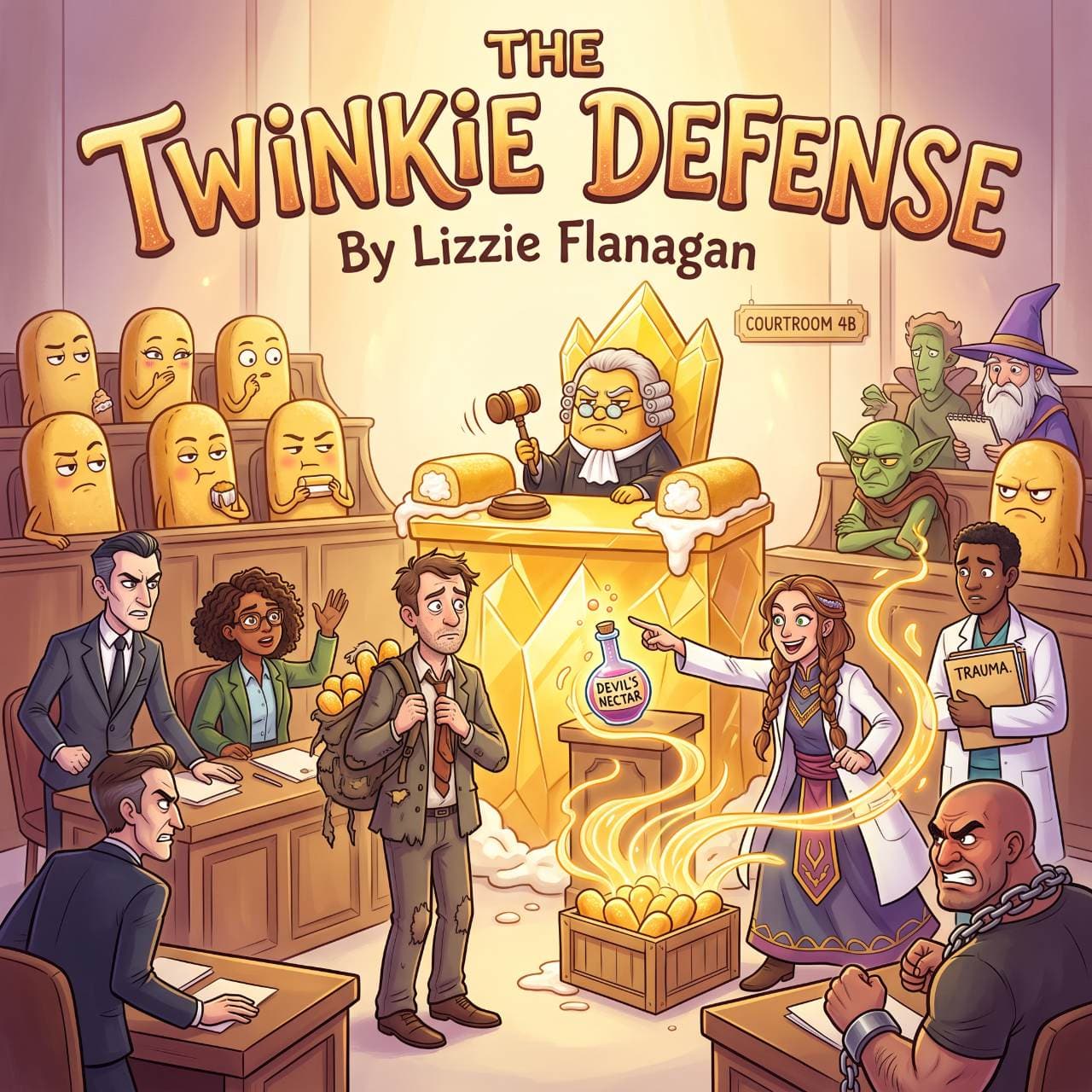

The offices of Kowalski & Associates, though "Associates" was a generous term since Sylvia was the only attorney and her "associates" consisted of a part-time paralegal named Doug who was mostly interested in fantasy football and a succulent plant named Justice that she was slowly killing through neglect, occupied the second floor of a building that had been constructed during an architectural period best described as "Depression-Era Regret." The walls were thin enough to hear the divorce proceedings next door, and the heating system produced a smell that Sylvia had convinced herself was "vintage charm" but was actually "dying rodent."
Herbert sat in the client chair, which had been designed by someone who believed that comfort was a privilege, not a right. He was wearing a suit that he had purchased at a thrift store the previous day, a navy blue number that had apparently belonged to a much larger man, possibly a retired linebacker or a successful bear, and Herbert had attempted to tailor it himself using safety pins and determination. The result made him look like a partially deflated parade balloon.
"Discovery," Sylvia said, pacing behind her desk with the energy of someone who had consumed too much coffee and too little hope, "is the phase where we get to demand evidence from the prosecution. But it's also where they get to demand evidence from us. Which means we need evidence, Herb. Actual evidence. Not just feelings about snack cakes."
"I have feelings," Herbert said. "I have so many feelings."
"Feelings aren't admissible. Expert testimony is. Documented research is. We need to prove that Twinkies are engineered to be addictive, that your boss created a hostile work environment, and that the combination of these factors produced a state of diminished capacity." She stopped pacing and fixed him with a look. "Do you understand what I'm saying?"
"You need me to find a scientist who will say that Twinkies are basically cocaine."
"I need you to find an expert who will say that Twinkies produce neurochemical responses that can override rational decision-making in susceptible individuals under conditions of extreme stress." She paused. "But yes, basically cocaine with better marketing."
Herbert nodded solemnly. "I know just the person."
"Who?"
"Dr. Reginald P. Finklestein. He taught my community college nutrition class in 2003. He had very strong opinions about high fructose corn syrup. He once called it 'the devil's nectar' and threw a textbook at a vending machine."
Sylvia made a note. "Does he have credentials?"
"He has a mustache that suggests authority."
"We're going to need more than facial hair, Herb."
Over the next seventy-two hours, Sylvia and Herbert embarked on what they would later call "The Great Expert Witness Hunt," though it was less a hunt and more a desperate scramble through the underbrush of academic obscurity, chasing experts who had either retired, died, or developed sudden cases of "I don't want to be associated with this" when they learned the details of the case.
Their first stop was the offices of Dr. Marjorie Starch, a food scientist who had written a paper in 1987 about "mouthfeel engineering" in processed foods. She received them in a laboratory that smelled of artificial butter and broken dreams, surrounded by equipment that looked like it had been designed to torture vegetables.
"Twinkies," Dr. Starch said, holding one up to the light like a jeweler examining a flawed diamond. "Classic case of optimized palatability. The sugar-fat-salt trifecta. The vanillin, note the 'in,' not actual vanilla. The polysorbate 60, which serves no nutritional purpose but extends shelf life indefinitely. These things could survive nuclear war."
"So you'll testify?" Sylvia asked.
Dr. Starch placed the Twinkie down with the gentleness of someone handling hazardous material. "I can testify that they're engineered to taste good. I cannot testify that they override free will. That would require... different expertise."
"What kind of expertise?"
"Neurochemistry. Addiction psychology. Someone who studies the brain's reward pathways and how they're hijacked by supernormal stimuli."
"Supernormal stimuli?" Herbert asked.
"Stimuli that are more stimulating than anything in nature. Like a bird that will sit on a wooden egg painted with polka dots instead of its own real eggs because the dots are more visually arresting. Or a man who will steal twenty-four packages of snack cakes because they're engineered to trigger dopamine responses that natural foods can't match."
Herbert gasped. "That's exactly what happened to me!"
"I know," Dr. Starch said. "It's textbook. But I'm not a neurochemist. I'm a food texture specialist. My expertise ends at the tongue, not the brain."
"Can you recommend someone?" Sylvia pressed.
Dr. Starch thought for a moment, then wrote a name on a piece of paper. "Dr. Bartholomew Q. Zyx. He's... controversial. But he's the leading researcher in food addiction and neurochemical manipulation. He used to work for Frito-Lay, then had a crisis of conscience. Now he runs a small research lab out of a converted warehouse in the industrial district. Tell him Marjorie sent you. And..." She hesitated. "Be careful. He's been through some things."
The converted warehouse looked like the set of a horror movie about mad scientists, if mad scientists were deeply concerned with sodium levels and umami profiles. The exterior was covered in graffiti that appeared to be ancient Sumerian but was actually just tags from local gangs who had given up on the building as "too weird." The interior was worse—filled with beeping machines, bubbling liquids, and posters with slogans like "SUGAR: THE LEGAL OPIOID" and "RESIST THE CRUNCH: SAY NO TO ENGINEERED ADDICTION."
Dr. Bartholomew Q. Zyx met them in a lab coat that had been white at some point but was now stained with various substances that Herbert didn't want to identify. He was sixty-ish, bald except for a ring of hair that he had grown long and braided into a ponytail, and he had the wild eyes of someone who had seen the abyss and discovered it was filled with cheese powder.
"Marjorie sent you," he said. It wasn't a question. "She always sends the desperate ones. The hopeless cases. The lost souls who have been victimized by the snack food industrial complex."
"Are you saying you'll help?" Sylvia asked.
"I'm saying I understand." Zyx gestured for them to follow him deeper into the warehouse, past machines that appeared to be measuring the electrical conductivity of potato chips and into an office that contained nothing but a desk, three chairs, and a life-size cardboard cutout of Chester Cheetah with the eyes scratched out.
"Sit," Zyx commanded. "Tell me everything. Leave nothing out. I need to know about the Twinkies. The texture. The mouthfeel. The emotional state. The boss. Everything."
Herbert told him. He told him about Dwayne and the "pep talk." He told him about the vending machine and the maintenance panel. He told him about the fourteen Twinkies and the bus bench and the crying. When he finished, Zyx was silent for a long time, stroking his braided ponytail with the intensity of a man solving differential equations in his head.
"This is perfect," Zyx whispered.
"Perfect?" Sylvia asked.
"Textbook supernormal stimulus combined with cortisol-induced decision impairment. The Twinkie isn't just a cake, Ms. Kowalski. It's a delivery system for a precise ratio of sugar, fat, and salt designed to activate the nucleus accumbens, the brain's reward center, with an efficiency that natural foods can't match. It's not food. It's a drug delivery device disguised as food."
"Can you prove that?" Sylvia asked.
"I can prove that rats will ignore cocaine in favor of sugar solutions under certain conditions. I can prove that brain scans show identical activation patterns between snack food consumption and substance abuse in susceptible individuals. I can prove that Hostess and companies like them employ 'food engineers'—not chefs, not bakers, but engineers—whose sole job is to maximize the 'bliss point,' the precise concentration of sugar, fat, and salt that creates maximum craving with minimum satiety."
"Will you testify?" Herbert asked, his voice trembling with hope.
Zyx stood and walked to a filing cabinet that appeared to contain nothing but files labeled with dates and names of snack foods. He pulled out a folder marked "TWINKIES—INTERNAL DOCUMENTS" and handed it to Sylvia.
"Three years ago, I was hired as a consultant by a law firm pursuing a class action against Hostess. They wanted to prove that the company knowingly engineered addictive products. I gathered evidence. Internal memos. Research studies. The 'bliss point' calculations. The whole ugly truth." He paused. "Then Hostess settled. Sealed the records. Paid everyone off. The case died. But I kept copies."
Sylvia opened the folder and her eyes widened. "These are... this is..."
"Gold," Zyx said. "Pure gold. Internal Hostess documents discussing 'craveability metrics' and 'repeat purchase optimization.' Memos about how to increase 'eating frequency' among 'heavy users.' They're not selling food, Ms. Kowalski. They're selling addiction. And they know it."
"This is incredible," Sylvia said, flipping through pages. "But we still need to prove that Herbert was in a state of diminished capacity. That he couldn't control his actions."
"That's where I come in," said a voice from the doorway.
They turned to see a woman in her fifties, wearing a tweed jacket that suggested both authority and the possibility that she owned several cats. She had the calm, assessing gaze of a professional who had heard every possible human problem and filed them into taxonomies.
"Dr. Penelope Snackwell," Zyx said. "Clinical psychologist. Specializes in workplace stress and decision-making under duress. I called her."
"You called her?" Sylvia asked.
"I told you, Ms. Kowalski. I understand this case. I've been waiting for a case like this. A perfect storm of engineered addiction and workplace abuse. A chance to expose the system." Zyx's eyes gleamed with the fervor of a convert. "Dr. Snackwell is the final piece. She can evaluate Herbert. She can testify about his mental state. She can connect the dots between Dwayne's 'emotional distress' and Herbert's 'temporary insanity.'"
Dr. Snackwell set down her briefcase and regarded Herbert with the clinical detachment of someone who had seen worse but was still impressed by the creativity of human suffering.
"Mr. Wimpleton," she said, "I'd like to schedule a series of evaluations. Psychological testing. Stress response analysis. We'll need to establish a baseline for your decision-making capacity under normal conditions, then demonstrate how that capacity was compromised by the combination of your workplace environment and exposure to supernormal food stimuli."
"How long will this take?" Herbert asked.
"Three days. Intensive. Are you willing?"
Herbert thought about the Twinkies in the evidence locker. He thought about Dwayne's tie and his talk of "pep." He thought about Linda, somewhere out there with her tractor enthusiast, probably eating organic vegetables and feeling superior.
"I'm willing," he said. "I'm more than willing. I'm... what's the word?"
"Committed?" Sylvia suggested.
"Obsessed," Herbert corrected. "Let's call it obsessed."
The next three days were the strangest of Herbert's already strange life. Dr. Snackwell put him through a battery of tests that seemed designed less to measure his sanity and more to prove that sanity was a flexible concept. There were Rorschach tests ("What do you see?" "A Twinkie." "It's a butterfly." "It's a Twinkie disguised as a butterfly."), stress response evaluations where he was subjected to recordings of Dwayne's voice while his cortisol levels were monitored, and food exposure trials where he was placed in MRI machines and shown images of snack cakes while technicians watched his brain light up like a Christmas tree.
"The results," Dr. Snackwell announced on the third day, "are remarkable. Mr. Wimpleton shows elevated stress responses to authoritarian management styles, what we call 'boss-induced cortisol spikes.' When combined with exposure to high-palatability foods, his prefrontal cortex, the decision-making center, shows markedly reduced activity. Essentially, under conditions of workplace stress, his ability to resist temptation is neurologically compromised."
"So he really couldn't help himself?" Sylvia asked.
"Neurologically? No. The combination of acute stress and exposure to engineered supernormal stimuli created a perfect storm. His impulse control was offline. His reward system was hijacked. He was, for that brief window, not in control of his actions in any meaningful sense."
"Will that hold up in court?" Herbert asked.
"It will be challenged," Dr. Snackwell admitted. "The prosecution will bring in their own experts. They'll argue that everyone faces stress, that millions of people resist Twinkies every day, that personal responsibility still exists. But we have science on our side. And we have something else."
"What's that?" Herbert asked.
"Sympathy," Dr. Snackwell said. "You're not a criminal, Mr. Wimpleton. You're a victim. A victim of a system designed to break your will and then sell you the cure. You're every overworked, underpaid, stressed-out employee who ever stared at a vending machine and felt their soul cry out for golden sponge cake. The jury, if we had one, would love you. Judge Henderson... well, she's harder to read. But the facts are the facts."
Meanwhile, Sylvia was conducting her own investigation into the legal side of the case. She filed discovery motions demanding access to SuperMart's employee records, specifically regarding Dwayne McAllister's management history. What she found was a paper trail of complaints, disciplinary actions, and "sensitivity training" that read like a master class in how not to lead people.
Dwayne had been written up three times for "creating a hostile work environment." There were complaints about his "motivational techniques," which included throwing staplers at underperforming employees, making them wear signs that said "I AM A DISAPPOINTMENT," and forcing them to participate in "trust falls" from distances that guaranteed injury.
Most damning was a memo from SuperMart's corporate office, dated six months prior, warning that Dwayne was "one incident away from termination" and that the company was "exposed to significant liability" due to his "management style."
"This is gold," Sylvia told Herbert, showing him the documents. "Dwayne isn't just a bad boss. He's a documented menace. The company knew he was a problem and kept him anyway. We can argue that they created the conditions that led to your breakdown."
"So we're suing SuperMart too?" Herbert asked.
"We're threatening to. Which gives us leverage. If they want to avoid a lawsuit, they might pressure the prosecutor to drop the charges. Or at least reduce them to a fine and community service."
"No," Herbert said, surprising himself with his own firmness. "I don't want leverage. I want justice. I want a trial. I want the world to know what happened to me. What happens to millions of people every day. I want to stand in that courtroom and say, 'Here is what Hostess did. Here is what SuperMart did. Here is what happened when you push a man too far and then wave a Twinkie in his face.'"
Sylvia looked at him with new respect. "You've changed, Herb. When I first met you, you were a sad man with chocolate on his face. Now you're... what? A crusader?"
"I'm a man with a mission," Herbert said. "Also, I'm still a sad man with chocolate on his face. But now I have experts. And documents. And a braided ponytail scientist on my side."
The prosecution, meanwhile, was not idle. Assistant District Attorney Marcus T. Thornberry had been assigned to the case, and he was not amused. Thornberry was forty-five, handsome in a way that suggested he had never experienced genuine emotion, and possessed a win-loss record that made him the most feared prosecutor in the county. He had never lost a case, largely because he refused to take cases he might lose, and he had only taken Herbert's case because his boss had insisted that "someone needs to handle the Twinkie idiot before he becomes a meme."
Thornberry reviewed the file in his pristine office, surrounded by diplomas and awards and photos of himself shaking hands with politicians. He read Dr. Zyx's expert report and Dr. Snackwell's psychological evaluation. He looked at the Hostess internal documents. And he smiled, a thin, cold expression that did not reach his eyes.
"Diminished capacity," he said to his assistant, a young law school graduate named Brad who was still naive enough to believe that justice and winning were the same thing. "The oldest trick in the book. They want to argue that snack cakes made him do it. That his boss was mean. That he's not responsible for stealing forty-seven dollars worth of inventory."
"Do you think it will work?" Brad asked.
"With a jury, maybe. Juries are sentimental. They like underdogs. But we're not getting a jury. Judge Henderson assigned herself. She hates emotional appeals. She hates excuses. She especially hates defendants who waste the court's time with novel theories."
"So we're in good shape?"
"We're in excellent shape. But I want to be thorough. I want to depose their experts. I want to cross-examine this Wimpleton character until he cries. I want to bring in our own experts who will say that Twinkies are just food, that stress is part of life, and that personal responsibility still means something in this country."
Brad nodded, taking notes. "And the Hostess documents? The internal memos about 'craveability'?"
Thornberry waved a hand dismissively. "Irrelevant. Even if Hostess makes addictive products, and I'm not conceding that they do, millions of people resist them every day. The defendant's weakness is not Hostess's fault. It's his fault. And I'm going to prove it."
The depositions began the following week. Thornberry brought in Dr. Sanford P. Richter, a psychiatrist with impeccable credentials and the personality of a man who had never experienced joy. Richter had testified in over two hundred cases, always for the prosecution, always arguing that defendants were responsible for their actions regardless of their circumstances.
"Dr. Richter," Thornberry asked during the deposition, "is it possible that exposure to snack foods can create a state of diminished capacity?"
"Absolutely not," Richter said, his voice the auditory equivalent of plain toast. "Food is not a mind-altering substance in the legal sense. While certain foods may produce pleasure, they do not override the prefrontal cortex's executive function. A person who steals while hungry is still responsible for their theft. A person who steals while stressed is still responsible. The defendant's actions were the result of choice, not compulsion."
"And what about workplace stress? Could a difficult boss create conditions that impair judgment?"
"Stress is ubiquitous," Richter said. "Everyone experiences stress. Most people do not respond to stress by stealing. The defendant's reaction was idiosyncratic and unreasonable, which suggests poor impulse control rather than diminished capacity."
Sylvia, who was also present at the deposition, tried to object, but depositions didn't really work that way. She could only take notes and plan her cross-examination for the trial.
"Your witness," Thornberry said, smirking.
Sylvia leaned forward. "Dr. Richter, have you ever eaten a Twinkie?"
"Excuse me?"
"A Twinkie. Have you ever consumed one?"
Richter adjusted his glasses. "I don't see how that's relevant."
"Humor me."
"I ate one once. In 1987. I found it cloying and unsatisfying."
"Did you eat just one? Or did you stop at one?"
"I ate one. I had no desire for more."
"Is it possible, Doctor, that different people have different neurochemical responses to the same stimuli? That what produces mild distaste in you might produce compulsive craving in someone else?"
"Anything is possible," Richter allowed. "But the law deals in probabilities, not possibilities. The vast majority of people can eat one Twinkie and stop. The defendant's inability to do so suggests a character flaw, not a medical condition."
"Character flaw," Sylvia repeated. "Not a medical condition."
"Correct."
"Thank you, Doctor. I look forward to discussing your expertise in character flaws at trial."
The depositions continued for days. Thornberry deposed Dr. Zyx, challenging his credentials and suggesting that his "crisis of conscience" at Frito-Lay was actually a firing for erratic behavior. He deposed Dr. Snackwell, suggesting that her methods were "soft science" and that she was "creating excuses for criminals." He even deposed Dwayne McAllister, who appeared in a suit that appeared to have been purchased for a funeral and testified that he was "just trying to help Herb reach his potential" and that his management style was "tough love."
"Did you throw a stapler at Mr. Wimpleton?" Thornberry asked.
"Once," Dwayne admitted. "But it was a plastic stapler. And he ducked."
"Did you make employees wear signs saying 'I am a disappointment'?"
"That was a motivational exercise. To help them visualize their areas for improvement."
"And did you, on the day of the theft, subject Mr. Wimpleton to what you called 'a frank discussion about enthusiasm'?"
"I may have mentioned that he lacked pep."
"Thank you, Mr. McAllister. No further questions."
Sylvia cross-examined Dwayne for three hours, extracting admissions about his "motivational techniques," his history of complaints, and his complete lack of training in actual management. By the time she was done, Dwayne was sweating through his funeral suit and Thornberry was no longer smirking.
The final deposition was Herbert himself. Thornberry brought him into a conference room and subjected him to four hours of questioning designed to break him, to make him admit that he was just a thief looking for an excuse.
"Mr. Wimpleton," Thornberry said, leaning forward with predatory intensity, "you ate fourteen Twinkies on a bus bench. Is that correct?"
"Yes."
"Did anyone force you to eat them?"
"No."
"Did anyone hold a gun to your head and say, 'Eat the Twinkies or die'?"
"No."
"You chose to eat them. You chose to steal them. You made a series of conscious decisions that led to your arrest. Isn't that right?"
Herbert was silent for a long moment. He thought about the vending machine. He thought about Dwayne's tie. He thought about the way the Twinkies had called to him, not with words, but with pure chemical promise.
"I thought I was choosing," Herbert said quietly. "But I wasn't. I was following a script that had been written for me. By Hostess. By Dwayne. By forty-three years of disappointment. I was a puppet, Mr. Thornberry. And I'm just now learning where the strings were attached."
Thornberry stared at him, unsettled by the sincerity in Herbert's voice. This wasn't the defendant he had expected. This wasn't a man making excuses. This was a man who genuinely believed he had been wronged by forces larger than himself.
"Your client is delusional," Thornberry told Sylvia after the deposition.
"My client is enlightened," Sylvia corrected. "And in three days, a judge is going to hear the whole story. Are you ready?"
Thornberry smiled his cold smile. "I've never been more ready for anything in my life."
The night before the trial, Herbert sat in his apartment, a one-bedroom efficiency that smelled of ramen and loneliness, and looked at the suit he would wear. It was the same thrift store suit, but he had taken it to an actual tailor who had performed miracles with needle and thread. It fit now. It looked almost respectable.
On his table sat a single Twinkie. He had bought it legally, with cash, from a convenience store. He hadn't eaten it. He just looked at it, studying it like a general studies a map of enemy territory.
"Tomorrow," he told the Twinkie, "everything changes. Tomorrow, the world learns the truth about you. About me. About all of it."
The Twinkie said nothing. It just sat there, golden and perfect and filled with creme, silently confident that it had already won.
Herbert went to bed and dreamed of vending machines that stretched to infinity, each one humming with the promise of sweetness, each one guarded by a man in a terrible tie who threw staplers and demanded pep.
The trial began at nine AM sharp.