


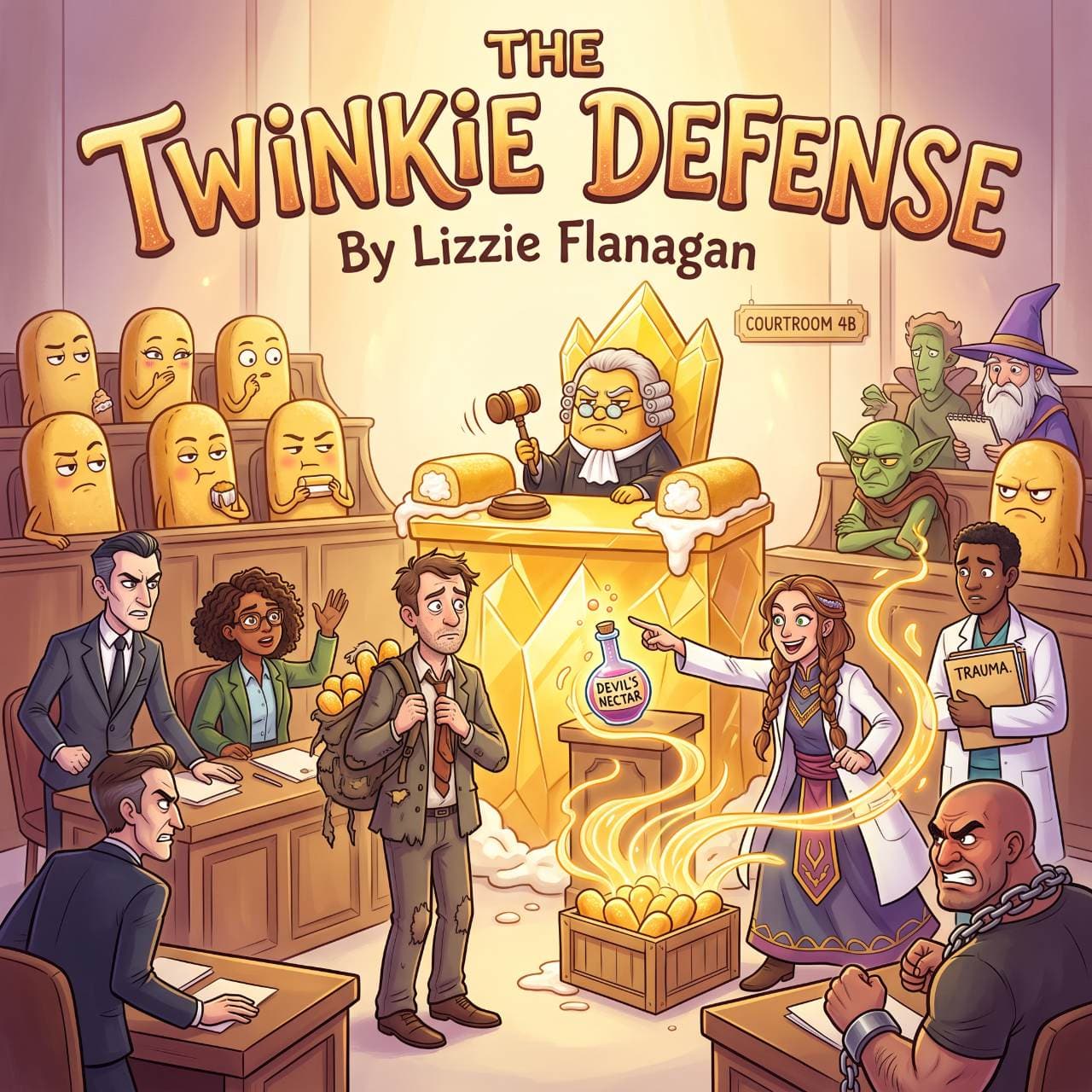

The fluorescent lights of the SuperMart on 47th Street hummed with that particular frequency that made bees commit suicide and retail employees contemplate arson. It was a Tuesday, statistically the most forgettable day of the week, and Herbert P. Wimpleton III was having what his therapist would later describe as "a complete psychological break disguised as a snack attack."
Herbert was forty-three years old, divorced twice, and possessed the kind of face that suggested he had been disappointed by soup. He worked in aisle seven, which contained paper products, light bulbs, and the occasional existential crisis. His name tag read "Herb—Here to Help!" though the exclamation point had been added by management against his will, and he had spent the last six months trying to scratch it off with his thumbnail during slow periods.
On this fateful Tuesday, Herbert's boss, Dwayne "The Chain" McAllister, had called him into the break room for what Dwayne called "a frank discussion about enthusiasm" and what Herbert's nervous system registered as "emotional waterboarding."
Dwayne was fifty-six, built like a filing cabinet that had been left in the rain, and possessed the managerial philosophy of a velociraptor with an MBA. He wore a tie that appeared to have been designed by someone who had only heard colors described secondhand, and he smelled perpetually of menthol cigarettes and broken dreams.
"Herbert," Dwayne had said, leaning back in a plastic chair that groaned like a dying animal, "I'm seeing a distinct lack of pep in your step."
Herbert, who had been stocking toilet paper for three hours while contemplating the infinite void of his existence, blinked slowly. "Pep?"
"Pep. Zest. Pizzazz." Dwayne made a gesture that he apparently believed conveyed pizzazz but actually looked like he was being attacked by invisible bees. "The customers can smell apathy, Herbert. It's like BO for the soul."
"I see," Herbert said, though he did not see. What he saw was the vending machine in the corner, which contained three remaining packages of Twinkies that had been calling to him with the siren song of high fructose corn syrup and polysorbate 60.
"Your numbers are down," Dwayne continued, consulting a clipboard that Herbert suspected contained nothing but doodles of motorcycles and angry notes about his ex-wife. "You moved forty-seven percent fewer units than Gerald in Sporting Goods last quarter."
"Gerald sells basketballs during March Madness," Herbert pointed out, his voice the sonic equivalent of beige. "I sell toilet paper. There's no Toilet Paper Madness. There's no ESPN special about the Big Flush."
Dwayne's left eye twitched, a sign that Herbert had learned meant either that Dwayne was about to fire someone or that he was experiencing gas. "That's exactly the kind of attitude I'm talking about. Where's your passion, Herbert? Where's your drive?"
It was at this precise moment that something inside Herbert, something that had been quietly fermenting for forty-three years of disappointments, from his failed marriage to Linda (who left him for a man who collected vintage tractors) to his abandoned dreams of becoming a professional yodeler, something snapped.
But it didn't snap loudly. It snapped quietly, like a twig in a forest where no one was listening, and it snapped in the direction of the vending machine.
"I'll show you passion," Herbert whispered, though not loud enough for Dwayne to hear.
"What's that?" Dwayne asked.
"I said I'll improve," Herbert lied.
Dwayne nodded, satisfied, and waddled off to terrorize the pharmacy section, leaving Herbert alone with the vending machine and his rapidly deteriorating sanity.
Now, it should be noted that Herbert had not eaten breakfast that morning. Or dinner the night before. He had been surviving on coffee and spite for approximately thirty-six hours, and his blood sugar had reached a level that scientists would later describe as "medically fascinating" and "technically impossible without supernatural intervention."
The vending machine hummed. The Twinkies sat in their plastic packaging, golden and tubular and filled with a cream filling that the Hostess Corporation insisted was "creme" with an 'e' because that made it legally distinct from actual cream, which would require refrigeration and standards.
Herbert fished in his pockets and found seventy-three cents. The Twinkies cost $1.50. The machine did not accept credit cards. The universe, Herbert decided, was conspiring against him.
He could have walked to the break room refrigerator, where he had left a modest turkey sandwich on wheat bread. He could have driven to the McDonald's across the street. He could have simply waited until his shift ended and purchased the Twinkies with proper currency like a functioning member of society.
Instead, Herbert P. Wimpleton III committed the first crime of his previously law-abiding life.
He reached into his backpack, a canvas bag he had received at a conference about "Synergizing Your Personal Brand" that he had attended in 2019 while trying to impress a woman from HR who turned out to be married to his cousin, and he began to fill it with Twinkies.
Not one package. Not two. All of them.
The vending machine contained twenty-four individual packages of Twinkies, each containing two golden snack cakes, and Herbert took them all. He didn't smash the glass. He didn't use a crowbar. He simply opened the maintenance panel, a skill he had acquired during his brief, disastrous stint as a vending machine repairman in 2015, and he removed the inventory with the methodical precision of a man who had completely lost his grip on reality.
Twenty-four packages. Forty-eight Twinkies. Approximately 7,200 calories of sponge cake and petroleum-based filling.
He didn't stop at the Twinkies. In the adjacent machine, he found Hostess CupCakes, chocolate with the distinctive white squiggle on top that looked like a signature from a god who had given up on humanity. He took those too. And the Donettes. And the Sno Balls, though he hated coconut, because at this point the crime had developed its own momentum.
His backpack, which had previously contained a paperback copy of The 7 Habits of Highly Effective People (unread), a lint roller, and his hopes and dreams (crushed), was now entirely filled with Hostess products. It weighed approximately eleven pounds and made a crinkling sound when he moved that he would later describe as "the sound of liberation" and his attorney would describe as "evidence."
Herbert shouldered the bag, walked past the security camera, which captured him on film with an expression that psychologists would spend months trying to categorize, and exited the store through the loading dock.
He walked for three blocks before he realized he was still wearing his "Herb—Here to Help!" name tag. He walked for two more blocks before he realized he had forgotten his car in the SuperMart parking lot. He walked for another block before he sat down on a bus bench and began to eat.
He started with a Twinkie.
The first bite was transcendent. The golden sponge cake, which had been engineered to survive nuclear war and still taste exactly the same, dissolved on his tongue with the chemical sweetness of a thousand childhoods that had never actually happened. The creme filling, spelled with an 'e' to avoid FDA scrutiny, filled his mouth with a texture that was simultaneously like nothing in nature and yet weirdly compelling, like a sunset painted by someone who had only read about colors in a book.
He ate the second Twinkie. Then the third. Then he lost count.
By the time Officer Marquez found him, Herbert had consumed fourteen Twinkies, six CupCakes, and was attempting to open a package of Donettes with his teeth while crying softly.
"Sir?" Officer Marquez said, approaching with the caution of a man who had been trained for armed assailants but not for whatever this was.
Herbert looked up. His face was covered in chocolate. His hands were shaking from the sugar rush. His eyes had the thousand-yard stare of a man who had seen things, specifically, he had seen the inside of forty-two snack cakes in rapid succession.
"I couldn't help myself," Herbert whispered.
"Sir, I'm going to need you to put down the... is that a Sno Ball?"
"They made me do it," Herbert said, gesturing vaguely with a Donette. "Hostess. They engineered these to be irresistible. The sugar. The fat. The polysorbate 60. It's not my fault. It's biology."
Officer Marquez, who had heard many excuses in his career, including a man who claimed a ghost had forced him to steal a kayak, was unimpressed. "Sir, you're sitting on a public bench with eleven pounds of stolen snack cakes. I'm going to need you to come with me."
"I have a condition," Herbert insisted, crumbs spraying from his mouth like confetti at the world's saddest parade. "Twinkie-induced mania. It's documented. Probably. In some journal. Have you read the Journal of Applied Snack Psychology?"
Officer Marquez had not read the Journal of Applied Snack Psychology, primarily because it did not exist. He placed Herbert under arrest, which required calling for backup because Herbert refused to stand up, claiming his legs had "gone to sleep" due to "sugar-induced neuropathy."
The backup officer, a young woman named Taylor, took one look at the situation and asked, "Is that the guy from SuperMart? The one who sells toilet paper?"
"Formerly," Herbert corrected, his mouth full of CupCake. "I think I quit. Or got fired. Or transcended the employment paradigm. It's unclear."
They loaded him into the squad car, which smelled of industrial cleaner and regret, and transported him to the 47th Precinct, where he was processed with the kind of bewildered efficiency that the criminal justice system reserves for first-time offenders who have committed crimes that don't fit neatly into any category.
The arresting officer asked, "Occupation?"
"Seeker," Herbert said.
"Previous occupation?"
"Vending machine repairman. Aisle stocker. Failed yodeler."
The officer wrote down "unemployed" and moved on.
They took his mugshot, which captured Herbert with chocolate on his upper lip and a look of profound confusion, as if he couldn't quite remember how he had gotten there but suspected it involved poor life choices and excellent snack cake engineering.
His backpack was catalogued as evidence. The inventory read like a diabetic fever dream:
- 10 packages Twinkies (remaining)
- 12 packages CupCakes
- 8 packages Donettes (powdered)
- 6 packages Sno Balls (pink)
- 1 package Ho Hos (unopened, possibly an afterthought)
The total value of the stolen goods was calculated at $47.83, not including tax, which made it a misdemeanor rather than a felony, though the prosecutor would later argue that the "brazen nature of the theft" and the "psychological element" warranted special consideration.
Herbert was placed in a holding cell with two other men, one who had been arrested for attempting to wrestle a statue in the town square, and another who had been caught selling counterfeit artisanal cheeses. He sat on the metal bench, his stomach gurgling with the sound of approximately 8,000 calories of processed sugar, and he realized that he felt better than he had in years.
"What's your story?" asked the cheese counterfeiter, whose name was Gary.
"I stole some Twinkies," Herbert said.
"That's it?"
"Well, I also ate fourteen of them in rapid succession and then claimed that Hostess had engineered them to control my mind."
Gary nodded sagely. "The old 'irresistible product' defense. Classic."
"You think it'll work?" Herbert asked.
"Depends on your lawyer," Gary said. "You got a lawyer?"
Herbert did not have a lawyer. He had a cousin who had once sued a trampoline park, but that seemed insufficient for the legal complexity of his situation.
By morning, Herbert had been assigned a public defender named Sylvia Kowalski, who had graduated from law school three years prior and had already developed the thousand-yard stare of someone who had seen too much justice and not enough mercy. She met with Herbert in an interrogation room that smelled of old coffee and broken promises.
"Mr. Wimpleton," she said, consulting his file, "you stole forty-seven dollars worth of snack cakes from your employer and then ate half of them on a public bench while claiming supernatural compulsion?"
"Not supernatural," Herbert corrected. "Neurochemical. There's a difference."
"Explain it to me."
Herbert leaned forward, his eyes bright with the fervor of the recently converted. "Twinkies are engineered to be addictive. The sugar-fat ratio. The mouthfeel. The way the creme filling activates the dopamine receptors. It's not accidental, Ms. Kowalski. It's design. Hostess has spent decades perfecting the art of irresistible snack food. They're basically drug dealers, but with better marketing and worse legal consequences."
Sylvia made a note. "And you believe this constitutes a defense?"
"I believe," Herbert said, choosing his words carefully, "that I was not in control of my actions. I was in the grip of something larger than myself. Something... golden. And tubular."
Sylivia stared at him for a long moment. Then she opened her laptop and began typing. "I'm going to need you to tell me everything. Start with your childhood relationship with snack cakes."
Thus began the longest intake interview in the history of the 47th Precinct public defender's office. Herbert spoke for three hours about his mother's fondness for Little Debbie, his first Twinkie at age six (a birthday party, he remembered, where he had eaten four and vomited into a clown's shoes), his failed marriage to Linda and how she had forbidden "processed garbage" in the house, and his subsequent descent into what he called "snack cake celibacy", years of deprivation that had left him vulnerable to the siren call of the vending machine.
"So you're saying," Sylvia summarized, "that Hostess created a product so addictive that it overrides free will, and your employer created conditions so stressful that they triggered a psychological break, and therefore you cannot be held responsible for your actions?"
"Exactly," Herbert said.
"That's... actually not the worst defense I've heard this week," Sylvia admitted. "Last Tuesday I had a guy who claimed his horoscope made him steal a llama."
"Did it work?"
"The llama was returned unharmed. The defense did not work."
Herbert nodded, digesting this information along with the lingering aftertaste of artificial vanilla. "What happens now?"
"Now," Sylvia said, standing and gathering her papers, "we go to arraignment. The judge will set bail. Given the nature of the crime, non-violent, first offense, under fifty dollars, you'll probably be released on your own recognizance. Then we prepare for trial."
"Trial," Herbert repeated, tasting the word. It sounded serious. It sounded permanent. It sounded like something that would require him to wear a tie.
"Unless you want to plead guilty," Sylvia added. "Pay a fine, maybe some community service. Cleanest option."
Herbert thought about this. He thought about Dwayne "The Chain" McAllister and his talk of "pep" and "zest." He thought about the Twinkies, golden and perfect, waiting in an evidence locker somewhere. He thought about the vending machine, humming its fluorescent hum, dispensing not just snacks but dreams.
"No," he said. "I want my day in court. I want the world to know what Hostess has done. I want to expose the truth."
Sylvia sighed, recognizing the tone of a client who had confused the criminal justice system with a TED Talk. "Fine. But I'm warning you, Mr. Wimpleton..."
"Call me Herb."
"I'm warning you, Herb, that the 'Twinkie Defense' has a very specific history, and it's not a good one."
"I know," Herbert said, though he did not know. "Dan White. 1979. San Francisco. He killed the mayor and claimed that junk food made him do it. Diminished capacity. The jury bought it. Reduced sentence."
Sylvia blinked. "You've done research."
"I've done a lot of things since yesterday," Herbert said. "Including eating fourteen Twinkies in one sitting. That changes a man, Ms. Kowalski. That opens doors in the mind."
The arraignment was held in Courtroom 4B, a room designed by someone who believed that justice should be administered in an atmosphere of profound institutional depression. The walls were painted a color that existed somewhere between "beige" and "surrender." The benches were designed for maximum discomfort. The judge's bench was elevated precisely high enough to remind everyone in the room that they were small and powerless.
Judge Harriet "Hard Gavel" Henderson presided. She was sixty-two, had never married ("I am married to the law," she told anyone who asked, which was no one), and possessed the judicial temperament of a disappointed librarian. She had seen every defense, every excuse, every pathetic attempt to avoid consequences, and she had developed a facial expression that conveyed "I am not impressed" without requiring her to move any muscles.
"Case number 47-2847," the bailiff intoned. "People versus Herbert P. Wimpleton III. Charges: petty theft, disorderly conduct, resisting arrest—"
"I didn't resist!" Herbert objected.
"...and public intoxication by sugar."
"That's not a real charge," Sylvia whispered to Herbert.
"It is today," the bailiff said, consulting his paperwork.
Judge Henderson peered down at Herbert with the expression of someone who had just discovered a new species of insect and found it wanting. "Mr. Wimpleton. You stand accused of stealing snack cakes from your place of employment. How do you plead?"
"Not guilty," Herbert said, his voice cracking slightly. "By reason of... of..."
"Of what?" the judge asked.
"Of Hostess," Herbert finished. "Not guilty by reason of Hostess."
The courtroom went silent. A court reporter paused, her fingers hovering over her stenography machine. A janitor stopped sweeping. Even the fluorescent lights seemed to dim slightly, as if the building itself was processing this information.
"Excuse me?" Judge Henderson said.
"Not guilty by reason of Hostess," Herbert repeated, louder now. "The defendant was under the influence of engineered snack foods designed to override rational decision-making, combined with extreme emotional distress caused by his employer, resulting in a temporary state of diminished capacity during which he could not be held responsible for his actions."
Sylvia put her face in her hands.
Judge Henderson removed her glasses, cleaned them on her robe, and replaced them, as if the problem might be optical. "Ms. Kowalski, is your client serious?"
"As a heart attack, Your Honor," Herbert said.
"I was asking your attorney."
Sylvia looked up, her face a mask of professional resignation. "The defense intends to argue diminished capacity resulting from a combination of extreme emotional distress and exposure to highly engineered food products, Your Honor. We request a jury trial."
Judge Henderson stared at them for a long moment. Then she did something unexpected. She smiled—a thin, sharp expression that suggested she was about to enjoy herself immensely.
"Denied," she said.
"Denied?" Sylvia and Herbert said in unison.
"This case is too ridiculous for a jury. I'm assigning it to a bench trial. I want to see this defense myself. I want to hear every detail of how Hostess snack cakes allegedly destroyed your client's free will." She leaned forward. "Mr. Wimpleton, you have chosen to dance. Now you will dance for me. Trial is set for three weeks from today. Bail is set at $500. Next case."
The gavel fell with a sound like a period at the end of a very long, very strange sentence.
As they led Herbert away to process his release, Sylvia turned to him and said, "Well. That happened."
"Is it good or bad?" Herbert asked.
"It's..." Sylvia searched for the word. "It's *something*. Judge Henderson is known for two things: her complete disregard for emotional appeals, and her obsession with procedural correctness. If we have evidence, real, scientific evidence, she'll consider it. If we have feelings and theories, she'll bury us."
"I have evidence," Herbert said, though he did not. Not yet. But as he collected his personal effects, including his backpack, now empty of Twinkies but still smelling faintly of artificial vanilla, he felt a strange sense of purpose. For the first time in his forty-three years of beige existence, Herbert P. Wimpleton III had a mission.
He was going to prove that Twinkies were irresistible.
He was going to prove that Hostess had engineered addiction.
He was going to prove that Dwayne "The Chain" McAllister was a monster who had driven him to the brink.
And he was going to do it all while wearing a tie that he would purchase specifically for the occasion, because even revolutionaries needed to respect the dress code of the court.
As Herbert stepped out into the afternoon light, free on bail and wanted by no one, he looked up at the sky and whispered, "This is for you, Linda. Wherever you are. With your tractor man."
Then he walked to the nearest convenience store and bought a single Twinkie, which he ate while sitting on a different bus bench, contemplating the nature of justice, addiction, and cream filling spelled with an 'e.'
Three weeks. He had three weeks to build the case of the century. The case that would change snack food law forever.
The Twinkie Defense was coming to court.