


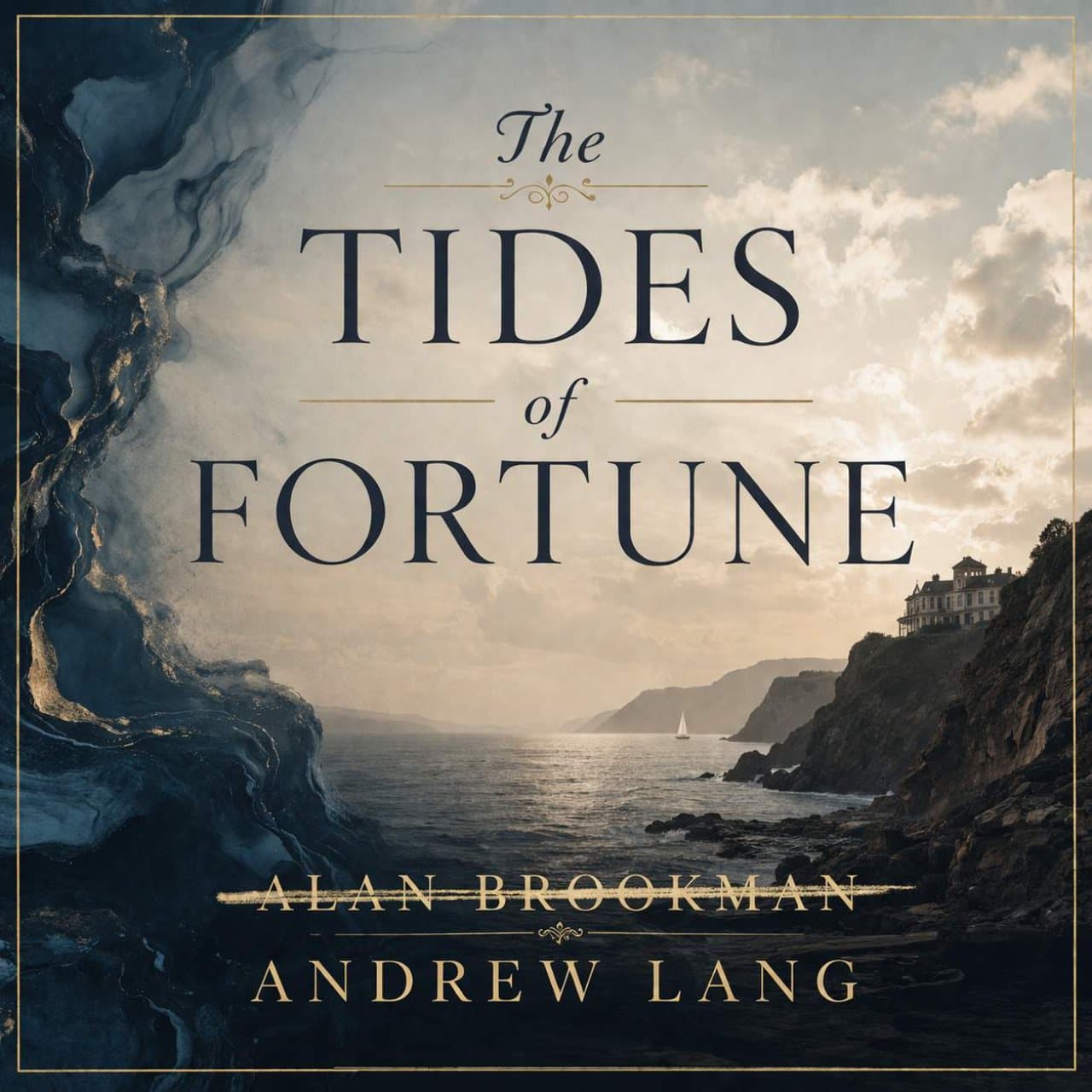
The lift shuddered up through Eaton-Holt's building like a reluctant confession. Fourth floor, mahogany corridor, the same glass door with the same discreet gold serif: Eaton-Holt. Alan’s name had once been a talisman in this place. Now it felt like a codeword for security to keep an eye.
Marla on reception gave him the look you give a man who’s either been bereaved or caught stealing stationery: gentle, incurious pity. “Victor will see you now,” she said, as if reading a line she’d practiced all morning.
Victor’s office was a reliquary of success—bottle-green carpet, the smell of coffee that had won awards, framed jackets aligned like battle honours. The window showed a slice of Great Marlborough Street doing its weekday impersonation of wealth.
“Alan, my boy.” Victor came round the desk, sleeves rolled, tie politely loosened. The performance of intimacy. He took both of Alan’s hands as if blessing them. “Sit, sit.”
Alan sat. He’d brought a folder. It contained hope, but bound sloppily.
Victor poured. “Before we get into the meat,” he said, “I was sorry to hear about the business with Joanne. Rotten business.” He gestured, compassionate but breezy. “Oh, bloody women. I’m on my third and, if I’m honest, the bookies wouldn’t price me long odds. Still. More to life, eh?”
Alan arranged his face into something resembling agreement. “More to life.”
“Exactly. Life isn’t like Daniel and bloody Maria.” Victor smiled, benevolent heretic. “Save that for fiction.”
It was a small sentence and a large blow. Alan felt it settle in his chest like ballast. He nodded, far too carefully, as though a more vigorous movement might let loose another round of tears. He had learned recently how faces malfunction.
Victor clapped his hands once, brisk. “Right then. Four months until final draft. I’m expecting the full map. Chapter beats, the spine, all the little vertebrae. Tell me where Daniel’s sailing.”
Alan put the folder on the desk as a priest might lay down a snake. “It’s not a sequel,” he said. His voice had a new carefulness, like walking on thin glass. “It’s a prequel.”
A beat. Somewhere in the city, a lorry backfired.
“A prequel,” Victor repeated, kindly as a dentist. “How interesting. Go on.”
“Daniel as a young man,” Alan said, and he heard himself—felt the old pitchmanship in the delivery and loathed it. He started again. “He’s raw. The forming years. Postgraduate drift, the experiments—music, chemicals, the unmade conscience. The weather before the weather. I’ve… I’ve been trying a different style.”
“Different is good.” Victor took the folder. “Different is exciting. Let’s have a shufti.”
He skimmed. The room turned into the sound of paper moving under breath. Alan watched Victor’s eyes. At line three the eyebrows rose. At line eight the mouth did something complicated and tried not to. At line fourteen a small cough attempted diplomacy and failed.
Victor set the pages down as if they had come to him hot. “Alan,” he said, and there was still warmth in it, the false kind, the kind for convalescents and children. “This… this is unreadable.”
Alan inhaled through the nose. “It’s a higher register.”
“It’s a foreign language.” Victor tapped a paragraph with one careful finger. “What does this mean? ‘Morality foams at the mouth of the sea and leaves a scum of righteousness on the pier’? Is that… I mean, what is that?”
“It’s—” Alan began, and felt blood rise. “It’s more literary.”
“Alan, you’re four months out from a draft. You were meant to give me the follow-up to Tides. You remember? The sequel? Daniel survives the storm, rebuilds the business, Maria the lighthouse — that sort of thing. Don’t you remember our discussion?”
Alan wore the expression of a man in the witness box answering to his own character. “I can’t do the other thing,” he said softly.
“The other thing?”
“The thing we talked about. Daniel steadies the ship; Daniel faces the storm; Daniel’s lighthouse—” He paused on the word. It carried shrapnel. “—the domestic anchor, all that.” He swallowed. “I can’t write it.”
Victor leaned back, steepling. “Because?”
“Because it’s trite,” Alan said, and here the syllables sharpened, acquired a borrowed confidence. “It’s middlebrow. Sentimental sludge. Airport fiction.”
Victor’s face did a series of tiny recalibrations, like a man listening for a note he was fairly certain wasn’t there. “Ah,” he said, after a moment. “We’ve swallowed a critic.”
Alan felt a flicker of heat. “We? I wrote those words.”
“You did,” Victor said. “And people lined up at WH Smith to say thank you. Trite? It’s what sells, Alan. It’s what you do. You’re not writing bloody Nabokov — you’re writing something people finish on a sun lounger.”
Alan shook his head. “I can’t do it. Not now.” He felt the humiliation as a kind of air pressure change. “I don’t believe in Daniel the way I… the way I did.”
Victor put his elbows on the desk, fatherly now, the good headmaster with the expulsions numbers under his blotter. “You don’t have to believe, Al. You have to deliver. There’s a difference. Belief is optional. Deadlines aren’t.”
Alan heard himself then, small and stubborn. “You still need me,” he said. “My name’s on the cover. I’m the writer.”
Victor’s smile was exquisite—pity, pride, a hint of awe at the purity of the delusion. “Your name,” he said, “is our brand.”
Alan blinked. “What?”
“Our brand,” Victor repeated, gently, as to a tourist who has boarded the wrong bus. “You should have read the small print. We own the series concept, the characters, the continuations, the lot. We steward the brand. The readers don’t buy paper and glue; they buy Alan Brookman. I don’t want to do this—God knows I don’t—but if we have to keep Daniel afloat while you find your inner Tolstoy, I’ll bring someone in. A ghost. It happens more than you think. Discreetly. Everyone’s happy.”
Alan saw it at once, in a horrid flash: a hand he didn’t know, writing his name; a voice not his, speaking in his mask. “You’d hire—” He couldn’t finish the sentence. It seemed impolite to suggest his own haunting.
“I’d prefer not to,” Victor said, palms up, the church of the inevitable. “I prefer the original article. But we are four months to a completed draft, and you’ve brought me the first draft of a nervous breakdown. The upmarket version. With footnotes.”
Alan reached over and turned a page that didn’t need turning. Words looked up at him in a new, alien shame. Morality foams… God save him. He’d written that. He could hear Joanne’s voice rehearsing the execution: trite… middlebrow… sludge. A modern absolution in reverse.
“Victor,” he said. “I can’t write the sequel. Not the way we planned.”
Victor nodded slowly, as if confirming a diagnosis he’d suspected since the patient walked in. “So,” he said, “we have choices. You take a fortnight, go somewhere unliterary—Cabo, the Costa, a Travelodge in Swindon—and you remember who you are. You write chapter beats that a primate could follow with one eye. Or I call in a favour and put flesh on the skeleton myself. And, yes, if we go the latter route, we activate certain clauses. Percentages shift. Names remain. Don’t make me the villain, Alan. I’m trying to keep a business alive.”
“I’m the business,” Alan said, but quietly, as though testing whether the sentence still meant anything.
Victor looked past him, out at the slice of London paying for everyone’s sins. “You were,” he said, without malice. “Be again.”
The meeting ended the way marriages do: with excessive politeness. They stood, they shook, they made arrangements to speak soon as if that were neutral. Victor squeezed his shoulder—affectionate, proprietary—and Alan performed gratitude for the performance of concern. Marla gave him a smile on the way out that belonged in a hospice.
He stood in the corridor, holding nothing — no folder, no future, no appetite for any of it. Since Joanne left, the days had turned gelatinous: time didn’t move; it wobbled. He’d stopped shaving regularly, then stopped noticing. The manuscript lay open on the desk at home like a corpse under a sheet. He couldn’t even look at the name Daniel without disgust: Daniel the righteous, Daniel the yacht-broker with a conscience, Daniel and his bloody lighthouse wife. Christ, the lighthouse — what a fraud. Maria wasn’t a beacon; she was a bulb that blew out the minute you needed light. And yet he’d built a career on her radiance, hadn’t he? A whole cottage industry of decency and redemption.
He could hardly look at the page now without gagging on his own virtue. People wanted to believe in “happily ever after,” wanted to be spoon-fed the illusion that goodness paid dividends, that moral men got their wives back and the sea calmed for them on cue. It was pap, all of it. Emotional blancmange. And he, Alan Brookman, had been the head chef.
What a purgatory it was — not the writing itself, but the pretending: pretending that Daniel mattered, that Maria loved him, that readers were looking for truth and not just comfort with better punctuation.