


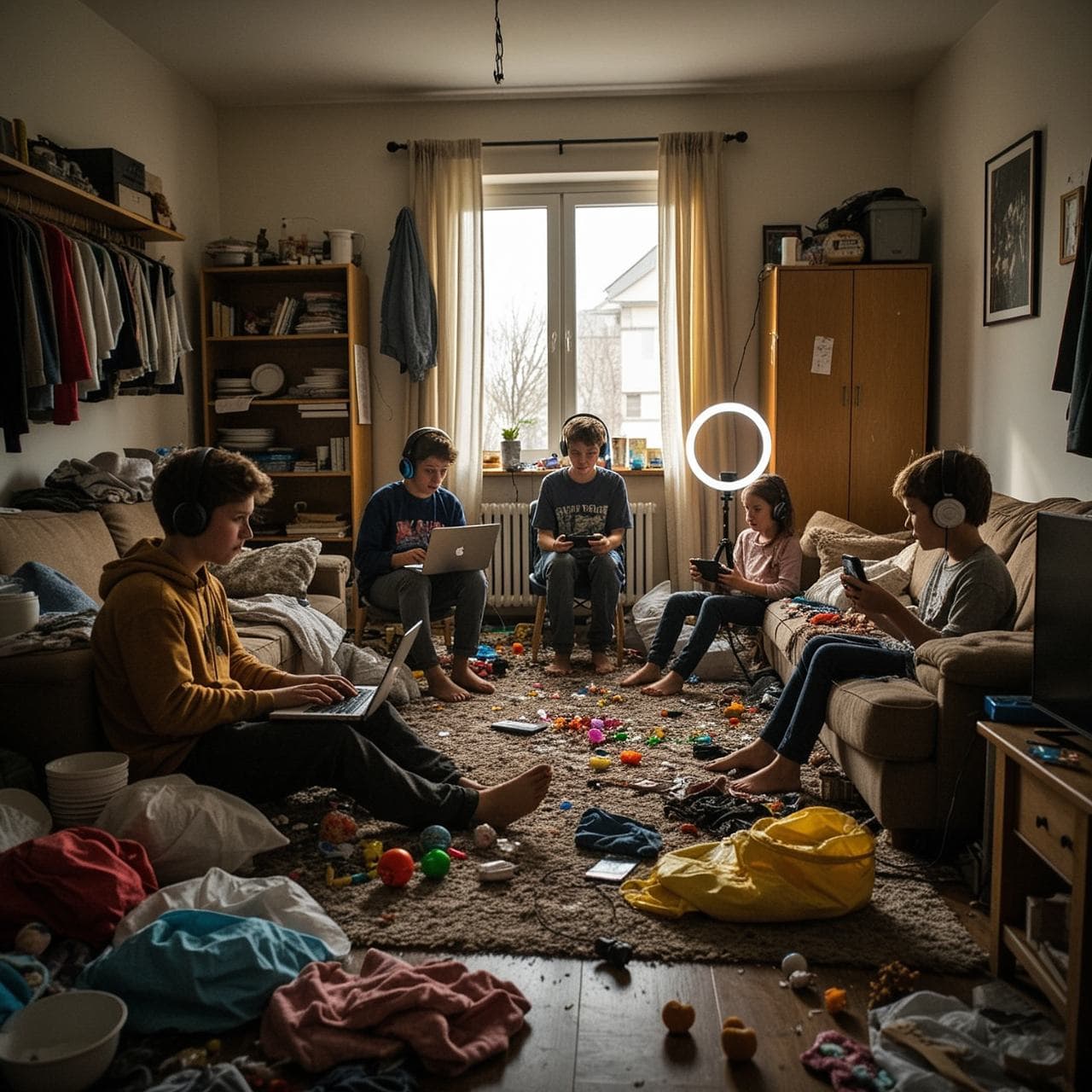

Morgan had been living in our basement for eight years, which in Millennial time was approximately "just until I get on my feet" and in Gen X time was "get a job and move out already." But over those eight months, I had learned something unexpected: Morgan wasn't just a symptom of a generation that couldn't afford houses; she was a bridge between the world I understood and the world my children inhabited.
It started on a Thursday afternoon when I came home early from work to find Morgan in the kitchen, crying over a spreadsheet.
"What's wrong?" I asked, dropping my keys on the counter.
"I'm ruined," Morgan said, tears streaming down her face. "I'm financially ruined. I'm going to die in your basement. I'm going to be the forty-year-old aunt in the basement. I'm a cliché. I'm a statistic. I'm—"
"You're thirty-four," I said. "And you're not dying in my basement. What's the spreadsheet?"
"My budget," Morgan sniffed. "Look at it. Just look."
I looked. The spreadsheet was color-coded, which I found impressive. It had categories I didn't recognize: "Self-Care Subscription," "Therapy Co-Pay," "Professional Development," "Networking Coffee," "Emotional Support Plants."
"Emotional support plants?" I asked.
"They're important for my mental health. But look at the bottom line. Look at the red number."
I looked. The red number was alarming.
"How much is your student debt?" I asked.
"Don't ask," Morgan said. "Don't ever ask. It's not polite."
"In my day—"
"Please don't say 'in my day college cost twelve dollars.' I know. I know. But I didn't live in your day. I lived in the day where college cost more than a house and then didn't guarantee you a job."
She had a point. I had paid for college with a part-time job at a video store. Morgan had paid for college with loans that would outlive her.
"Okay," I said, sitting down. "Let's figure this out. Gen X style."
"What's Gen X style?"
"Pragmatic. No feelings. Just solutions."
"That sounds terrible for my mental health."
"It sounds like you might be able to afford rent."
We spent the next three hours going through Morgan's finances, and I learned more about the Millennial condition than I had in years of living with her. I learned about the gig economy, about side hustles, about the constant pressure to "brand yourself" and "optimize your content" and "leverage your network."
"You don't have a job," I said. "You have five jobs."
"Exactly!" Morgan said. "I'm an entrepreneur!"
"You're exhausted."
"That's just part of the hustle."
"No," I said. "That's unsustainable."
I called Jennifer down, and the three of us sat at the kitchen table trying to solve a problem that felt bigger than just Morgan's budget.
"You need to make more or spend less," Jennifer said, in her Gen X directness.
"I can't make more," Morgan said. "I'm already working fifty hours a week on my various streams. And I can't spend less because... because..."
"Because?" I prompted.
"Because if I cut anything, I'll be failing at self-care. I'll be letting myself down. I'll be..."
"Being realistic?" I suggested.
"Being poor!" Morgan said. "And not just financially poor. Emotionally poor. Spiritually poor. I'm supposed to invest in myself. That's what all the podcasts say. You have to spend money to make money. You have to prioritize your wellness. You can't pour from an empty cup."
"Who's telling you this?" Jennifer asked.
"Everyone. Instagram. TikTok. My therapist. My life coach. My—"
"You have a life coach?" I asked.
"Had," Morgan admitted. "I had to stop because I couldn't afford it. But she was helping me manifest abundance."
I rubbed my temples. This was the Millennial paradox: they were drowning in advice, in "self-improvement," in the constant pressure to optimize their existence, and it was making them miserable.
"Okay," I said. "New plan. You need a real job. One job. With benefits."
"But that would be selling out!" Morgan said. "That would be giving up on my dreams!"
"What are your dreams?"
"I... I want to... I want to have a platform. I want to influence. I want to—"
"You want to be famous for being yourself," I said.
"Is that wrong?"
"It's not wrong," Jennifer said. "It's just hard. And expensive. And maybe... maybe not sustainable."
Morgan looked at us, her Gen X sister and brother-in-law, the generation that had given up on dreams early and settled for survival.
"How do you do it?" she asked. "How do you just... accept? How do you just survive?"
"We don't just survive," I said. "We live. We have families. We have dinners. We have... this."
"But don't you want more?"
"Sure," I said. "But I also want to sleep at night. And pay my mortgage. And know that my kids have health insurance."
Morgan was quiet for a long time. "I think," she said finally, "that I might need to move out of the basement."
"You're welcome to stay," I said. "But maybe... maybe with a plan. A timeline. Some goals that don't require a brand deal."
Morgan laughed, the first laugh I'd heard from her in weeks. "That's very Gen X. Very 'manage your expectations.'"
"Expectations are just premeditated resentments," I said.
"Who said that?"
"I don't know. Some boomer probably."
Over the next few weeks, Morgan started changing. She got a part-time job at a coffee shop—"just for now," she said, "just until I figure things out," but she said it with less desperation. She started cooking with us instead of ordering delivery. She started playing with the kids without filming it.
And one night, she sat down with Dakota and had a conversation that I overheard from the hallway.
"You're going to college next year," Morgan said.
"Unfortunately," Dakota replied.
"Don't 'unfortunately' it. College is... well, it's complicated. But you need to think about the cost. Seriously think about it. Don't just go to the 'best' school. Go to the school you can afford."
"That's not what the college counselors say."
"The college counselors aren't going to be paying your loans when you're thirty-four and living in someone's basement."
Dakota was quiet. "Is that what happened to you?"
"Yeah. And I'm not saying don't go. I'm saying be smart. Be smarter than I was. Learn from my mistakes."
"That's very... un-Millennial of you."
"I'm evolving," Morgan said. "I'm becoming... I don't know. A pragmatist."
"Next you'll be telling me to just 'pull up my bootstraps.'"
"God no. That's boomer nonsense. I'm just saying... be aware. Know what you're signing up for. The world is different now. It's harder. And nobody's going to save you."
I smiled in the hallway. Morgan was becoming Gen X, whether she liked it or not. She was learning the lesson that my generation had learned early: the world is indifferent to your dreams, so you better have a backup plan.
And maybe that was the gift of multigenerational living. Not that we understood each other perfectly, but that we could learn from each other's mistakes. The Boomers had taught us grit, for better or worse. We Gen Xers could teach Millennials pragmatism. And maybe, just maybe, they could teach our children to dream a little bigger, but smarter.
The Silent Crew was learning. And so was I.