


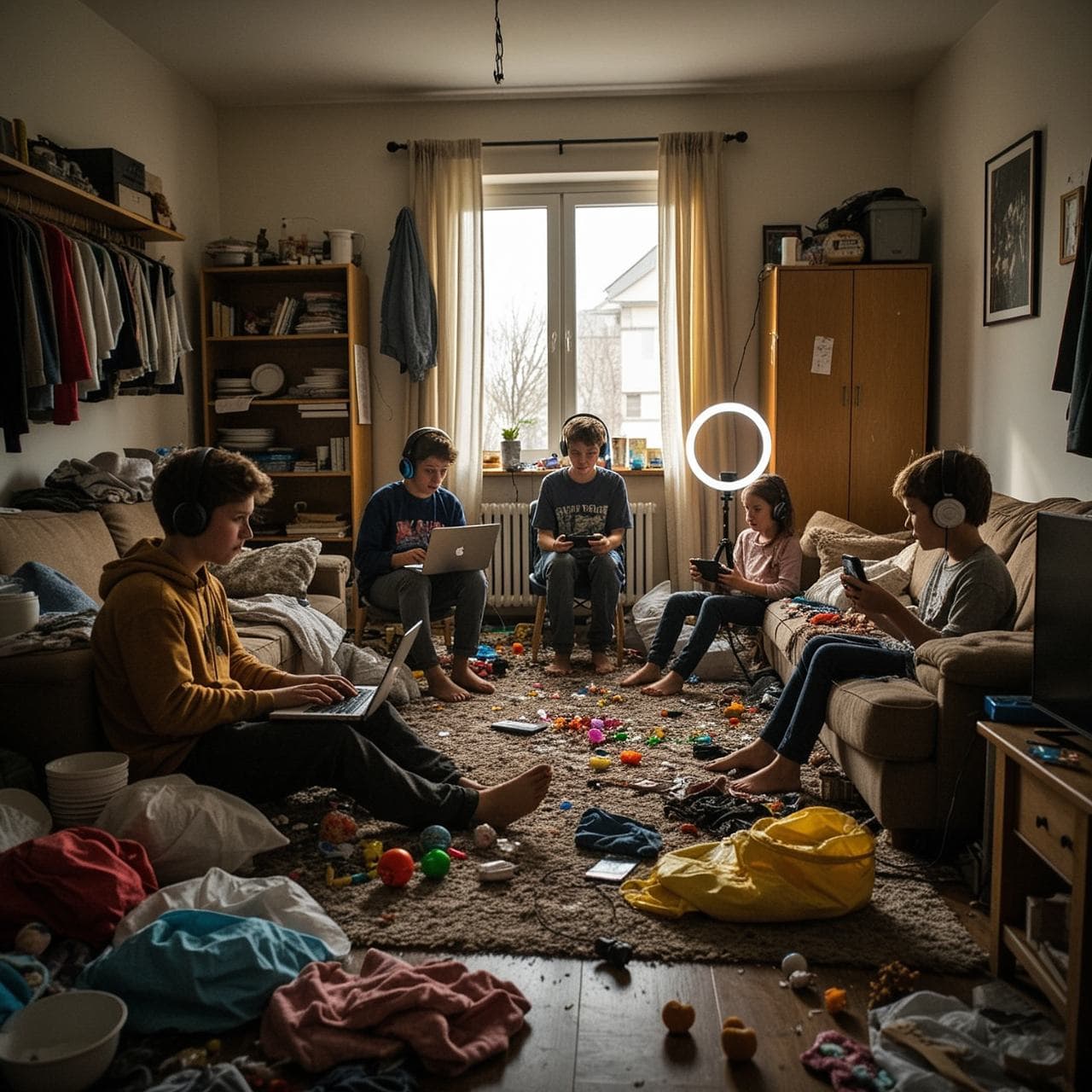

If you think a regular dinner is a minefield, try Christmas. Christmas in a multigenerational household is like a UN peacekeeping mission with eggnog and passive-aggressive gift-giving.
It started with the tree.
My mother believed that Christmas trees should be real, cut down with your own hands (or at least purchased from a parking lot lot), and decorated with ornaments collected over decades, each one a memory, each one sacred.
Morgan believed that Christmas trees should be "sustainable," which meant either a potted living tree that would be planted later (optimistic) or a "minimalist wooden ladder draped with fairy lights" (impractical).
Dakota believed that Christmas trees were "symbols of capitalist excess" and "environmental destruction" and that we should instead donate to charity in each other's names.
Phoenix believed that the tree should be "aesthetic," which meant color-coordinated, Instagram-ready, and probably not actually a tree but rather a "conceptual installation."
Atlas didn't care what kind of tree it was as long as they could put Minecraft ornaments on it.
Nova wanted a pink tree with unicorns.
And Jennifer and I, Gen X that we were, just wanted everyone to stop arguing so we could drink bourbon in peace.
"We're getting a real tree," my mother announced. "End of discussion."
"But Grandma," Dakota protested. "Real trees are cut down. They're killed for our temporary amusement. It's like... tree murder."
"Trees don't have feelings," my mother said.
"How do you know? Have you asked them?"
"Don't be ridiculous."
"I'm not being ridiculous. I'm being ethical."
"You're being difficult."
"I'm being conscious!"
While they argued, Morgan was researching "sustainable Christmas alternatives" on her phone.
"What if," she said, "we did a 'experience Christmas' instead of a 'stuff Christmas'? Where instead of gifts, we give each other time? Like coupons for hugs or... or..."
"Or what?" my mother asked. "Or nothing? You want to give nothing for Christmas?"
"I want to give presence, not presents," Morgan said.
"That's the same word," Atlas pointed out.
"No, it's—okay, yes, it's the same word, but different meanings."
"I want presents," Nova said. "Real presents. In boxes. With wrapping paper."
"Wrapping paper is wasteful," Dakota said.
"Everything is wasteful to you!" Nova shouted, and then burst into tears.
This was the holiday spirit in our house: everyone crying and arguing about the carbon footprint of joy.
In the end, we compromised. We got a real tree (my mother's victory), but we bought it from a local sustainable farm (Morgan's compromise), and we agreed to mulch it after Christmas (Dakota's demand), and we let Phoenix decorate it "aesthetically" (which meant it looked like a department store display and made my mother twitch), and we let Atlas put exactly three Minecraft ornaments on it (hidden in the back), and we let Nova put a unicorn topper on it (which clashed horribly with the aesthetic but made Nova happy).
Then came the gifts.
My mother had bought traditional gifts: socks, sweaters, books. Practical things. Things that "lasted."
Morgan had made "experience vouchers" that promised things like "One Coffee Date with Morgan" and "One Afternoon of Emotional Support."
Dakota had made donations to various social justice organizations in our names, which meant we received cards saying "A donation has been made in your name to Defund the Police" which made my mother's face turn an alarming shade of purple.
Phoenix had bought gifts based on "vibes" rather than actual utility, which meant I received a crystal that was supposed to "promote abundance" and Jennifer received a tarot deck.
Atlas had made gifts in Minecraft and printed screenshots of them, which was either very thoughtful or very lazy, depending on your perspective.
Nova had made gifts at school: clay ashtrays (we don't smoke), paperweights (we don't have papers), and a macaroni necklace (which was actually pretty cute).
Jennifer and I had bought gifts from Amazon because we were Gen X and exhausted and Amazon was easy.
We sat around the tree, five generations of conflicting values and expectations, and opened presents.
"This is very... pink," my mother said, holding up the sweater Morgan had bought her.
"It's millennial pink!" Morgan said. "It's very in right now."
"I'm seventy-two. I'm not 'in.'"
"You're timeless!"
"I'm old. And this sweater makes me look like a cotton candy."
"I got you socks," I said, handing my mother a package.
"Thank you, Alex. Practical. Useful. Real."
"They're compression socks," I said. "For circulation."
"Even better."
We continued in this fashion—my mother praising practicality, Morgan explaining the emotional significance of her vouchers, Dakota lecturing about the charities, Phoenix interpreting the energy of their gifts, Atlas explaining the Minecraft builds, and Nova just happy that people were opening things.
And then, the miracle happened.
We started eating. My mother's casserole made an appearance (tuna noodle, eternal, unchanging). Jennifer's "deconstructed Christmas ham" (which was just ham cut fancy). Morgan's "plant-based sides" that were actually pretty good. Dakota's "ethically sourced vegetables" that cost more than the ham. Phoenix's "charcuterie board" that was mostly for Instagram. Atlas's "Minecraft cookies" shaped like pixels. And Nova's cookies that were just... cookies.
And we talked. Not argued. Talked.
My mother told stories about Christmas in the 1950s, when she got an orange and was grateful for it. Morgan talked about how she wished she could have experienced a "simpler time" (which made my mother laugh and say "it wasn't simpler, you just didn't know about the problems"). Dakota talked about how consumerism was killing the planet but also admitted that they liked getting presents. Phoenix talked about how they just wanted everyone to be happy. Atlas talked about Minecraft (always Minecraft). And Nova fell asleep with their head on my mother's lap, the unicorn sweater still wrapped around them.
And I looked around at my family—this impossible, ridiculous, beautiful collection of humans spanning eight decades of history—and I thought that maybe, just maybe, we were going to be okay.
Not because we agreed. Not because we understood each other. But because we were trying. Because we showed up. Because we opened the presents and ate the food and sat in the same room together, five generations of chaos, and called it love.
The Silent Crew was silent that night, sleeping off their sugar highs and their emotional exhaustion. And I sat in the dark living room, looking at the tree with its clashing ornaments and its unicorn topper, and I thought:
This is it. This is the whole thing. The mess, the love, the trying.
Merry Christmas.