


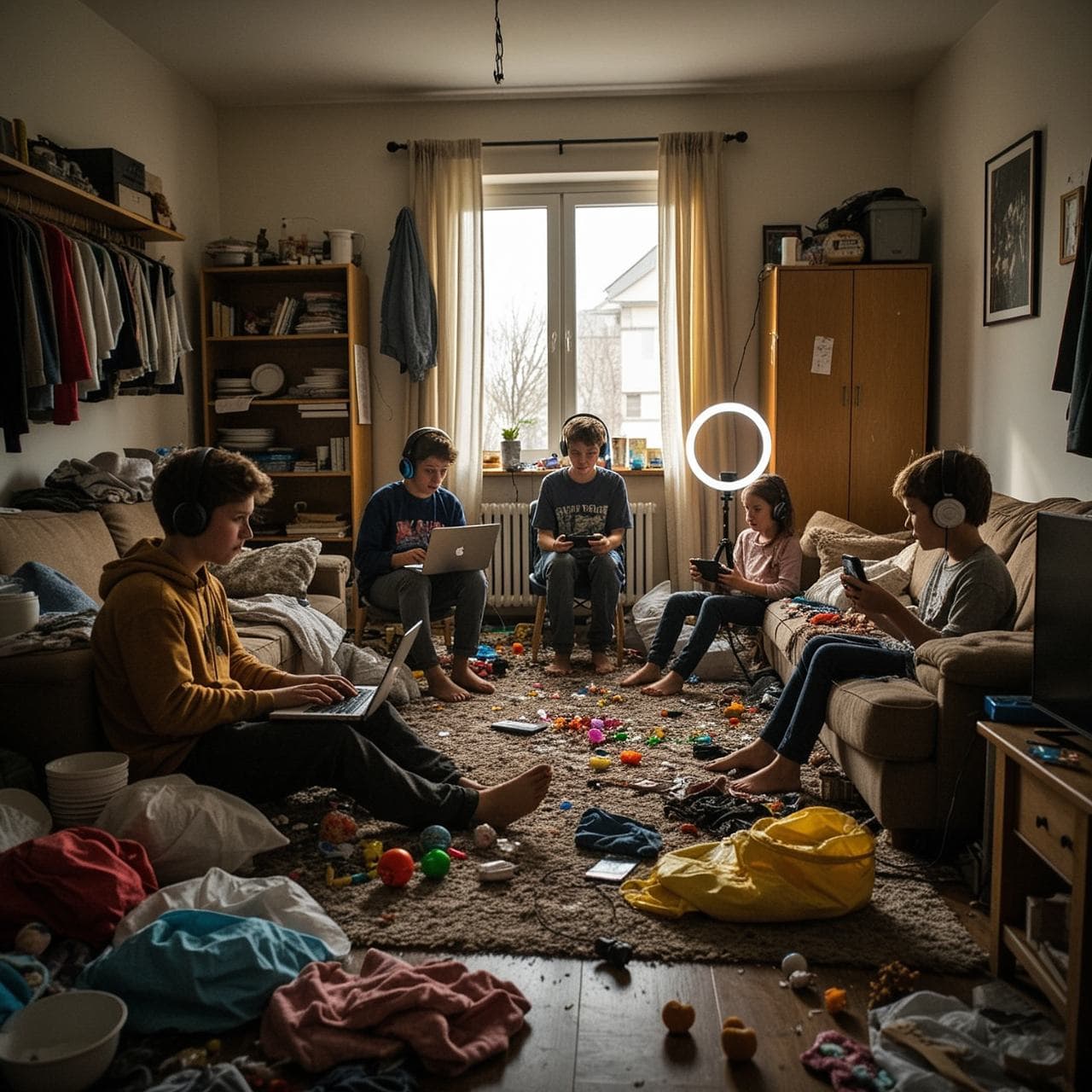

If you want to understand the difference between five generations, ask them to explain technology. Not use it—explain it. The gap between "I can operate this" and "I understand how this works" is where the generational fault lines become canyons.
It started with the Wi-Fi.
Specifically, the Wi-Fi was down, which in our house was treated with the same urgency as a gas leak or a zombie apocalypse. Within minutes of the outage, the house had transformed from a semi-functional family unit into a Lord of the Flies situation with better snacks.
"What's happening?" Nova asked, staring at their iPad with the expression of someone watching their god die.
"The Wi-Fi is down," I said.
"Fix it."
"I'm trying."
"Try harder."
This was Gen Alpha: they viewed technology as a utility, like water or electricity. They had no concept of how it worked, only that it should work, and that when it didn't, an adult should fix it immediately through sheer force of will.
"Have you tried turning it off and on again?" Morgan asked, emerging from the basement with the panic of someone who had been in the middle of a Zoom call about "brand synergies."
"Yes, Morgan. I'm Gen X. That's our entire troubleshooting repertoire."
"Maybe it's the router," Phoenix said, looking up from their phone which, miraculously, still had cellular data. "Maybe we need to reset the IP configuration."
"Do you know what an IP configuration is?" I asked.
"No. But I saw it in a TikTok."
This was Gen Z's relationship with technology: they were digital natives, fluent in the interface, but with no more understanding of the underlying mechanics than a fish has of water. They could navigate complex social media algorithms but couldn't explain how Wi-Fi actually worked. They were users, not engineers.
"Let me see," my mother said, approaching the router with the confidence of someone who had once fixed a rotary phone. "In my day, we didn't have all these... these..."
"Wireless networks?" I suggested.
"Yes. We had wires. Everything had wires. And when something broke, you could see the wire and fix it. This..." She gestured at the router, a black box with blinking lights that might as well have been a monolith from 2001: A Space Odyssey. "This is just magic. Black magic."
"It's not magic, Patricia," Morgan said. "It's just radio waves. Like... like invisible wires."
"Radio waves," my mother repeated. "In my day, radios had tubes. You could take out the tubes and see them. You can't see radio waves."
"That's the point of them being invisible," Dakota said.
"Don't be smart."
"I'm not being smart. I'm being accurate. There's a difference."
While we argued about the ontology of wireless communication, Jennifer was on the phone with the internet provider, navigating the automated menu with the patience of a saint and the determination of someone who had done this too many times before.
"Yes," she was saying. "I've tried unplugging it. Yes, I've checked the lights. Yes, I've—no, I don't want to upgrade to the premium package. I just want the regular package to work. What do you mean 'there's an outage in my area'? When will it be fixed? Two to four hours?"
The house groaned collectively. Two to four hours without Wi-Fi might as well have been two to four years.
"What are we supposed to do?" Atlas asked, genuinely baffled. "Just... sit?"
"You could read a book," my mother suggested.
"A what?"
"A book. Those things with pages. Made of paper."
"Paper?" Nova asked. "Like... from trees?"
"Yes, from trees. You know, those things outside?"
Nova looked out the window with suspicion, as if the trees might be involved in the Wi-Fi conspiracy.
"I have books," I said, going to the shelf and pulling out my old paperbacks. Gen X still had physical media, a trait that both Boomers admired and younger generations found quaint, like churning butter or believing in privacy.
"Here," I said, handing Atlas a copy of *The Hobbit*. "Read this."
Atlas looked at the book like it was a relic from an alien civilization. "It doesn't have a screen."
"No."
"How do I turn it on?"
"You open it."
"And then what?"
"And then you read the words. With your eyes."
"Does it have a progress bar?"
"No."
"How do I know how much is left?"
"You feel the pages. The fewer pages on the right, the closer you are to the end."
Atlas considered this. "That's... primitive."
"It's classic."
"It's boomer."
"Hey," my mother said. "I like books."
"Exactly," Atlas said.
While Atlas grappled with the concept of analog reading, Phoenix was having a different crisis.
"I can't post," they said. "I can't check my engagement. I can't—"
"You'll survive," I said.
"But my streaks!"
"Your what?"
"My streaks! On Snapchat! If I don't post, I'll lose my streaks!"
This was Gen Z's unique anxiety: the fear of digital disappearance, of losing the tenuous connections that maintained their social existence. They had grown up with the quantified self, with metrics for everything, and the idea of not measuring up—literally—was terrifying.
"Streaks are just numbers," I said.
"They're not just numbers! They're social capital! They're—"
"They're meaningless," Dakota said.
"Easy for you to say! You have anxiety! You don't care about social capital! You just want to overthrow the government!"
"I want to overthrow capitalism, not the government. There's a difference."
"Not to my follower count!"
Morgan, meanwhile, was experiencing her own Millennial crisis. Without Wi-Fi, she couldn't work from home, which meant she couldn't "hustle," which meant she was having an identity crisis.
"I should be productive," she said, pacing. "I should be grinding. I should be—"
"You should be relaxing," Jennifer said. "It's okay to not be productive for two hours."
"But that's how you fall behind! That's how you become irrelevant! I need to be constantly upskilling, constantly networking, constantly—"
"Constantly exhausting yourself?" I asked.
"Yes! No! I mean... it's just... if I'm not producing, what am I?"
This was the Millennial condition: the internalized capitalism, the belief that worth was tied to output, that rest was laziness, that if you weren't hustling, you were failing. They had inherited the Boomer work ethic but without the Boomer economic security, creating a perfect storm of anxiety.
"You're a person," I said. "You're allowed to just be."
"That's very Gen X of you," Morgan said. "Very 'whatever, man.'"
"Maybe 'whatever, man' is the right approach sometimes."
While we debated the philosophy of productivity, my mother had found the solution to the crisis: she had retrieved a deck of cards from her purse.
"In my day," she said, with the satisfaction of someone who had been waiting for this moment, "we didn't need Wi-Fi to have fun. We played cards. We talked to each other. We looked at each other. Like this."
She demonstrated by looking at me with an intensity that made me uncomfortable.
"Mom, you're staring."
"I'm engaging. It's called eye contact. You should try it with your children sometime."
"I have eye contact with my children."
"You have screens between you and your children."
She dealt the cards with the efficiency of someone who had spent decades in bridge clubs and church socials. "Gin rummy. Everyone play."
"I'm not playing cards," Phoenix said. "I need to preserve my energy for when the Wi-Fi comes back."
"You'll play," my mother said, with a tone that brooked no argument. It was the Boomer voice, the voice that had launched a thousand childhood traumas, and it still worked.
We played. Reluctantly, awkwardly, we played.
And something strange happened. We started talking. Not arguing about politics or trauma or who should empty the dishwasher, but just... talking. Nova told a story about their day at school that didn't involve memes. Atlas explained Minecraft in a way that actually made sense. Phoenix shared a funny video they had seen (describing it verbally, which was a lost art). Dakota discussed their plans for college without mentioning the impending collapse of civilization.
Morgan talked about her dreams of starting her own business, not as a hustle, but as something she actually wanted to do. Jennifer talked about wanting to take up painting again. I talked about... well, I mostly listened, which was the Gen X way.
And my mother watched us with a smile that wasn't smug, wasn't triumphant, just... pleased.
"See?" she said. "We don't need technology to connect."
"It's not that we don't need it," Dakota said, not unkindely. "It's that we shouldn't depend on it. There's a difference."
"That's what I said!"
"No, you said 'in my day we didn't need it.' That's different from saying 'we shouldn't depend on it.' One is nostalgia. The other is wisdom."
My mother looked at Dakota for a long moment. "You're a smart kid. Annoying, but smart."
"I know," Dakota said. "I get it from Dad."
"Hey," I said.
"Well," my mother said, collecting the cards. "You also get the stubbornness from him. And the inability to express emotions. But maybe..." She looked at me. "Maybe that's changing."
The Wi-Fi came back on at 6:47 PM, announced by a chorus of chimes and notifications that sounded like digital birds returning to roost. The house immediately fragmented again—Phoenix to their phone, Atlas to their iPad, Morgan to her laptop, Nova to their games.
But for two hours, we had been a family. A weird, multigenerational, technologically impaired family, but a family nonetheless.
And as I watched my mother teach Nova how to shuffle cards, her hands over Nova's small ones, Boomer and Gen Alpha touching across the gulf of years, I thought that maybe the technology gap wasn't unbridgeable after all.
Maybe we just needed to find the right interface.