


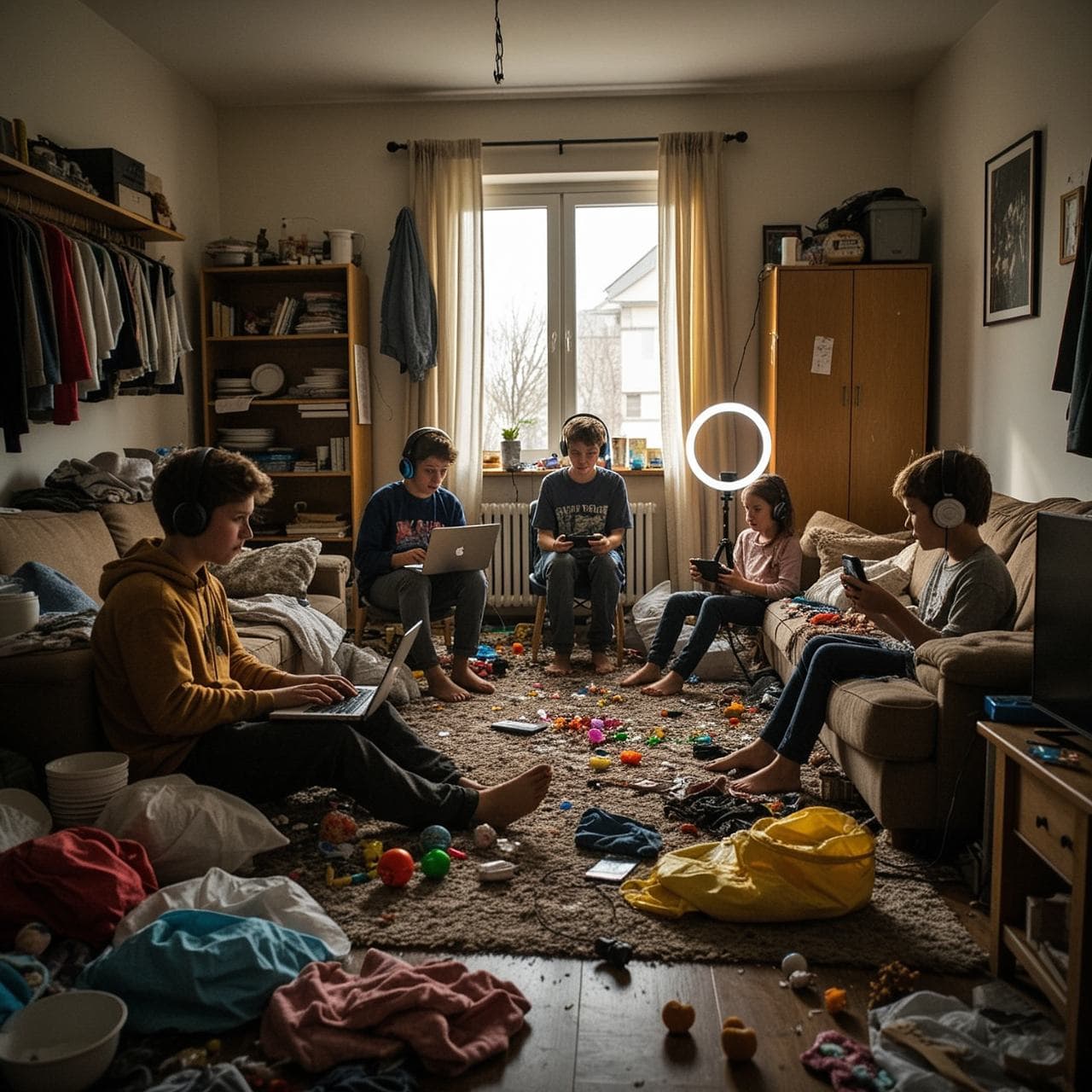

Dinner in a multigenerational household is less a meal and more a UN Security Council meeting with better lighting and worse outcomes. The dinner table is where all the fault lines of generational difference collide, where Boomer practicality meets Millennial anxiety meets Gen Z activism meets Gen Alpha meme-speak, and where Gen X (me) tries to keep the peace while secretly wishing we could all just eat in silence like nature intended.
My mother had stayed for dinner, which meant the casserole had made an appearance, along with her commentary on my parenting, my marriage, my career, and the general state of the world, which she believed had peaked sometime around 1974 and had been in steady decline ever since.
Jennifer had made her famous "deconstructed lasagna," which was regular lasagna but she called it "deconstructed" because Morgan had told her that "deconstructed" food was trending on Instagram and Millennials valued "aesthetic presentation." It tasted exactly like regular lasagna but took three times as long to make because each component had to be arranged artfully on the plate.
"So," my mother said, surveying the table with the expression of a general surveying a battlefield that was not going well. "Who wants to say grace?"
"Grace?" Dakota said, looking up from their phone. "As in... the prayer?"
"Yes, the prayer. Who wants to say it?"
"We don't really do that," I said.
"You don't pray?"
"We're not... we're not really religious, Mom."
"Not religious?" My mother's hand went to her chest, as if she were having a heart attack, though I knew from experience that this was just her "shocked Boomer" gesture. "What do you mean, not religious? You were baptized! You went to Sunday school! You—"
"That was forty years ago, Mom. Things change."
"But what about the children? Don't they need moral guidance? Spiritual foundation?"
"We get moral guidance from TikTok," Phoenix said.
My mother's fork stopped halfway to her mouth. "You get... what?"
"Moral guidance. There are accounts that explain ethical philosophy using SpongeBob clips. It's very accessible."
"SpongeBob," my mother repeated. "The yellow... the cartoon?"
"Yes. He's very memeable."
My mother looked at me. "Alex, your children are learning ethics from a sponge."
"Better than learning it from some of the priests we had," I muttered.
"What's that?"
"Nothing."
Morgan, sensing tension, jumped in with her Millennial conflict-resolution training. "Patricia, I think what Phoenix means is that they're finding community and values in digital spaces. It's actually really beautiful. Gen Z is so much more socially conscious than we were. They're leading the charge on climate change, on social justice, on—"
"On eating Tide Pods," my mother interrupted.
"That was one time!" Phoenix protested. "And it was years ago! And it was just a few people!"
"But it happened," my mother said, with the satisfaction of someone who had found evidence for their thesis. "In my day, we didn't eat laundry detergent. We had common sense."
"Common sense is just internalized social conditioning," Dakota said.
"What's that?"
"Common sense. It's not objective. It's just the rules that the dominant culture decided were 'normal.' And those rules were usually designed to oppress marginalized groups."
My mother set down her fork. "Are you saying that not eating soap is oppressive?"
"No, I'm saying that the concept of 'common sense' is used to delegitimize alternative ways of knowing and being. Like how you think your way of parenting is 'common sense' but actually it's just the way you were raised in a specific historical context that doesn't apply anymore."
I watched my mother's face cycle through emotions: confusion, anger, defensiveness, and finally, resignation. This was the Gen Z rhetorical style: they didn't just argue; they deconstructed the entire framework of the argument. They didn't say "you're wrong"; they said "your epistemological framework is rooted in hegemonic power structures."
"Well," my mother said, returning to her casserole with renewed vigor. "In my day—"\
"Here we go," Jennifer muttered.
"In my day, we respected our elders. We didn't talk back. We didn't... deconstruct things. We just did what we were told."
"And how did that work out for you?" Dakota asked.
My mother's eyes narrowed. "What do you mean?"
"I mean, you have ulcers, right? And you don't talk to Uncle Ray because of some fight in 1987 that nobody remembers the cause of? And you think therapy is for crazy people?"
"Therapy IS for crazy people!"
"No, it's for people who want to process their trauma instead of passing it down to the next generation."
The table went silent. Even Nova stopped playing with their food. This was the nuclear option, the thing that Gen Z had that previous generations didn't: the willingness to name the trauma, to call out the patterns, to refuse the silence that had been the Gen X and Boomer way.
"Are you saying..." my mother said, her voice dangerously quiet. "Are you saying I traumatized your father?"
"I'm saying that trauma is intergenerational," Dakota said, not backing down. "And that refusing to examine it doesn't make it go away. It just means the next generation has to deal with it. Like how Dad can't express emotions because you taught him that feelings are weakness."
I felt the weight of the table's attention shift to me. This was the Gen X experience: being caught between the Boomers who raised us and the Gen Z who were analyzing us, both convinced they were right, both looking at us for validation.
"I express emotions," I said.
"You grunt," Phoenix said.
"I grunt emotionally."
"See?" my mother said, finding her footing. " is fine. Alex doesn't need to talk about his feelings. He just needs to work hard and take care of his family."
"But is he happy?" Morgan asked.
The Millennial question. The question that Boomers never asked because they were too busy surviving, that Gen X never asked because we were too busy being cynical, that Gen Z asked constantly because they believed happiness was a right, not a privilege.
"Happy?" my mother said, as if the word were foreign. "What does happy have to do with anything?"
"It has everything to do with it!" Morgan said. "What's the point of working hard if you're not happy? What's the point of any of it?"
"The point is survival! The point is providing! The point is—"
"The point is joy," Dakota said. "The point is fulfillment. The point is living a life that's authentic to your values, not just following some script that was written before you were born."
"Authentic," my mother scoffed. "In my day—"
"Your day is over," Dakota said. Not cruelly. Just factually. "Your day created climate change and economic inequality and systemic racism. Maybe it's time to admit that your day didn't have all the answers."
My mother stood up. She looked at Dakota, at Phoenix, at Atlas and Nova who were watching with wide eyes, at Morgan who was filming this (because of course she was), at Jennifer who was staring at her plate, and at me, her Gen X son, who had failed to mediate this because I was too busy having an existential crisis about whether I was actually happy.
"My day," she said, her voice shaking, "built this country. My day fought for civil rights. My day went to the moon. My day—"
"Your day had lead paint and casual sexism," Dakota said. "And yes, you did some good things. But you also broke a lot of things that we're going to have to fix. So maybe instead of telling us how great your day was, you could ask us what we need to make tomorrow better."
My mother looked at Dakota for a long moment. Then she looked at me.
"Alex," she said. "Are you going to let your child speak to me this way?"
I thought about it. I thought about my Gen X upbringing, the "seen and not heard" childhood, the emotional constipation, the belief that respect meant obedience. I thought about how Dakota was right, even if they were being abrasive. I thought about how my mother was wrong, even if she was being loving in her own way.
"Mom," I said. "Maybe... maybe we should listen to them."
"Listen to them? They're children!"
"They're the future," I said. "And they're scared. And they're angry. And maybe... maybe we should find out why."
My mother sat back down. She didn't look happy. But she didn't leave, either. And that was something.
"Fine," she said. "Tell me. Tell me why you're so angry."
And for the next hour, over deconstructed lasagna and tuna noodle casserole, the Silent Crew spoke. Dakota talked about climate anxiety, about watching the world burn while adults argued about whether it was happening. Phoenix talked about the pressure of social media, of never being able to turn off, of the constant performance of existence. Atlas talked about school, about standardized testing, about feeling like a widget in a machine. Even Nova contributed, talking about how they wanted to save the animals but didn't know how.
Morgan talked about student debt, about the housing market, about the lie of the American Dream. Jennifer talked about the double burden of work and home, of trying to be everything to everyone.
And my mother listened. She didn't agree. She didn't understand everything. But she listened.
And when they were done, she said: "Well. I still think you should eat the casserole. But... I hear you. I don't understand all of it. But I hear you."
It wasn't reconciliation. It wasn't understanding. But it was a start. It was five generations sitting at one table, speaking different languages, but at least trying to translate.
And that night, for the first time in weeks, Dakota emptied the dishwasher without being asked.
Progress, I thought. Slow, painful, generational progress.