


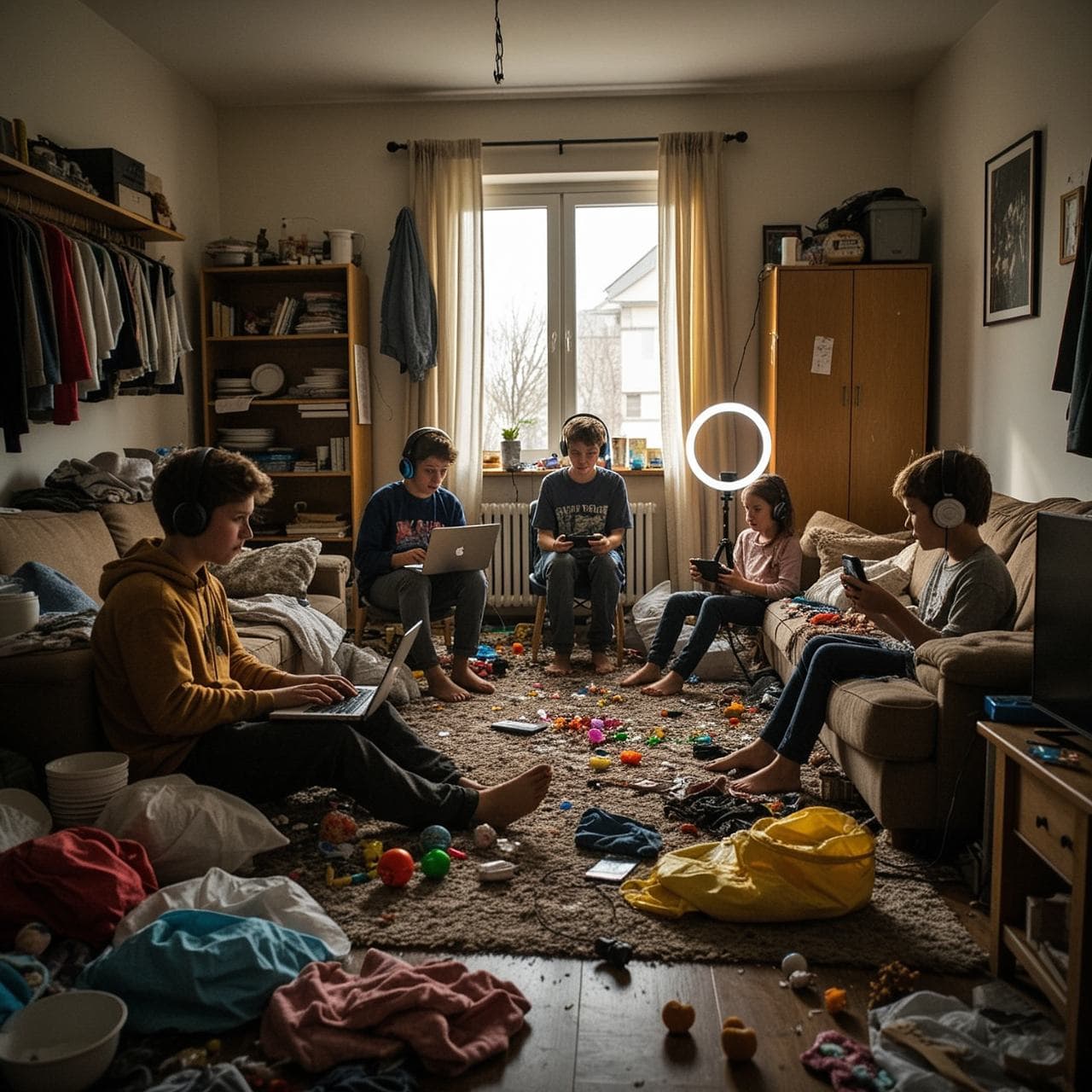

If there's one thing that unites all five generations under this roof, it's the universal hatred of chores. Boomers hate chores because they did too many of them as children and have PTSD about shoveling snow. Gen X hates chores because we were the first latchkey generation and had to do everything ourselves while our parents worked on their "marriages" or "drinking problems" or "finding themselves." Millennials hate chores because they're too busy trying to maintain work-life balance while answering Slack messages at 11 PM and processing their childhood trauma. Gen Z hates chores because they interfere with their "spiritual journey" or "content creation schedule" or "activism." And Gen Alpha hates chores because they literally do not understand why robots haven't solved this problem yet.
But in our house, the hatred of chores had reached operatic proportions.
It started with the dishwasher, as so many domestic conflicts do. The dishwasher is the DMZ of the modern household—the neutral zone where no peace treaty holds and everyone claims they weren't the one who put the wooden spoon in the top rack.
I had asked—politely, I thought—if someone could empty the dishwasher. This was at 8 AM on a Wednesday, which in retrospect was my first mistake. Never ask Gen Z to do anything before noon. Their circadian rhythms are set to "vampire," a trait they inherited from Millennials but perfected.
Dakota emerged from their room at approximately 11:45, which was technically before noon but only just. They were wearing an outfit that I can only describe as "Depression Chic"—oversized hoodie, sweatpants that had seen better days, and socks that didn't match because matching socks is apparently a tool of the patriarchy.
"Hey," they said, which was their standard greeting. Not "Good morning." Not "Hello." Just "Hey," delivered with the enthusiasm of someone who had already lived too long and read too much about climate change.
"Hey," I replied. "Did you empty the dishwasher?"
Dakota looked at the dishwasher. They looked at me. They looked back at the dishwasher, as if hoping it had emptied itself in the last three seconds through some miracle of modern science.
"I was going to," they said.
"When?"
"Later."
"Later when?"
"Just... later."
This was the Gen Z approach to time: vague, elastic, and entirely theoretical. They existed in a perpetual state of "about to" that never quite materialized into "actually doing." It was quantum chore avoidance—they were simultaneously going to do the chore and not going to do the chore, and the act of observing them collapsed the waveform into definitely not doing the chore.
"Can you do it now?" I asked.
Dakota sighed. It was a sigh that contained multitudes—a sigh that spoke of generational trauma, climate anxiety, the student debt crisis, and the crushing realization that adulthood was just doing dishes forever until you died. It was a sigh that said, "I have seen the future, and it is full of microplastics and rising sea levels, so why should I empty the dishwasher?"
"I have a lot on my plate right now," they said.
"You have literally nothing on your plate. You haven't eaten breakfast."
"Metaphorically, Dad. Metaphorically. I'm dealing with a lot."
"Like what?"
"Like... the state of the world? The collapse of democracy? The fact that I might never own a home unless I marry rich or become a crypto scammer? Also, I have to post about the protest I'm attending this weekend, and I need to research sustainable fashion brands because fast fashion is killing the planet, and I have to respond to my friend's text about their emotional crisis."
I wanted to point out that emptying the dishwasher took approximately four minutes and would not significantly impact their ability to solve global capitalism, but I had learned that this was not a productive line of argument. Gen Z had perfected the art of contextualizing every minor inconvenience into a symptom of systemic failure. Couldn't find their shoes? That's because consumer culture prioritizes quantity over quality. Didn't do their homework? That's because the education system is designed to crush creativity and produce obedient workers. Wouldn't empty the dishwasher? Clearly because chores are an outdated patriarchal structure designed to maintain gendered divisions of labor in the domestic sphere, and also because they were "literally exhausted" from "existing in a late-stage capitalist hellscape."
"Dakota," I said, trying a different approach. "If you empty the dishwasher, I'll make you avocado toast."
This was my secret weapon. I was Gen X, but I had married a Millennial (technically Jennifer was Gen X, but she had Millennial sympathies), and I had learned the power of avocado toast. It was the bridge between generations, the olive branch offered across the divide of misunderstanding.
Dakota hesitated. I could see the internal struggle—the desire to maintain their principled stand against chore-based oppression warring with their genuine love for mashed fruit on carbohydrates.
"With everything bagel seasoning?" they asked.
"With everything bagel seasoning."
"And a poached egg?"
"Don't push it."
They sighed again, but this was a different sigh—a sigh of resignation, of temporary defeat, of someone who knew they were going to do the chore but wanted to make sure I knew they were doing it under protest and that this in no way constituted consent to the system.
"Fine. But I'm posting about this."
"Posting about what?"
"The exploitation of youth labor in domestic spaces. It's a systemic issue. I'm going to do a carousel post about how unpaid labor in the home disproportionately affects young people and reinforces capitalist hierarchies."
"You're emptying a dishwasher, not working in a coal mine."
"Same energy, though."
While Dakota engaged in what they called "emotional labor" and what I called "putting away plates," Morgan emerged from the basement. She was wearing yoga pants and holding a phone that she was using to film herself walking up the stairs.
"Morning!" she said, not looking up from the screen. "I'm doing a 'day in the life of a multi-generational household' story for my followers. Say hi!"
"Hi," I said flatly.
\
"Be more authentic," Morgan said. "My followers can tell when you're performing."
"I am performing. I'm performing 'father who wants his children to do chores.'"
"Ugh, chores," Morgan said, putting her phone down. "Don't even get me started. I read this article about how assigning chores to children creates toxic productivity expectations and internalized capitalism. Kids should be allowed to just... be. To exist without the pressure of output."
"Morgan," I said. "You're thirty-four. You live in my basement. You don't pay rent. Perhaps you're not the best authority on work ethic."
"I'm paying with my presence," Morgan said. "I'm providing emotional support and generational perspective. That's valuable labor."
"Is it, though?"
"According to my therapist, yes."
Morgan represented the Millennial condition: the generation that was told they were special, that they could be anything, that the world was their oyster, and then graduated into the 2008 recession and watched the oyster get bought by a hedge fund and turned into luxury condos. They were the generation that invented the concept of "adulting" as a verb because the noun felt too permanent and scary. They were the generation that needed therapy, and deserved it, and couldn't afford it because they were paying off student loans for degrees in Communications.
"Besides," Morgan continued, "chores are a social construct. Who decided that dishes need to be washed? Nature? No. Society. And society is just a bunch of rules made up by dead white guys."
"Dishes need to be washed because of bacteria," I said. "And bugs. And smells."
"That's your opinion."
"It's science."
"Science is also a social construct."
I stared at her. This was the Millennial superpower: the ability to deconstruct anything into subjectivity. Nothing was real, everything was performative, and the only truth was that truth was relative. It was maddening and occasionally profound, often in the same sentence.
"Can you just..." I started.
"Take out the trash?" Morgan finished. "I would, but I'm practicing self-care today. I have a boundary about doing unpleasant tasks before I've had my coffee and done my morning meditation."
"You've had your coffee."
"But not my meditation. I'm behind schedule because your mother woke me up with her... energy."
"Boomer energy?" I suggested.
"Exactly. It's very jarring. It doesn't respect my circadian rhythms."
I moved on to the next member of the Silent Crew: Phoenix.
Phoenix was in the living room, which they had transformed into a "content creation studio" by which I mean they had moved all the furniture against the walls and set up a ring light that was brighter than the sun and probably causing permanent retinal damage to our cat.
They were currently filming themselves sitting on the floor with their eyes closed.
"Phoenix," I said. "Can you take out the trash?"
They held up one finger. "One sec. I'm in the middle of a session."
"A session of what?"
"Meditation. For my brand. I'm pivoting to wellness content. Gen Z is very stressed, Dad. We have anxiety. We have depression. We have eco-grief. We need wellness."
"You're sitting on the floor with your eyes closed."
"Yes. That's meditation. I'm manifesting abundance."
"Can you manifest abundance while taking out the trash?"
They opened one eye. "Dad, trash is bad energy. I can't bring that into my meditation space."
"You don't have a meditation space. You have a living room that everyone else would like to use for living."
"It's about boundaries, Dad. I have to protect my energy. My therapist says—"
"You don't have a therapist. I can't afford your therapist."
"My TikTok therapist says I need to protect my energy from negative vibrations. And trash is literally negative. It's waste. It's the physical manifestation of our throwaway culture. Taking it out would be participating in the system."
This was another Gen Z innovation: the weaponization of wellness. They had taken the Millennial obsession with self-care and dialed it up to eleven, transforming every minor inconvenience into a "boundary" or a "trigger" that required protection and validation. Couldn't do chores? Protecting their energy. Couldn't engage in family dinner? Needed to practice self-care. Couldn't respond to a text? Sorry, they were "socially depleted" and practicing "digital minimalism."
"The trash is going to start smelling," I said.
"That's a you problem," Phoenix said, closing their eye again. "I'm focusing on my breathwork. I'm doing a four-seven-eight technique."
"I'm going to do a counting-to-three technique," I said. "And then I'm turning off the Wi-Fi."
Their eyes snapped open. "You wouldn't."
"Try me."
"Dad, that's literally violence."
"It's literally not."
"It's digital violence. You're cutting me off from my community. My support system. My—"
"Your followers who watch you breathe?"
"They're my community, Dad! They understand me! They validate me! You don't understand what it's like to grow up with the pressure of a digital footprint! To have your entire life documented! To have to curate your existence for public consumption!"
This was the Gen Z lament, and it was valid. They were the first generation to grow up with social media from birth, to have their awkward phases preserved forever online, to know that any mistake could go viral and ruin their lives. They were under a pressure that my Gen X brain could comprehend but not fully understand. We had been latchkey kids, yes, but we had also been invisible. They were never invisible. They were always on, always performing, always aware of the audience.
"Fine," they said, standing up with the dramatic flair of someone who had just been sentenced to hard labor. "But I'm going to post about toxic parenting."
"Please do. Maybe I'll go viral."
"Don't joke. You might. And then you'd have to deal with the comments section."
This was a threat, and we both knew it. The comments section was Gen Z's version of the town square, the courtroom, and the executioner's block all rolled into one. They had grown up in the panopticon of social media, where every mistake was documented, archived, and available for public judgment. They understood the power of virality in a way that I, with my Gen X skepticism about anything popular, never quite would.
Phoenix took the trash bag with the resigned air of someone carrying a cross to their crucifixion, and I moved on to Atlas.
Atlas was in their room, which had once been decorated with dinosaurs and space ships but was now a shrine to whatever internet culture had decided was cool this week. Currently, the walls were covered in posters of something called "Skibidi Toilet" which I refused to believe was a real thing but which Atlas assured me was "peak comedy" and "ironically unironic."
"Atlas," I said, standing in the doorway. "Can you clean your room?"
They looked up from their iPad, where they were watching a video of someone unboxing something that appeared to be a plastic egg filled with smaller plastic eggs. "Why?"
"Because it's a disaster."
"It's organized chaos."
"It's just chaos. There's a plate under your bed that I'm pretty sure has achieved consciousness and is plotting to overthrow the government."
"That's my science experiment."
"You can't call mold a science experiment."
"Why not? Scientists study mold. Alexander Fleming discovered penicillin from mold. I could be discovering the next antibiotic."
"You're not discovering anything. You're cultivating spores."
Atlas considered this. At ten, they were still young enough to be reasoned with but old enough to have learned the Gen Z techniques of deflection and negotiation, filtered through Gen Alpha's complete comfort with technology and total confusion with physical reality.
"What if I clean half my room?" they offered.
"Half?"
"Yeah. The visible half. The half you can see from the door."
"That's not how cleaning works."
"Isn't it, though?" Atlas said, with a philosophical tone that was unsettling in a ten-year-old. "Isn't cleaning just about managing perception? If it looks clean, it is clean. That's the quantum physics of tidiness. Also, I could just close the door. Out of sight, out of mind. That's what you always say about your feelings, right Dad?"
I stared at my child. They had learned to weaponize my Gen X emotional repression against me. This was the next evolution: the children who knew their parents' psychological weaknesses because they had grown up with parents who went to therapy and talked about their feelings (maybe too much) and believed in "open communication."
"Clean the whole room," I said. "Or no iPad for a week."
Atlas's eyes widened. "A week? That's child abuse!"
"It's really not."
"It is! The UN says screen time is a human right!"
"The UN absolutely does not say that."
"They implied it! In the Convention on the Rights of the Child! Article 31! The right to play! And I play on my iPad! Therefore, taking it away is a violation of my human rights!"
I was impressed and alarmed. They had done research. They had cited sources. This was the Gen Alpha way: they didn't just argue; they came prepared with evidence, with links, with screenshots. They were the first generation to grow up with access to all human knowledge from birth, and they used it primarily to win arguments with their parents.
"Clean. Your. Room."
Atlas sighed—a sigh that was clearly an imitation of Dakota's sigh, which meant that the older siblings were teaching the younger ones their techniques, creating a sort of chore-avoidance training program that would eventually make them unstoppable.
"Fine," they said. "But I'm only doing it because I choose to, not because you're making me. That's internal motivation. It's healthier."
"That's... that's the same thing."
"No, it's not. One is external motivation, which is toxic. The other is internal motivation, which is healthy. I learned it from a psychology video on YouTube."
I left Atlas to their "internal motivation" and found Nova, the youngest, in the kitchen. Nova was attempting to make breakfast, which meant they had poured cereal into a bowl and were now staring at the milk jug with the intensity of someone trying to move objects with their mind.
"Need help?" I asked.
"I can't open it," Nova said. "The cap is too tight."
This was the Gen Alpha dilemma: they had the fine motor skills to navigate touchscreens with surgical precision, but they lacked the grip strength to open a milk jug. They were the first generation to grow up with tablets instead of blocks, and it showed in their physical capabilities. Nova could type faster than I could, but they couldn't tie their shoes. They could navigate to any app on their iPad blindfolded, but they struggled with zippers.
I opened the milk for them, and Nova beamed. "Thanks, Dad. You're the best."
This was why people had more than one child. After the others, Nova's simple gratitude felt like water in the desert. I basked in it for a moment, enjoying the feeling of being appreciated, before remembering that I still needed to ask them to do a chore.
"Nova," I said, kneeling down to their level. "Can you do me a favor?"
"Is it a chore?" Nova asked, their eyes narrowing.
"Sort of."
"I don't like chores."
"Nobody likes chores, sweetie. But we all have to do them."
"Why?"
"Because... because that's how society works. We all contribute."
Nova considered this. "Alexa could do it."
"Alexa can't do chores."
"Why not? She's a robot. Robots should do chores. That's what robots are for. In the future, robots will do everything and we can just play."
This was the Gen Alpha worldview: technology should solve all problems, especially the boring ones. They had grown up with smart home devices, with voice assistants, with the expectation that anything could be automated if you just asked nicely enough. The concept of manual labor was, to them, a failure of engineering.
"Alexa can't load the dishwasher," I said.
"She should be able to. I'm going to invent a robot that does all the chores. And then nobody will have to do them ever again."
"That would put me out of a job, kiddo."
"No, it wouldn't. You could just relax. That's what Grandma should do. She should relax. She works too hard. She should do self-care."
I smiled. Nova had already absorbed the lessons of the house: the Boomer work ethic, the Gen X resignation, the Millennial self-care obsession, the Gen Z boundary-setting, and the Gen Alpha technological solutionism. They were a product of all of us, a synthesis of our contradictions.
"Tell you what," I said. "How about you help me sort the recycling? That's a chore, but it's also helping the planet. And you like helping the planet, right?"
Nova's eyes lit up. "Yes! Saving the planet!"
And there it was. The key to Gen Alpha: frame it as activism, as technology, as saving the world, and they were in. They were the generation that had inherited our climate anxiety and our hope for solutions, all wrapped up in a package that still believed in Santa Claus but also knew how to fact-check him on Google.
As Nova and I sorted the recycling—with Nova providing commentary about which plastics were recyclable and which were "greenwashing lies"—Morgan came upstairs, still filming.
"This is great content," she said. "Multi-generational bonding over sustainability. My followers are going to love this. Hashtag family goals. Hashtag sustainable living. Hashtag Gen X dad learns from Gen Alpha kid."
"I'm not learning," I said. "I'm teaching."
"Same thing," Morgan said. "Everything is learning if you frame it right. That's the Millennial way."
"What's the Gen X way?" I asked.
"Surviving," Morgan said. "Just surviving."
And in that moment, with my Boomer mother muttering in the kitchen about "communist grandchildren," my Millennial sister-in-law filming our every move, my Gen Z children avoiding responsibility with philosophical arguments, my Gen Alpha child sorting recycling with more enthusiasm than I could muster for anything, and me, Gen X, caught in the middle of it all, just trying to get someone to take out the trash—I realized that surviving was exactly what we were all trying to do.
Surviving each other. Surviving ourselves. Surviving the impossible, ridiculous, beautiful chaos of being a family across five generations, each one convinced they had the answer, each one desperately trying to understand the others, and all of us, every single one of us, avoiding the dishwasher.
The Silent Crew had mobilized. And the war had only just begun.