


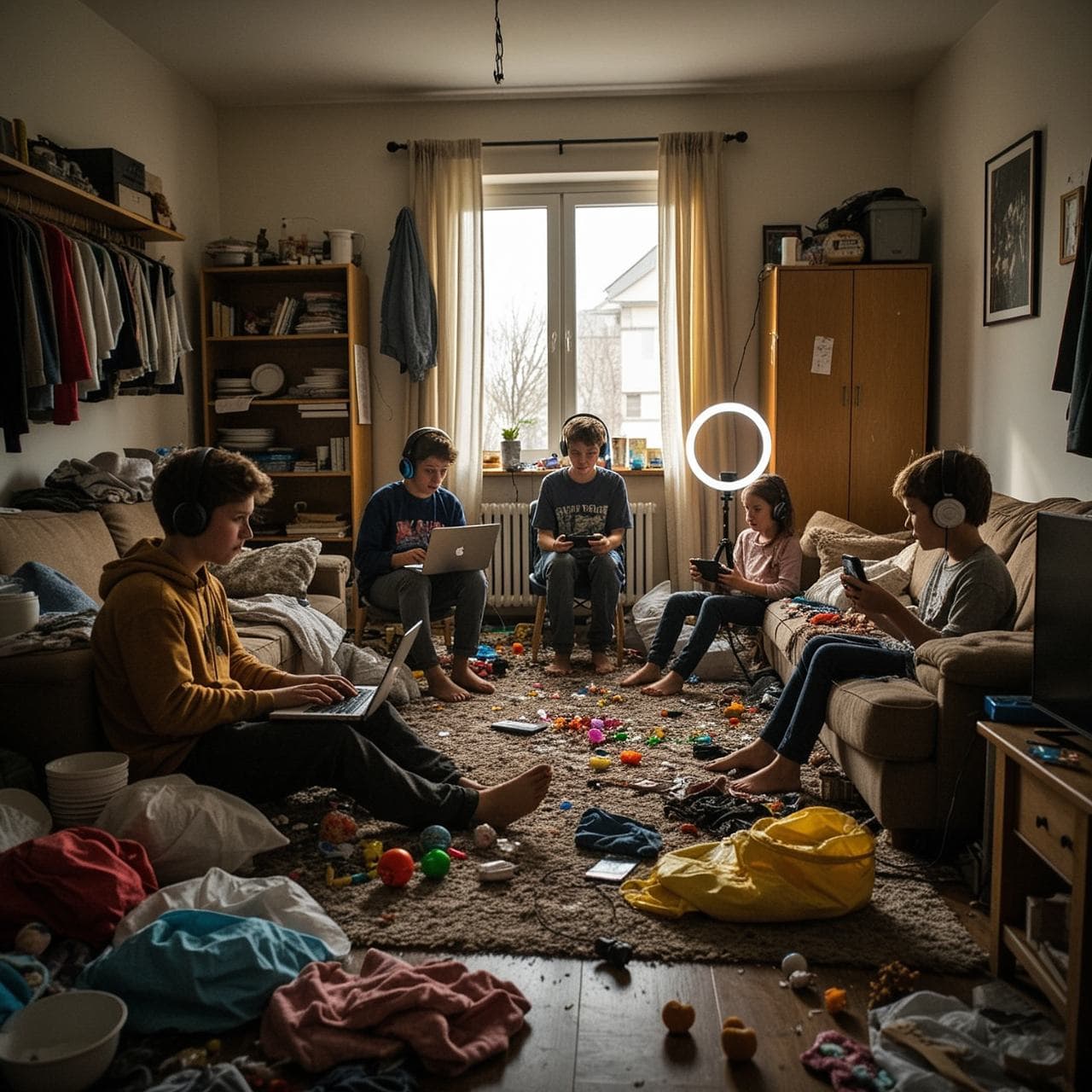

I used to think I understood the world. I was wrong. I understood my world—a quaint little bubble where phones had cords, encyclopedias were physical objects that required dusting, and the phrase "I'll be there in five minutes" meant you were literally five minutes away, not that you were still in bed scrolling through TikTok in your underwear.
Then I had children.
Not just any children. The Silent Crew. Four of them. A quadrilateral of chaos that arrived in this world with the apparent mission to ensure I never again experience what my mother so quaintly calls "peace and quiet."
Let me introduce you to the cast of characters, because understanding this family requires understanding the geological strata of humanity we've managed to compress into one suburban split-level:
There's me: Alex, aged fifty-two, card-carrying Generation X, the forgotten middle child of generations. I'm the one who learned cursive in elementary school only to discover it was as useful as a VHS rewinder. I can change a tire and troubleshoot a Wi-Fi router, which makes me either the most versatile or most pathetic generation in history. I grew up with "latchkey" stamped on my forehead—came home to an empty house, made my own snacks, and learned that the world was indifferent to my suffering. I am simultaneously cynical and pragmatic, sarcastic and surprisingly soft-hearted. I am the generation that watched MTV when it still played music videos, and I have strong opinions about which Star Wars trilogy is the real one (it's the original, obviously, and if you think otherwise, you're either too old or too young to understand).
My wife, Jennifer: Also fifty, also Gen X, but from the female perspective, which means she carries the additional burden of being told she could "have it all" and then discovering that "all" apparently included doing 90% of the parenting while also maintaining a career and somehow looking like she didn't just survive a natural disaster. Jennifer was raised by Boomer parents who divorced when she was ten, gave her a key to the house, and told her to "figure it out." She did figure it out, and now she runs a tight ship that her children are constantly trying to sink.
And then we have the bridge generation—my sister-in-law Morgan, age thirty-four, the Millennial. Morgan is what happens when you take Gen X's cynicism and add participation trophies, helicopter parenting, and a crippling student debt burden. Morgan lives in our basement (not because she has to, but because she "needs to save for a down payment while pursuing her passion," which currently appears to be something involving "influencer marketing" and "plant-based living"). Morgan is the cool aunt who buys the kids expensive coffee drinks and validates their feelings, which makes her either the most beloved or most resented person in the house, depending on whether you're asking the children or me.
Morgan represents everything my generation finds baffling about Millennials: their need for constant validation, their belief that work should have "meaning," their inability to simply shut up and do the job without processing their emotions about it. But Morgan also represents everything the kids find appealing: she speaks their language, she knows what "cheugy" means, and she doesn't make them do chores because she "understands that traditional domestic labor is rooted in patriarchal oppression."
And then, finally, the Silent Crew themselves—the children of Gen X, the products of our cynical, pragmatic, "figure it out" parenting:
Firstborn: Dakota, age sixteen, Generation Z. Dakota is what happens when you give a generation both crippling anxiety about the future and access to unlimited information about how screwed the planet is. Dakota communicates primarily through facial expressions that range from "mildly disappointed in your life choices" to "actively mourning the death of a houseplant." Dakota has strong opinions about capitalism, fast fashion, and why we should all be eating bugs to save the environment. Dakota has never once, in sixteen years, loaded the dishwasher correctly, despite having been shown approximately four thousand times.
Dakota represents the Gen Z condition: they are the most educated generation in history, the most socially conscious, the most technologically fluent, and yet they cannot operate a can opener. They can explain the complexities of intersectional feminism but cannot explain why their room smells like a dead animal. They are terrified of phone calls but will post their entire emotional breakdown on Instagram for strangers to consume. They are, in short, a mystery to my Gen X brain, which was raised on the principle that you should never show weakness and that the only appropriate response to "how are you" is "fine."
Second: Phoenix, age fourteen, also Gen Z but a different flavor of Gen Z. While Dakota is busy saving the world one infographic at a time, Phoenix is trying to become TikTok famous by posting videos of themselves doing absolutely nothing for hours at a time. Phoenix's generation discovered that you could monetize existing, and Phoenix intends to exploit this discovery to its fullest potential. Phoenix has 47,000 followers who watch them lie on the floor. Phoenix cannot locate the washing machine in our house, despite having lived here for fourteen years, but can navigate the complex economics of Discord server moderation with the skill of a Wall Street trader.
Phoenix embodies the Gen Z paradox: they are simultaneously the most connected and loneliest generation. They have hundreds of "friends" online but panic at the thought of ordering pizza over the phone. They are fluent in the language of memes but struggle with face-to-face conflict resolution. They are, as my mother would say, "a piece of work," but the work is abstract and probably involves NFTs.
Third: Atlas, age ten, the cusp generation—Gen Z trailing into Gen Alpha. Atlas is what happens when you give a child an iPad before they can hold their head up. Atlas speaks in memes. Literal memes. Atlas will respond to "How was school?" with "It's corn!" or "She's a 10 but—" and then trail off, waiting for me to understand the reference, which I never do. Atlas believes that chores are a human rights violation and has recently started referring to me as "bruh" in what I can only assume is an attempt to establish dominance or possibly just because they think it's funny.
Atlas represents the terrifying future: a generation that has never known a world without smartphones, without streaming services, without instant gratification. They are the first generation to grow up with AI as a normal part of life, with voice assistants as surrogate parents, with the entire accumulated knowledge of humanity available at the swipe of a finger. They are also, apparently, the first generation to decide that speaking in complete sentences is optional.
Fourth and final: Nova, age six, full Gen Alpha, the generation that will probably colonize Mars and then complain that the Wi-Fi is spotty. Nova is still young enough to be cute but old enough to have mastered the iPad better than I have. Nova has already asked Alexa to add "overthrowing the patriarchy" to the shopping list, which I found both alarming and impressive. Nova's contribution to chores is to create new ones, usually involving glitter.
Nova represents the final evolution: a generation that takes technology for granted in a way that even Gen Z doesn't. To Nova, the internet isn't a tool; it's the air they breathe. To Nova, physical toys are merely props for YouTube unboxing videos. To Nova, the concept of "waiting" is as foreign as the concept of "dial-up internet."
And then, looming over all of us like a monument to a bygone era, there is my mother: Patricia, aged seventy-two, Baby Boomer, the generation that walked uphill both ways to school and then invented the concept of walking uphill both ways as a personality trait. My mother raised three children while smoking cigarettes in the car with the windows up, fed us TV dinners that contained colors not found in nature, and somehow we all survived to tell the tale. She has opinions about "participation trophies" despite the fact that she has literally never seen one in real life, and she believes that the reason young people today are "soft" is because we don't let them play with power tools unsupervised.
My mother represents the Boomer ethos: self-reliance, bootstrap-pulling, and a casual disregard for emotional safety that borders on performance art. She is the generation that invented the suburbs, rock and roll, and the concept of "kids should be seen and not heard." She is also, unfortunately, the generation that now has to watch their Gen X children raise Gen Z and Gen Alpha grandchildren, which is causing her visible physical pain.
This is my family. Five generations. Five different operating systems. Five incompatible worldviews crammed into one house with questionable plumbing and a mortgage that will outlive us all.
It all started on a Tuesday.
Tuesdays are theoretically unremarkable days. They lack the fresh-start energy of Mondays, the downhill momentum of Wednesdays, the anticipatory thrill of Thursdays, or the merciful release of Fridays. Tuesdays are the plain toast of weekdays. But this Tuesday was different because it was the day my mother decided to visit, bringing with her the full force of Boomer energy and a casserole that could survive nuclear winter.
She arrived at 9 AM sharp, because Boomers believe that "fashionably late" is a moral failing, carrying a glass dish that weighed approximately forty pounds and contained enough sodium to preserve a blue whale.
"Alex!" she announced, barging through the door without knocking, because privacy is apparently a Millennial invention that Gen X never fully adopted anyway. "I brought you a tuna noodle casserole! The recipe calls for three cans of Cream of Mushroom soup, but I used five, because your generation doesn't understand the value of richness."
I took the dish, which immediately began burning through my nerve endings. "Thanks, Mom. You know Jennifer's lactose intolerant, right?"
"Nonsense. In my day, we didn't have lactose intolerance. We had 'suck it up and eat your dairy.' Nobody was allergic to anything. We ate peanuts on airplanes and drank from garden hoses, and we turned out fine!"
This is a typical Boomer argument. They believe that medical conditions were invented sometime around 1992, probably by Millennials who needed something else to complain about, and that the key to health is simply being tough enough. My mother thinks gluten sensitivity is a lifestyle choice and that ADHD is code for "needs more spankings." She also thinks that Gen X turned out "just fine" despite the fact that half my high school classmates are in therapy and the other half are dead.
"Where are my grandchildren?" she demanded, wiping her feet exactly nowhere near the doormat.
"Upstairs," I said. "Probably sleeping. It's summer break."
"Sleeping? At nine in the morning?" My mother's face contorted into an expression of such profound disappointment that I felt guilty for something I hadn't even done yet. "In my day, children woke up at dawn to do chores. We had a work ethic. We understood the value of—"
"Hard work, I know," I interrupted. "You've mentioned. Every visit. For thirty years."
"Well, someone has to mention it! You Gen Xers are too soft on your kids. You let them sleep until noon! You negotiate with them! In my day, we didn't negotiate. We obeyed!"
This was the Boomer mythos: the belief that they were raised in a military-style boot camp and turned out better for it. The reality, of course, was that my mother grew up in a time of unprecedented economic prosperity, when a single income could buy a house and college cost approximately twelve dollars. But try telling a Boomer that they had advantages and watch them implode with defensive rage.
"Mom," I said, trying to channel the Gen X trait of selective hearing. "They're teenagers. They biologically can't wake up before eleven. It's science."
"Science," she scoffed, as if I'd just blamed the situation on witchcraft. "You and your science. In my day—"
"In your day, you smoked while pregnant and thought seatbelts were for cowards," I said. "Things change."
She marched upstairs, her orthopedic shoes—purchased from a department store that also sells garden supplies and artificial Christmas trees—thumping against our hardwood floors. I followed, carrying the casserole of gastrointestinal regret, bracing myself for what I knew was coming.
She threw open Dakota's door without knocking, because consent is also apparently a concept that skipped the Boomer generation entirely.
"Rise and shine!" she bellowed.
Dakota, buried under a weighted blanket that cost more than my first car, emerged like a groundhog predicting six more weeks of depression. They blinked at the light, at my mother, at the concept of consciousness itself, and said: "What."
Not "What?" with a question mark. "What." With the period of someone who has already given up on this interaction.
"Good morning, sunshine!" My mother was undeterred. Boomers are undeterred by most things, including social cues, personal boundaries, and empirical evidence. "Your grandmother is here! And I've brought a casserole!"
Dakota stared at her with the hollow eyes of someone who has seen the future and found it wanting. "Is it... gluten-free?"
"Gluten-free?" My mother laughed, a sharp barking sound that had startled many a small animal over the decades. "In my day, we ate gluten for breakfast, lunch, and dinner! We didn't have 'gluten-free!' We had 'food!' And we liked it! We didn't have celiac disease. We had 'stomach aches!' And we walked them off!"
Dakota looked at me. I shrugged. This was the generational divide in action: the Boomer who believed that suffering built character, and the Gen Z who believed that suffering should be avoided at all costs and also documented on Instagram if unavoidable. The Gen X parent (me) caught in the middle, too cynical to believe either of them fully.
"Also," Dakota said, pulling their blanket over their head, "it's nine AM. This is basically the middle of the night. Teenagers need nine to ten hours of sleep for proper cognitive development. There's studies."
"Studies!" My mother turned to me, her face a mask of betrayal. ",Alex what have you done to these children? They sleep like vampires! They eat like... like..."
"Like people with dietary restrictions?" I suggested.
"Like communists!"
This was a new one. "Communists?"
"Yes! In my day—"
"Mom, I really don't think dietary preferences are political."
"Everything is political!" she declared, which was rich coming from someone who thought discussing money was "in poor taste" and that racism ended in 1968 because she personally stopped noticing it.
She moved to Phoenix's room, throwing open that door with the same lack of ceremony. Phoenix was awake, which was surprising, but they were filming themselves with their phone, which was not.
"Say hi to Grandma," Phoenix said to their phone, not to my mother.
"Who are you talking to?" my mother demanded.
"My followers."
"Your what?"
"My followers. On TikTok."
My mother's face underwent a series of contortions that suggested she was trying to process this information using a mental framework designed in 1958. "You have... followers? Like... like a cult leader?"
Phoenix considered this. "Kind of, yeah. But with better lighting. And less Kool-Aid."
"And you're just... filming yourself? In bed?"
"Yeah. It's a 'day in the life' video. I'm doing a 'morning routine' segment."
My mother looked at the screens, at the ring light, at the child who was somehow doing four things at once and paying attention to none of them. "Alex, why is your child filming themselves doing nothing?"
"Because people watch it," I said, as if this explained anything.
"Why would anyone watch someone do nothing?"
"For entertainment?"
"In my day, entertainment required talent! You had to sing, or dance, or tell jokes! You couldn't just... lie there!"
Phoenix, still filming, interjected: "Actually, Grandma, it's about authenticity. People are tired of the polished Instagram aesthetic. They want realness. They want to see people just existing. It's a rejection of capitalist productivity culture."
My mother blinked. "Capitalist what?"
"Productivity culture. The idea that your worth is determined by your output. We're reclaiming leisure as resistance."
My mother looked at me with genuine fear in her eyes. "Alex, your child is a communist."
"I thought you liked hard work," I said.
"I do! But this..." She gestured vaguely at Phoenix, who had now shifted to get better lighting from the window. "This is something else. This is... laziness with a manifesto."
"Exactly!" Phoenix said, delighted. "You get it!"
My mother did not get it. My mother would never get it. This was the fundamental tragedy of our multigenerational household: we were all speaking English, but we were speaking different dialects of reality.
She moved on to Atlas's room, perhaps hoping for a child who still believed in the traditional values of respecting elders and not having political ideologies before puberty.
She was disappointed.
Atlas was awake, which was good. Atlas was playing Minecraft, which was expected. But Atlas was also simultaneously watching a YouTube video on a second screen, listening to something on Spotify, and carrying on a text conversation that involved so many abbreviations it might as well have been hieroglyphics.
"Atlas, honey!" my mother tried.
Atlas held up one finger without looking away from the screen. "One sec, Grandma. I'm in the middle of something."
"You're in the middle of... what, exactly?"
"PvP. Player versus player. This guy's trying to grief my base. Also, I'm learning about the French Revolution from this YouTube video, and listening to phonk music, and texting my friend about how school is literally a prison."
My mother looked at the screens, at the headphones, at the child who was somehow absorbing information at a rate that would have given her generation an aneurysm. "Alex, why does your ten-year-old have more screens than a movie theater?"
"Because we live in the future," I said. "And because I'm Gen X and I don't know how to say no."
"The future is going to ruin their eyes! And their attention spans! In my day, we played outside! With sticks!"
"We have sticks," Atlas said, still not looking up. "They're in Minecraft. I can craft them. It's way better than real sticks. Real sticks don't have crafting recipes. Also, Grandma, did you know that the French Revolution was basically caused by economic inequality and food shortages? Sounds familiar, doesn't it?"
My mother opened her mouth, closed it, and seemed to realize that she had entered a reality where her reference points no longer applied. She was a Boomer in a Gen X house, watching Gen X raise Gen Z and Gen Alpha children, and the ground was shifting beneath her orthopedic shoes.
She found Nova last, the youngest, perhaps hoping that here, at least, she would find a child who still understood the value of grandmothers and casseroles.
Nova was awake, dressed, and sitting at their small table with an iPad propped up in front of them.
"Nova, my sweetie!" my mother cooed, approaching with arms open.
Nova looked up. "Hi Grandma. I'm watching a video about how to make slime without borax because borax is toxic and also capitalism."
My mother froze. "You're... six."
"And?"
"And you're talking about... toxic... capitalism?"
"Yeah. From the video. The algorithm showed it to me because I watched a video about sustainable toys yesterday. Also, Grandma, can you buy me a Robux gift card? I need to buy a skin in Adopt Me."
"The... algorithm? Robucks? Skin?" My mother backed out of the room slowly, like someone retreating from a bear encounter. She found me in the hallway, the casserole still burning my hands, and she looked at me with eyes that had seen the rise of the internet, the fall of the Soviet Union, and the invention of the smartphone, and yet had never felt as lost as she did right now.
"Alex," she whispered. "Your children are... different."
"They're of their time," I said.
"But when will they do chores? When will they learn responsibility? You Gen Xers were responsible! You had to be! I worked three jobs! I—"
"Mom," I interrupted. "I was a latchkey kid. I raised myself. I'm doing my best."
"But your best isn't—" She stopped herself. She looked at me, her Gen X son, the one who had survived her parenting and the divorce and the 80s and the 90s and the 2008 crash and the pandemic, and something in her face softened. Just a little. "Just make sure they know how to work, Alex. That's all. Make sure they know how to work."
And then, as if summoned by the mention of work, Morgan emerged from the basement.
Morgan was wearing what I can only describe as "Millennial Business Casual"—a blazer over a band t-shirt, wide-leg pants that looked like they could house a small family, and sneakers that cost more than my first semester of college. She was holding a matcha latte that she had somehow acquired despite it being 9:15 AM, and she looked like she had just come from a very important meeting about "synergy" or "brand alignment."
"Good morning!" Morgan chirped, seeing my mother. "Oh, hi Patricia! Is that a casserole? It looks amazing! Is it gluten-free? Dairy-free? Keto-friendly?"
My mother's face hardened. "It's food. Real food. Not... not whatever that green drink is."
"It's matcha! It's full of antioxidants. It's part of my morning wellness routine. I journal, then I meditate, then I have my matcha, then I check my email but only if I'm not feeling triggered by my notifications."
"Triggered?" My mother looked at Morgan, then at me, then back at Morgan. "Alex, why is your sister-in-law talking like a robot?"
"I'm practicing mindfulness, Patricia," Morgan said, not offended because Millennials don't get offended; they get "big feelings" that they process through therapy and Instagram stories. "It's about being present in the moment and honoring my boundaries."
"Boundaries?" My mother turned to me. "What boundaries? It's nine in the morning!"
"Emotional boundaries," Morgan explained patiently. "I don't let work stress invade my personal space before 10 AM. It's about work-life balance."
"In my day," my mother said, her voice rising, "we didn't have work-life balance! We had work! And then more work! And we were grateful for it!"
"And that's why you have ulcers and a strained relationship with your emotions," Morgan said brightly. "But we're healing that! Gen X and Millennials are healing that! We're breaking cycles!"
My mother looked at Morgan, then at me, then at the casserole in my hands. She seemed to realize that she was outnumbered, that her way of life—the Boomer way, the grit-and-bear-it way—was being replaced by something softer, something more emotional, something that required trigger warnings and gluten-free options and therapy sessions.
"Well," she said, straightening her posture. "I'm going to put this casserole in the kitchen. And then I'm going to sit down. And then I'm going to watch my grandchildren do absolutely nothing while everyone talks about their feelings and their algorithms and their communism."
She marched toward the kitchen, a Boomer general retreating from a battle she didn't understand, leaving behind a Gen X son, a Millennial in-law, and four children who represented the terrifying, confusing, glorious future.
I looked at Morgan. Morgan looked at me. We both looked at the stairs, where we could hear Dakota sighing, Phoenix filming, Atlas crafting, and Nova asking Alexa about the current state of the patriarchy.
"She's taking it well," Morgan said.
"She's going to put whiskey in her coffee," I said.
"Is that a bad thing?"
"For her? No. For us? We're about to hear about how 'in her day' people didn't need 'emotional support beverages.'"
And thus began the saga of the Silent Crew—the creators of all chores, the avoiders of all responsibility, the generation that would inherit the earth and probably sell it on Depop as a "vintage planet, slightly used, good vibes only."
Little did I know that this Tuesday, this unremarkable Tuesday, would be the beginning of a journey through the hellscape of generational misunderstanding, the comedy of errors that is modern family life, and the slow, painful realization that we are all, in our own ways, trying our best—even if our best looks like filming ourselves doing nothing or making slime without borax because capitalism.
The Silent Crew had arrived. And they were not going to load the dishwasher.