


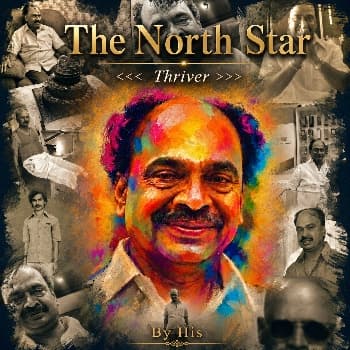

Before Appa became a husband, he was, like many young men, simply finding his place in the world.
He would occasionally smile when speaking about his college days, admitting that there had been a few innocent crushes along the way. Friends would tease him about the attention he received from girls on campus. He was never the loudest or the most flamboyant person in a room. Quite the opposite. His quiet confidence, disciplined nature, intelligence, and willingness to work harder than everyone else made him stand out. He was a man of few words, and perhaps that mystery only made him more admired.
Nothing ever came of those youthful admirations. As life moved forward, many of those classmates remained what they had always been at heart—good friends. Years later, when they met again, there was only warmth, respect, and shared memories of a simpler time.
Then, quite unexpectedly, one young woman quietly became different from everyone else.
She was my mother.
In those days, marriages within the extended family were not uncommon. As conversations about her future began among the elders, one proposal in particular gathered momentum—not for Appa, but for one of his elder brothers.
For the first time in his life, hesitation became impossible.
The thought of watching the woman he loved marry someone else was unbearable.
So he did something that was completely unlike him.
He spoke.
My mother did not immediately say yes.
In fact, she refused him at first.
Looking back, I often smile at that part of the story. It makes their love feel wonderfully human. Great love stories are rarely straightforward.
What followed was not a whirlwind romance but something gentler.
Letters.
Carefully written.
Carefully hidden.
Carefully treasured.
Words became the bridge between two shy hearts.
Page after page, they came to know each other—not only through conversations but through thoughts that perhaps could never have been spoken aloud.
Those letters slowly transformed uncertainty into trust.
Affection became companionship.
Companionship became love.
Eventually, together, they found the courage to speak with both families.
Convincing everyone was not immediate, nor was it effortless, but love, when carried with sincerity and patience, often finds its own path.
In time, it did.
They were married.
Just as my mother's name implied, my father found peace in her.
My maternal great-grandmother loved recounting, with her trademark sarcasm, how my mother had threatened to board a train and elope if the family stood in their way. Behind every teasing retelling was the quiet acknowledgment that theirs was a love worth fighting for.
As children, we naturally imagine our parents always having been “Amma” and “Appa.”
It never occurs to us that they too were once young people with nervous hearts, uncertain futures, and dreams they barely dared to speak aloud.
Only much later did I begin to appreciate that before they became the safe place I called home, they had first built that home for each other.
It wasn’t built with wealth.
It wasn’t built with comfort.
It was built with shared hope.
Together they started with very little.
Their first home was small and modest.
Nothing about their beginning suggested the life they would eventually build.
There were no shortcuts.
No sudden fortune.
Every improvement came slowly.
A slightly better house.
A little more stability.
A few more comforts.
A little less worrying than the year before.
Looking back now, I think that gradual journey is one of the greatest gifts my parents unknowingly gave us.
We did not simply inherit a comfortable life.
We witnessed it being built.
Brick by brick.
Year by year.
Salary by salary.
Prayer by prayer.
As children, we hardly noticed the transformation.
To us, it simply felt like life.
Only as adults do I realize how much sacrifice quietly lived beneath ordinary days.
My father often dreamed aloud.
One day he would buy another house.
One day each daughter would have her own security.
One day there would be enough that none of us would ever have to worry.
Those dreams came from a childhood where worrying had been unavoidable.
Even now, I cannot think of those dreams without tenderness.
He was never chasing wealth for its own sake.
He was trying to outrun the poverty that had once followed him.
Whether he succeeded completely no longer matters to me.
Because somewhere along that journey, he achieved something far greater.
He built a home where three daughters never doubted that they were deeply loved.
And that, I have come to believe, is the richest beginning any child can receive.