


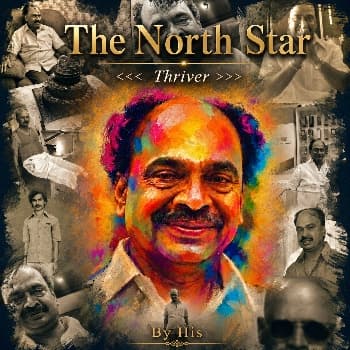

Before I knew my father as Appa, he belonged to someone else first.
He was his mother’s son.
Whenever he spoke about his childhood, the stories almost always found their way back to her. There was admiration in his voice that never faded with age. Even after becoming a husband, a father, and later a grandfather, he still spoke of his mother with the quiet reverence of a little boy.
In many homes, the father is remembered as the pillar of the family.
In Appa’s childhood, that pillar was his mother.
My grandfather loved his family dearly and worked in his own way, but it was my grandmother who carried much of the family’s weight. She was the one who somehow managed to keep ten children fed, educated, clothed, and hopeful through years when there was very little to spare.
Even now, I marvel at what she accomplished.
Ten children.
Five sons.
Five daughters.
Not one of them was denied an education.
More remarkably, she did not stop at basic schooling. She insisted that every one of her children pursue higher education, encouraging them to earn postgraduate degrees during a time when such opportunities were far from common.
Whenever Appa spoke about her, he never talked about sacrifice as though it were extraordinary. To him, it was simply who she was.
He remembered how she somehow made sure everyone had enough to eat. If there was one luxury she protected fiercely, it was food. However difficult life became, she tried to ensure that at least once every week her children enjoyed a proper non-vegetarian meal.
Perhaps that is why all of her children grew up with such affection for food.
Whenever Appa remembered those meals, it was never the menu he recalled.
It was the love that had cooked it.
I was fortunate enough to know both my grandparents before I entered my teenage years. By then they were older, gentler, and surrounded by grandchildren, yet I could still glimpse the extraordinary parents they had once been.
My grandfather brought laughter wherever he went.
He had one charming weakness.
He could never remember which child was in which class at school.
Sometimes he struggled even to remember names correctly.
That became one of Appa’s favourite childhood stories.
Whenever report cards came home, children were expected to get their father’s signature.
For Appa, that often meant facing a series of questions.
“What class are you in now?”
“How many marks did you get?”
Like many mischievous boys, he occasionally decided that avoiding those questions was easier than answering them.
If the marks were disappointing, he would quietly sign the report card himself.
But report cards were not the only documents that found their way beneath his pen.
Because he excelled in football, he often participated in tournaments where prize money was awarded to the winners. The school would send home permission slips or sports-related letters that required a parent’s signature.
Appa had discovered a practical little secret.
If his father signed the papers, he might also ask where the prize money had gone.
So, with the confidence that only a spirited young boy could possess, Appa would sometimes sign those letters himself. The winnings stayed safely in his pocket, giving him a little extra spending money—a small luxury in a childhood where luxuries were almost nonexistent.
Whenever he narrated this story years later, he laughed with genuine delight.
It was impossible not to laugh with him.
Although I remember my grandfather as a man skilled in English grammar; he carried a pen until his very last day. One of his diary revealed I was one of his favourite grandchildren.
For a few moments, the responsible father who carried the weight of so many lives disappeared, and in his place stood a clever schoolboy trying to protect his hard-earned pocket money.
My grandfather used to say that the child who performs a parent’s final rites would one day receive a hidden treasure. Whenever Appa found himself short of money, he would jokingly wonder, “I don’t know when that treasure is going to come.” I would laugh and reply, “I am the treasure Thatha was talking about.” He would smile—and somehow, in that moment, we both believed it.
Those stories mattered to me.
They reminded me that our parents were not born as parents.
They were children first.
Dreamers first.
Students first.
Sons and daughters first.
Before Appa became the man I admired, he had already lived an entire lifetime as someone else’s child, he had already been shaped by the extraordinary woman who raised him.
Looking back now, I realise that much of the father I loved had already been quietly formed in that crowded little home.
His patience.
His generosity.
His belief in education.
His instinct to feed people before himself.
His habit of helping without expecting recognition.
Those qualities did not begin with him.
They began with the woman he called Amma.
And perhaps that is how love truly travels through generations—not by inheritance of wealth, but by inheritance of character.