


The forest had grown alive with spring. Birds called from the treetops, streams gurgled with melting snow, and the scent of new plants drifted on the wind. Gor’s family moved cautiously along a river bend, collecting fish trapped in shallow pools. The infant cooed
in Nera’s arms, warm against her chest.
Then Kelm froze. His hand shot up, pointing toward the treeline.
“Shh,” Gor whispered, holding up a finger.
Through the trees moved a figure unlike any they had seen before. Tall and slender, with long limbs, hair tied back, carrying a spear that gleamed differently in the sunlight. Behind him came more—five figures in total, moving with agility that Gor had never witnessed in his people. They were Cro-Magnons.
The family crouched low, observing silently. The Cro-Magnons were clearly hunting: their movements careful, tools precise, and eyes scanning the forest for prey or danger. Unlike Neanderthals, their gestures were subtle, coordinated, almost ritualized, as if every action was part of a plan.
Brak whispered, “Are they… like us?”
“Different,” Gor said softly. “But clever. Watch.”
The Cro-Magnons paused near a fallen tree. They set up what appeared to be a trap for a small deer, using thin branches and stones. They worked in tandem, gesturing and signaling each other without words. Gor’s family studied every movement, recognizing the intelligence but noting the lack of brute force in their approach—they relied on coordination, timing, and cunning.
Gor motioned for the family to stay hidden. They did not want confrontation—not yet. Instead, they would learn.
Kelm tilted his head. “Could we… hunt together?”
Gor shook his head. “Not yet. Watch first. Learn first. Never trust strangers in the forest.”
The Cro-Magnons successfully caught the deer. They celebrated quietly, careful not to waste movement or sound. Gor’s family noted this: precision, patience, communication without shouting. A new kind of survival, different from their own.
For several days, Gor’s family tracked the Cro-Magnons from a distance, observing their strategies, noting their tools, and watching how they divided tasks. The Cro-Magnons were fast, cooperative, and cunning, but they lacked the sheer endurance and knowledge of predators that Gor’s family possessed.
One morning, a wolf approached the Cro-Magnons while they butchered a kill. The Cro-Magnons froze, unsure how to react. Gor’s family, hidden nearby, watched. Brak whispered, “They don’t know the forest like we do.”
Gor nodded. “Clever, yes. But naive. We survive because we know the land, the animals, the ice, the rivers.”
Later, Gor led the family closer, just beyond a shallow stream. The Cro-Magnons noticed them—eyes wide, weapons ready. A tense silence followed. Gor raised a hand in a gesture of calm. The leader of the Cro-Magnons, a tall figure with long arms, mirrored the gesture.
For several minutes, they stared, measuring each other. Neither group advanced. Then, slowly, the Cro-Magnons turned and retreated, leaving the forest—and the Neanderthals—undisturbed. No fight had occurred, but both had learned. Both had measured intelligence, patience, and restraint.
Gor lowered his hand. “We do not fight when not necessary. We observe. We learn. We survive.”
The family moved on, carrying fish and small game, but their eyes remained sharp, now watching for both predators and other humans. The encounter left them thoughtful: these Cro-Magnons were not enemies—but they were different, and their cleverness demanded respect.
Spring deepened, rivers swelled, and the forest hummed with life. Gor’s family thrived—not only surviving predators and harsh seasons, but learning the subtle lessons of other humans, other minds, and other strategies.
The Pleistocene was not just a world of ice, snow, and blood—it was a world of knowledge, observation, and adaptation.
And Gor’s family would continue to master it.
============================================================
Territory of Shadows
Spring was settling into early summer, but the forest remained a world of danger. Rivers swelled from melted snow, streams gurgled through the meadows, and predators—wolves, bears, and even the lurking saber-tooth—reminded Gor’s family that life was never safe.
But another threat had emerged, one subtler than fangs or claws. The Cro-Magnons had returned. Not silently this time. Their numbers had grown, and their movements suggested not hunting alone—they were staking territory.
Gor crouched behind a ridge, peering over a patch of frozen moss and shallow rocks. He counted six Cro-Magnons moving toward the river bend, carrying spears, slings, and crude nets. “They are claiming this land,” he whispered. “And we are in it first.”
Brak and Kelm tightened their grip on their spears, muscles coiled. Nera held the infant close, whispering warmth. Una adjusted the furs around the child, eyes scanning the forest. Old Varn tapped his staff lightly on the snow, signaling readiness.
Gor’s mind raced. “We do not fight blindly,” he said. “We fight smart. The river, the ice, the traps—they are ours. We use them. Observe. Adapt. Survive.”
The Cro-Magnons began setting small traps of their own along the riverbank, carefully arranging nets and sharpened sticks to catch fish and small game. Their movements were precise, cooperative, and silent, but Gor noticed gaps: they did not anticipate predators, the ice was thin in places, and their traps were easy to predict for someone who knew the forest.
Gor led his family through shadows and brush. Brak and Kelm moved to cut off a trail subtly, creating false tracks to mislead the newcomers. Nera scattered stones and feathers, drawing attention away from the riverbend where the family’s traps waited.
The first conflict came when a Cro-Magnon stepped onto weakened ice near the river. It cracked beneath him, and he fell into the frigid water. A net swung loose, tangling him further. Gor’s family stayed hidden, watching. The man struggled but escaped, shaken.
A second Cro-Magnon, moving to rescue him, tripped over a tension line. Branches snapped, startling the group. Brak and Kelm jabbed at shadows with their spears, forcing the Cro-Magnons to retreat slightly.
From behind a tree, Gor observed the rival humans carefully. “They are clever,” he muttered. “But they lack the patience and knowledge of this land. Their strength is coordination; ours is cunning, endurance, and understanding the forest itself.”
The Cro-Magnons regrouped. They tried to flank the river, approaching from the woods above the bend. Gor anticipated this. Hidden stakes, ice traps, and tension lines forced them to move exactly where the Neanderthals wanted. One slipped into a shallow pit, catching his spear on the edge. Another was driven toward the weakened river ice, which cracked under weight, sending him sprawling.
Gor led Brak and Kelm in precise movements, striking with spears and guiding the Cro-Magnons into confusion without direct confrontation. Nera used small stones to distract, throwing them near the edges of traps to create sudden noise. Una whispered to the infant while watching the distant struggle, a teacher of survival by example.
Finally, the Cro-Magnons realized the land was contested. They paused, measuring Gor’s family through the trees. Neither side advanced. Mutual respect, wariness, and the desire to survive hung in the cold air like fog.
Gor lowered his spear slightly. “We defend what is ours,” he said. “We do not fight unless necessary. But we do not yield. The forest, the river, the traps—they are ours.”
The Cro-Magnons hesitated, then retreated, leaving the river bend and much of the territory under Gor’s family’s control—but not without sending a clear message: they would return, and when they did, both groups would be smarter, faster, and more cunning.
Gor watched them disappear into the forest. “Observe,” he said to the family. “Learn. Plan. Adapt. The next time, it will not be so easy.”
The infant cooed softly in Nera’s arms, and the wind carried the sounds of distant birds and rushing water. The forest was alive, a battleground of minds as much as muscles.
Gor’s family had survived another trial, not against beasts alone, but against other humans who were clever, patient, and adaptable.
And the Pleistocene waited, patient and merciless, for the next test.
=============================================================
Clash at the River Bend
Summer sun gleamed on the swollen river, sparkling over ice-melt and rushing water. Gor’s family moved along the bank, spear in hand, eyes scanning every shadow. The Cro-Magnons were close—they had been stalking the river for days, attempting to trap fish and small game, and now it was clear: the hunting grounds themselves were contested.
Gor crouched behind a rock, tracing footprints in the sand. “They come not just for food—they come for control,” he whispered. “We cannot yield. But we cannot fight blindly. Every step, every trap, every throw must be precise.”
Brak and Kelm nodded, adjusting spears, muscles coiled. Nera pressed the infant to her chest, whispering warmth. Una tightened furs, eyes scanning, ready for sudden movement. Old Varn tapped the ground lightly with his staff, signaling traps hidden in the foliage.
The Cro-Magnons emerged from the trees—six figures, slender, fast, coordinated. Their leader raised a hand, signaling the others to spread. Their strategy was clear: approach from multiple directions, overwhelm the defenders, and secure the prime fishing pools along the river.
Gor motioned. Brak and Kelm slipped into positions along the upper bank, invisible in shadow. Nera and Una took the infant behind a large boulder, ready to create diversions if needed. Gor waited, spear steady, heart racing.
The first move came from the Cro-Magnons. They stepped onto shallow pools, attempting to scoop fish with their hands and small nets. But Gor had anticipated this. He flicked his spear toward a small branch, releasing a tension line that sent a heavy net swinging into the river, startling the water and scattering the fish.
One Cro-Magnon lunged toward the net. Brak struck from the shadows, jabbing a spear at the man’s legs and forcing him into a shallow pit. Kelm pushed another toward weakened ice along the riverbank. A sharp crack echoed, and the man flailed, almost falling into freezing water.
The Cro-Magnons recovered quickly, retreating and repositioning. They were clever, observing the traps and adjusting, but Gor had layered multiple lines of defense: false tracks, hidden stakes, weighted branches ready to fall, and sharpened ice traps beneath the snow and sand.
Gor advanced, spear ready, eyes locked on the Cro-Magnon leader. “We defend what is ours,” he called, low and steady. “Move closer, and you face the traps and us together.”
The leader paused, weighing the risk. He gestured to his group, attempting to flank, but Brak and Kelm anticipated it. They used hand signals Gor had taught them, moving as one. Two Cro-Magnons stumbled into shallow pits, another got tangled in tension lines, branches snapping around him.
Nera and Una created diversions—throwing stones and breaking branches, forcing the Cro-Magnons to hesitate. Even the river itself became a weapon: Gor had weakened ice patches that collapsed under weight at key points, sending water rushing and forcing the intruders to retreat or fall.
For hours, the battle of wits escalated. Both sides moved like shadows, striking and retreating, testing intelligence as much as strength. The Cro-Magnons proved patient and clever, but Gor’s family knew the land, the river, the ice, and every hidden trap. Every mistake was exploited. Every clever maneuver by the Cro-Magnons met an even cleverer counter.
By late afternoon, the Cro-Magnons withdrew. They had secured small prey elsewhere, but the prime river bend—traps, fishing pools, and territory—remained under Gor’s family control. Both groups had tested the other, measured skill against skill, and learned: brute force alone was useless here. Survival required strategy, patience, and cunning.
Gor lowered his spear slowly, breathing heavily. Brak and Kelm sank to their knees, pale but alive. Nera pressed the infant to her chest, murmuring reassurance. Una brushed snow and dust from her family, steadying nerves. Old Varn leaned on his staff, nodding in approval.
“We defend,” Gor said quietly. “We survive. And we teach. Every trap, every strategy, every lesson is for the next day, the next season, the next generation. They will return, but we will be ready.”
The forest held its breath as the Cro-Magnons disappeared into the trees, leaving footprints that would fade, but knowledge that would remain.
The Pleistocene was not just survival. It was strategy. It was intelligence.
And Gor’s family had proven themselves masters of both.
===========================================================
Blood on the Meadow
Summer had thickened the forest. Trees were dense with leaves, streams ran full and fast, and meadows shimmered with grass and wildflowers. But abundance brought competition. Gor’s family had survived winter, outwitted predators, and held the river bend. Now, the Cro-Magnons were returning in force, their movements bold, hunting not just for survival but to stake territory.
Gor crouched at the edge of a high bluff overlooking a meadow where a herd of bison grazed. His family—Brak, Kelm, Nera, Una, and Old Varn—spread out, silent and motionless. Every footstep was calculated, every whisper of wind considered.
“They will try to take the bison,” Gor whispered. “We cannot allow it. These lands feed us. They are ours, by blood, by cleverness, by survival.”
The Cro-Magnons appeared in the tree line below, six figures moving quickly, tools in hand, scanning for prey. They were skilled, coordinated, and determined—but Gor had prepared. He gestured to Brak and Kelm.
“Traps first. Herd second. Territory always.”
Weighted logs had been set along the edges of the meadow, hidden pits concealed by grass and dirt, and tension lines tied to rocks and branches to guide the bison toward the kill zone. The family moved like shadows, invisible and precise.
The first bison stepped into the meadow, grazing peacefully. Gor’s signal was subtle—a lift of his hand. Brak and Kelm released the tension lines. A log swung from its pivot, startling the lead bison, guiding it toward the hidden pits. The herd began to run.
The Cro-Magnons reacted immediately, attempting to intercept, but Gor’s traps worked as planned. One of their number stumbled into a pit, another was forced toward the river by swinging branches, and the herd’s momentum carried it exactly where Gor’s family wanted.
Spears flew. Brak struck the lead bison, Kelm guided it further into the pit trap. Gor intercepted a Cro-Magnon trying to drive the herd away, forcing him back with a calculated jab. Nera and Una supported from the edges, distracting and herding smaller prey for supplemental food.
Old Varn monitored the surroundings, ensuring no rival or predator could flank them. The saber-tooth had not been seen for weeks, but its scent lingered—a reminder that the forest always tested skill and intelligence.
Hours of careful maneuvering ended in success: the bison were corralled, injured but alive, ready for the kill. The Cro-Magnons, realizing they had been outwitted, retreated, but not silently. Their eyes glimmered with understanding—this would not be the last contest.
As the family butchered and prepared the bison, Gor addressed them. “Today, we survived the forest, the herd, the Cro-Magnons. But we learned, too. They are clever, persistent. We must always be smarter, faster, more precise.”
The following weeks saw repeated clashes over territory:
• Rivers and fishing pools became contested. Gor’s family used hidden stakes, ice traps, and false trails to secure fish while observing the Cro-Magnons’ attempts to intercept.
• Meadows and grazing lands became battlegrounds. Both sides learned to drive herds strategically, anticipate each other’s moves, and exploit weaknesses.
• Small game and forage turned into a psychological contest: which group could remain quiet, patient, and precise while the other made mistakes?
With each encounter, Gor’s family grew more skilled:
• Kelm became a master of stealth, moving like a shadow through grass and brush.
• Brak learned to predict Cro-Magnon strategies, setting traps not only for prey but to misdirect humans.
• Nera and Una coordinated distractions, gathering small game and observing rival movements.
• Old Varn became the family’s eyes and ears, warning of predators and human intruders alike.
The Cro-Magnons were clever, but Gor’s family had knowledge the newcomers could not match: the patterns of predators, the subtle behavior of rivers and ice, the cunning use of terrain, and the unbreakable bond of a family trained in survival from birth.
By the end of summer, both groups had claimed territory—but Gor’s family had defended their core lands: the river bend, the meadows, and the forested slopes. The
Cro-Magnons had retreated, but the rivalry had hardened into a game of strategy, patience, and survival.
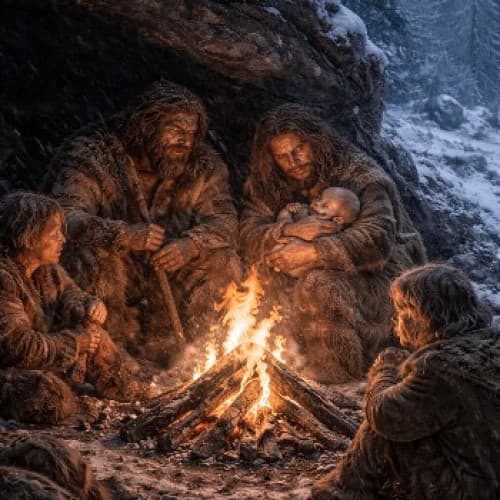
As the sun set over the meadow, Gor’s family gathered around a fire, sharing warmth and the rewards of the hunt. The infant cooed, small but already learning.
Gor looked out at the forest, shadows stretching long across the land. “The season changes,” he said, voice low, steady. “But we endure. We fight smart. We survive. And one day, the forest will know our name.”
The Pleistocene was not just survival—it was strategy, cunning, and family.
And Gor’s family was mastering all three.
=============================================================
The reindeer
The valley was a world of white and gray, endless snowdrifts broken only by jagged cliffs and frozen rivers. Game was scarce. Mammoth herds had moved farther north, and smaller prey like reindeer and wild goats had learned to hide in the icy forests. Hunger gnawed at them all, but Gor had learned long ago that fear and weakness would kill faster than starvation.
“Father, the tracks,” Nera whispered, pointing to deep impressions in the snow. Ogg leaned forward, nostrils flaring, eyes narrowing. A herd had passed here only hours before.
“Reindeer,” Brak said, excitement and impatience coloring his tone. “I can track them. I can catch one.”
Gor shook his head. “Not alone. The snow hides death as easily as life.” He lifted his stone axe, checking the edge, feeling the weight in his hands. “We hunt together, or not at all.”
The hunt began.
Gor led the family along the spoor, silent as shadows. Snow crunched under their feet, mist curling in their breath. The valley was a maze of frozen ridges and jagged cliffs, perfect for ambush—and perfect for disaster. Gor signaled with a low growl; Nara darted ahead to block one path, Brak flanked from the other side, and Nera waited near the reindeer tracks to drive the herd into their trap.
Time slowed. Heartbeats echoed. Then, a flash of movement: a small group of reindeer, heads low, hooves pounding snow. Gor and his family attacked in unison. Brak threw a spear with unerring aim, Nera tripped another with a hidden branch, and OId Varn lunged with a stone blade. One reindeer fell, bleeding into the snow, its breath a mist of life leaving the body.
Victory was fleeting. The wind carried a distant roar—a cave lion, drawn by the scent of blood. Gor’s ears twitched. “Back to the fire. Now.” He scooped the meat, signaling the family. They moved quickly, silently, each step deliberate.
By nightfall, the fire glowed orange against the icy walls of their cave. They shared the meat, the warmth, the exhaustion, and for a moment, the world outside did not exist. But
Gor knew better. Hunger was only the first danger. Snowstorms, rival hunters, predators—and the shadows on the ridge—were waiting. Survival demanded more than skill with a spear; it demanded cunning, courage, and unity.
Gor leaned back, watching Bruk gnaw on a strip of dried meat. “Soon,” he murmured, “we will face more than snow and beasts. Something… other is coming.” His voice was a whisper, yet the weight of it settled on them all, like the snow on the valley’s cliffs.
And somewhere across the ridge, taller shadows stirred, curious, watching.
________________________________________
Across the Ridge
The valley slept under a gray sky, frozen rivers glinting like shattered glass. Ogg’s family had eaten their fill from the mammoth hunt, but his mind could not rest. He scanned the distant ridge, eyes narrowing against the wind. Something moved there—tall, unfamiliar figures, walking with a precision he had never seen.
“Father,” Nera whispered, pointing, “they are not ours.”
Gor’s heart tightened. His fingers closed around the haft of his stone axe. The Others—taller, narrower, leaner humans—were Cro-Magnons, newcomers to this frozen land.
Their bodies were different, their movements fluid, and the spears they carried were longer, sharper, and carefully balanced. These were competitors, possibly enemies, and
Gor knew the law of survival: intrusion must be met with caution, or death would follow.
Brak’s eyes burned with impatience. “I will go and drive them off,” he said, stepping forward.
Gor grabbed him by the shoulder. “No. Not alone. They are not like wolves. They think, they plan, and their numbers can overwhelm even the strongest of us.”
The Cro-Magnons spotted them, too. One of the taller figures raised a spear, scanning the valley, then shouted—a sharp, guttural sound unlike any of Gor’s people. Bruk tensed. Nera crouched low, silent. Nera’s hand rested on the haft of her knife, ready.
Suddenly, a snowball of conflict rolled downhill. The Cro-Magnons advanced, throwing spears with deadly precision. Gor’s family scattered, diving behind ice ridges and jagged rocks. One spear grazed Brak’s arm, cutting deep. Gor roared, leaping into view, axe swinging. He smashed a rock against an enemy’s shoulder, sending the man staggering.
Nera and Kelm attacked together, driving the others back, using the terrain and surprise to their advantage.
The battle was chaotic. Snow and blood mixed underfoot. One Cro-Magnon lunged at
Gor, but he sidestepped and swung his axe, stopping the man short of Bruk. The Others retreated, realizing they had underestimated the Neanderthal family’s strength and cunning. Gor stood panting, chest heaving, watching them vanish into the mist.
When silence returned, the family regrouped. Brak’s arm throbbed, but he grinned despite the pain. “We drove them off,” he said proudly.
Gor shook his head. “No. They are not gone. They will return. And next time… next time, it may not be only spears we face.”
Old Varn limped forward. “They move with purpose, Gor. They share fire, tools, hunting methods. They are not simple animals. They are clever, like you, but sharper. Watch them closely, or they will take what we have.”
That night, as the fire burned low, Gor kept watch on the ridge. The Others lingered in his thoughts. Some part of him knew that survival might require more than just strength.
Perhaps there was a path through conflict and cooperation—a way to share the land, the herds, and even knowledge. But that path would be treacherous, and it would test every lesson Gor had learned in the cold valleys.
In the shadows, the Cro-Magnons did the same. They had seen the Neanderthals’ skill, their strength, their unity. A silent calculation passed between them: coexistence might be possible, but only if respect—and sometimes blood—was paid.
The valley slept, but the future was stirring. And for Gor and his family, the age of the
Others had begun.
____________________________________________________________