


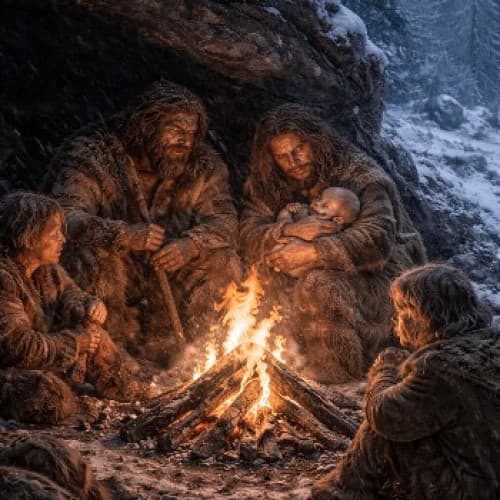
The forest was a white maze, endless and cruel, every step a test.
Gor’s family moved cautiously, hunting small game while staying alert. The snow hid footprints, but they could feel them—traces of the rival group, faint, broken by wind and ice. Every snapped twig, every hollow crunch beneath their feet reminded them they were being watched.
Brak scanned the trees constantly, muscles coiled, ready to throw a spear. Kelm followed quietly, eyes on the tracks, learning. Nera clutched the infant, whispering warmth and calm, while Una adjusted their furs, tightening straps, checking blades. Old Varn walked last, tapping branches, muttering low warnings, eyes sharp despite age.
Gor stopped suddenly, kneeling to examine the snow. “They move fast,” he said. “Always around. Waiting. Watching. We must be clever.”
He led them to a narrow pass, hemmed by jagged rocks and thick pine. “Here,” he said. “We make the forest our trap. They will not see us, but we will see them.”
Hours passed. Snow fell steadily, covering footprints, masking scent, turning the world pale and silent. The family crouched in the shadows, watching, waiting.
Finally, a shape moved among the trees—tall, broad-shouldered, carrying spears, cautious. One of the rivals stumbled on a hidden patch of ice, snow spraying around him. Brak raised his spear, then Gor gestured—wait.
The rival group did not notice the traps along the river bend, or the sharpened stakes hidden beneath branches. Gor whispered instructions. Kelm and Brak tightened ropes between trees, setting tension lines that would trip or slow an intruder. Nera scattered stones to make faint sounds in snow, drawing attention away from their true position.
The first rival stepped onto the shallow ice near the river. It cracked beneath his weight. A second slipped on hidden snow, crashing into a bush. The family moved as one—silent, efficient. Gor jabbed a spear into a riverbank, forcing a rival toward a frozen patch. The ice groaned and fractured beneath him, and he tumbled into the icy water, claws scrambling for purchase.
The rest of the rival group hissed in frustration and rage. They had expected an easy claim of territory; instead, the forest turned against them.
Brak struck first, spear grazing a rival’s shoulder. Kelm jabbed from behind, forcing them into the river bend. Nera threw stones and ice shards, creating distractions. Gor faced the leader, eyes locked, spears clashing in a violent rhythm.
The fight was chaotic—snow flying, blood mixing with ice, raw shouts cutting through the winter silence. But Gor’s family was coordinated. Every movement had purpose. Every strike had a target.
Finally, the rival leader roared and pulled his group back, dragging the wounded. “This is not over!” he shouted, voice cracking with anger and fear.
Gor did not chase. He exhaled slowly, chest aching, eyes scanning the retreating shapes.
Brak sank to his knees, exhausted. Kelm’s hands shook. Nera pressed the infant close, murmuring softly. Una’s hands trembled, fur clinging with sweat and snow. Old Varn leaned on his staff, nodding once, slowly.
Gor looked at them all. “We survive,” he said. “Because we are clever. Because we are together. They will return. And we will be ready.”
The snow fell in heavy silence, blanketing the world, hiding the tracks of both groups. But the forest had learned their names. The river had seen their courage. The Pleistocene waited, patient and cruel, for the next mistake, the next challenge, the next strike.
And Gor’s family would meet it, together.
________________________________________________________
Clash of Shadows
The wind had sharpened overnight, slicing through fur and bone. The snow was deeper now, knee-high in some places, drifting against rocks and fallen logs, and the river had frozen solid enough to bear weight—but not safely.
Gor’s family moved like shadows, silent, every step measured. The rival group had returned. They had learned from the last encounter, but Gor had learned too. He had studied their patterns, anticipated their moves, and turned the forest into a battlefield.
Brak led the way cautiously, spear poised. Kelm followed, eyes flicking between footprints in snow and overhead branches. Nera clutched the infant tightly, whispering warmth into its tiny ears. Una moved beside her, adjusting the layers of fur to shield them from the cold. Old Varn tapped his staff lightly, alert to every crack, every hollow sound.
Gor stopped at a bend in the river, nodding to Brak and Kelm. Hidden stakes had been set beneath snow, tension lines anchored to trees, ice patches weakened deliberately, and rocks positioned for sliding strikes. The family had prepared for this, combining intelligence with brute force.
From the treeline, the rival group emerged. Six figures, broad and fierce, spears in hand, faces painted with ash and blood. Their leader, taller and scarred, glared at Gor. “No more hiding,” he snarled. “Today, we take what is ours.”
Gor stepped forward, spear in hand, chest broad, breath steaming in the frozen air. “We do not hide,” he said. “We fight. You will not pass.”
The rivals advanced cautiously. They had learned patience, but the family had learned cunning.
The first strike came as a distraction—a rival lunged toward Brak, expecting an easy target. Brak sidestepped, driving his spear into the snow behind the attacker. The ice beneath the rival groaned and shifted, forcing him to stumble.
Kelm pulled a rope taut, and a hidden branch snapped down, crashing against another attacker. The snow and ice concealed the trap, and the rival tumbled, yowling.
The saber-tooth tiger, their previous predator, howled faintly from the forest. It had watched the rival group’s approach and retreated for now, sensing the chaos.
Gor met the rival leader head-on, spears clashing, teeth bared in determination. Each strike was precise, calculated. Brak and Kelm flanked the leader, driving him toward the river bend where ice had been weakened. Nera scattered stones, creating sound and motion, forcing the rivals to hesitate.
The fight escalated. Snow exploded underfoot, blood spattered against white fur, ice cracked beneath struggling feet. One rival slipped, arms flailing, and tumbled into the river, the cold water stealing his strength instantly. Another struck at Brak, but Gor intercepted, spear jabbing and forcing the attacker into a hidden stake trap.
The leader roared, fury and fear mingling. He lunged, desperate, but Kelm jabbed at his legs, tripping him over the weakened ice. Brak followed, thrusting the spear against the rival’s shoulder. Gor pressed forward, spear steady, eyes locked on his foe.
Finally, one by one, the rival group retreated. They dragged the wounded, leaving deep grooves in the snow as proof of their defeat. The leader hissed, eyes burning with hate.
“This is not over!” he shouted, retreating into the gray forest.
Gor lowered his spear slowly, chest heaving, muscles trembling from effort. Brak and
Kelm sank to their knees, pale but alive. Nera pressed the infant to her chest, whispering soothing words. Una’s hands shook as she brushed snow from the child. Old Varn leaned on his staff, nodding slowly, approvingly.
Gor looked at them all, pride and exhaustion mingling. “We survive,” he said. “Because we are clever. Because we are together. Today, the forest, the ice, the rivals—they all tested us. And we won.”
The snow fell heavier now, softening the scars of battle but not erasing the lesson. The Pleistocene did not forgive weakness. Strength alone would not keep them alive; intelligence, teamwork, and courage were their only allies.
And Gor’s family had them all.
They were bloodied. They were tired. They were cold.
But they were alive.
And they would continue to fight.
____________________________________________________________
Winter’s Teeth
The forest had become a world of white and gray, stripped bare of leaves, brittle with ice and snow. The river’s frozen surface reflected pale sunlight, like a knife slicing through the endless drifts. Every step was a test. Every breath burned in lungs already chilled by the wind.
Gor’s family moved carefully, aware that survival was not a single battle—it was every day, every hour, every choice. The river crossing, the saber-tooth, the rival group—they were lessons in the truth of the Pleistocene: cleverness, courage, and unity were as vital as strength.
The first challenge of the long winter was shelter. Gor led them to a hidden cave along a rocky hillside, half-shielded by frozen boulders. Inside, snow had blown in, forming small drifts, and the floor was slick with ice. Brak shoveled snow aside while Kelm arranged furs and moss to insulate the floor. Nera tucked the infant into layers of warmth, humming softly to mask the wind’s howl. Una gathered branches, building small fire pits from stone and moss. Old Varn scouted the entrance, noting weak ice patches and the tracks of predators.
“We will stay,” Gor said. “We make this place alive with warmth. We make it ours.”
Hunting was a constant struggle. Small animals were scarce under deep snow. Gor taught Brak and Kelm how to track rabbits under drifts, how to set snares invisible beneath the snow, and how to use ice and branches to create false trails for prey—or predators. Nera discovered frozen berries beneath shrubs, roots that had survived frost, and mushrooms hidden beneath ice.
The saber-tooth returned occasionally, prowling beyond the trees, drawn by scent and curiosity. Gor set traps along its likely paths: weighted logs to fall, sharpened stakes hidden beneath snow, and tension lines that would startle or redirect it. The predator tested them, and they adapted, learning to anticipate its cunning.
The rival Neanderthal group stalked as well. Sometimes, distant shouts and the cracking of branches warned Gor’s family that the rivals were near, searching for weaknesses.
Gor’s response was strategy: false tracks, decoy fires, and careful placement of traps to protect both food and territory. Brak and Kelm became skilled in deception and ambush, their movements precise and silent.
Inside the cave, they shared stories, gestures, and murmurs. Nera collected unusual stones, feathers, and pieces of bark, arranging them with care—small tokens of beauty in a brutal world. Una prepared food, using every scrap, every root, every bit of meat.
Old Varn taught the boys about tracks, the behavior of animals, and the signs of winter storms that could turn deadly.
Days merged into nights, nights into blizzards. Snow piled high outside, wind gnawed at exposed fur, and the river hissed beneath its icy shell. Yet the family endured, their bonds growing stronger with each shared challenge.
One morning, Gor led Brak and Kelm to a frozen river bend where elk tracks were fresh. The family worked as a unit, silent, precise. Brak’s spear struck first, wounding the elk.
Kelm guided it toward a hidden pit, the tension lines snapping branches and startling it into submission. Nera and Una helped drag the kill back to the cave, the infant bundled safely. Old Varn monitored the shadows for rival eyes or predator scent.
Evenings were brief and precious. They huddled around small fires, sharing warmth, stories, and reassurance. Brak learned the rhythm of the forest, Kelm the patience of a hunter, Nera the observation of life even in snow and ice. Gor watched them, heart heavy with responsibility but light with pride.
The saber-tooth, the river, the rival group—they were all challenges that shaped the family, sharpened their minds and skills. Winter would test them again, and again. But they had learned: survival was not just enduring the cold—it was outthinking it, moving with it, living inside it.
And in this frozen world, Gor’s family thrived.
They were bloodied. They were cold. They were hunted.
But they were alive.
And that was the first victory of the long winter.
-----------------------------------------------------------------------------
Fang and Shadow
The wind had risen overnight, sharper than any the family had felt. Snow whipped through the trees, coating the cave’s entrance and hiding tracks in a white blur. Gor’s family moved carefully, aware that every sound—every crack of ice or snap of branch—could be a predator stalking them.
They had prepared: hidden pits along the river, sharpened stakes buried under snow, tension lines stretched between trees, and false trails to mislead hunters. But nothing could prepare them for what was coming.
A low growl echoed through the frozen forest, a sound that vibrated through bone and ice. Gor froze, chest tight. The saber-tooth had returned.
It emerged from the shadows like a living nightmare: massive, fur thick and gray, muscles rippling beneath its skin, fangs glinting like ivory knives. Its eyes locked on the family, calculating, predatory. This was no casual hunt. It had learned. It had adapted.
And now, it was hungry.
“Positions,” Gor whispered. He gestured to Brak and Kelm. They crouched, spears ready.
Nera pressed the infant to her chest, whispering warmth. Una adjusted their layers, eyes scanning. Old Varn tapped his staff lightly on the frozen ground, signaling danger.
The saber-tooth approached cautiously, testing the traps. Its claws tore through snow, ice crackling under each step. Gor stayed low, spear poised. The predator circled, stalking like smoke through the trees, looking for weakness.
Then it lunged.
The first attack was sudden—a swipe of massive claws sent snow spraying, knocking
Brak backward. Kelm rolled to the side, spear thrusting at the tiger’s flank. Gor met the predator head-on, spear braced, muscles screaming with tension.
The fight became a brutal dance. The saber-tooth struck again and again, powerful jaws snapping, claws tearing ice and earth. Gor jabbed with precision, keeping the predator at bay, forcing it toward the traps along the river bend. Brak and Kelm flanked from opposite sides, coordinated, striking at legs and shoulders.
Nera, perched behind a rocky ledge, threw weighted stones at the tiger’s head, aiming for eyes and nose to distract. Una grabbed a burning branch from the fire pit, swinging it toward the saber-tooth’s snout, smoke and flame making it hesitate. Old Varn used his staff to strike at the predator’s hind legs, causing it to stumble momentarily.
The river bend became the battlefield. The ice, weakened deliberately by Gor’s earlier planning, gave way beneath the tiger’s massive weight. It roared in fury as it slid dangerously toward the current, claws scraping at snow and frozen water.
Gor seized the moment. Spear thrust after thrust, combined with Brak and Kelm’s attacks, pushed the saber-tooth closer to the edge. Finally, it plunged into the icy water with a howl, struggling to regain footing. Snow and ice sprayed over the rocks as it thrashed, teeth snapping at nothing but air and freezing river.
The family watched, hearts pounding, as the massive predator fought against the cold current. After moments that felt like hours, it clawed its way back to the far bank, battered, frustrated, and wary. Its eyes met Gor’s one last time before it disappeared into the forest, leaving only prints and broken branches as proof of its fury.
Gor lowered his spear slowly, muscles trembling. Brak sank to his knees, pale, hands raw. Kelm pressed a hand to his chest, trying to calm his racing heart. Nera held the infant tightly, whispering warmth, while Una brushed snow from her family’s fur. Old Varn leaned heavily on his staff, nodding with relief and awe.
“We live,” Gor said, voice low and steady. “We fight together. We are clever. We survive.”
The wind carried the faint roar of the saber-tooth, a promise of future danger, but the family stood together, unbroken.
The forest was cruel. The Pleistocene was relentless. But Gor’s family had faced the deadliest predator of the ice—and endured.
They were bloodied. They were tired. They were cold.
But they were alive.
And that was their victory.
__________________________________________________________
Winter’s Reckoning
The forest lay silent under a thick blanket of snow, but silence was never peace. Every crack of ice, every rustle of branches, carried warning. Gor’s family had grown sharper, faster, smarter over the long winter, but they knew the rival Neanderthals had not forgotten.
From the far ridge came movement: six figures, broad and ragged, faces streaked with ash and blood, weapons ready. Their leader’s eyes burned with hate, his scars catching the pale sunlight. They were returning—not to negotiate, but to claim.
Gor crouched behind a snowdrift, spear poised. “Positions,” he whispered. Brak and Kelm moved into place, ready to flank. Nera pressed the infant close, her feathers trembling in the cold, while Una adjusted their furs, eyes scanning every shadow. Old Varn tapped his staff lightly, tracing hidden traps in the snow with his gaze.
“Remember what we learned,” Gor murmured. “The forest is ours. The ice is ours. The traps are ours. Fight clever, move together, survive together.”
The rivals advanced cautiously, unaware of the false tracks, the hidden pits, and the tension lines stretched between trees. Gor’s family waited, silent and coiled like a spring.
A branch snapped underfoot—a signal. The battle began.
The first rival stepped onto a hidden patch of ice. It cracked beneath him, sending him sprawling. Brak jabbed at his legs, forcing him toward a pit concealed by snow. Kelm pressed from the side, pushing another rival into a tangle of tension lines that snapped branches and ice in his face.
Gor met the rival leader directly, spears clashing in a violent rhythm. The man was strong, skilled, but Gor’s movements were practiced, precise. Every step, every strike, drove him toward the final trap along the frozen river bend.
Nera and Una moved silently, keeping the infant safe while hurling stones and ice to distract the attackers. Old Varn used his staff to sweep away the snow and trip a rival who tried to flank.
Suddenly, a roar echoed from the trees—the saber-tooth had returned. Its massive form emerged, eyes locked on the largest threat: the rival leader. The predator’s presence changed everything.
The rival group faltered, fear mixing with fury. The saber-tooth lunged, massive jaws snapping. The leader tried to fight both the predator and Gor, but the traps and family attacks forced him into the icy river, struggling against current and freezing water.
The rest of the rival Neanderthals tried to flee, but Brak and Kelm struck swiftly, driving them toward hidden pits and tension lines. One tumbled over a sharpened stake; another became tangled in the rope traps. Nera and Una kept the infant safe, guiding them behind rocks and snowbanks.
Gor faced the final rival—the leader—pinned by the saber-tooth’s roar, ice, and Gor’s spear. With a final, precise thrust, Gor forced him to yield. The rival sank to his knees, hands raised, and backed away slowly.
The saber-tooth snarled one last time, retreating into the forest, leaving snow and broken branches as proof of its presence.
Gor lowered his spear slowly, chest heaving, muscles trembling from exertion. Brak and Kelm sank to their knees, pale but alive. Nera pressed the infant to her chest, whispering soft words of warmth. Una’s hands shook, brushing snow from their family. Old Varn tapped his staff lightly, eyes wide with approval.
Gor looked at his family, proud and exhausted. “We survive,” he said, voice low but steady. “We survive because we are clever. We survive because we are together. Today, we are stronger than winter, stronger than the forest, stronger than fear.”
Outside, snow fell softly, blanketing the scars of battle, hiding the footprints of enemies, predators, and hunters alike. The forest was silent again, but silence no longer meant vulnerability—it meant mastery.
The Pleistocene had tested them. The river, the ice, the saber-tooth, the rival Neanderthals—they had faced it all and endured.
Gor’s family huddled together inside the cave, warming themselves by the fire. They were bloodied. They were exhausted. They were cold.
But they were alive.
And now, the forest, the ice, and the winter itself had learned the name of Gor’s family.
They had survived.
They had triumphed.
And they would continue to thrive.
________________________________________
Spring Thaws
The snow softened. Rivers swelled with melting ice, carrying branches and debris through the forest. The bitter winter had passed, but survival did not pause. Every season brought new challenges, and Gor’s family moved carefully, aware that the world was alive with threats—and opportunities.
Brak and Kelm led the way along a stream swollen with meltwater. Fish darted beneath the surface, quick and slippery, but Gor had taught them patience. They fashioned small weirs from sticks and stones, directing the current to trap fish for easy collection. The infant gurgled in Nera’s arms, safe in layers of moss and fur.
The saber-tooth had vanished for now, likely retreating into deeper forests or hunting elsewhere, but the signs of its presence remained: tracks, fur caught on branches, broken ice near the riverbank. Gor studied these with care, teaching Brak and Kelm to read predator behavior. Survival meant understanding every creature around them—not just fighting it.
Other animals tested their skill. A herd of wild horses appeared along the meadow,
nervous eyes scanning for danger. Gor and the boys prepared spears, but Gor shook his head. “Observe first,” he said. “Not all hunts need blood.” They watched, learning the patterns of movement, timing of grazing, and signs of alarm.
A sudden rustle in the trees drew their attention. Wolves moved through the underbrush, lean and cunning, hunting smaller game. Gor whispered instructions: use traps if necessary, never fight unless forced. The family learned to coexist with predators, using intelligence rather than brute force.
As spring deepened, signs of other humans began to appear. Stones arranged in unusual patterns, remnants of fires long cold, and footprints too delicate for Neanderthal size hinted at the presence of Cro-Magnons—slender, agile, moving differently through the forest. Gor studied these traces carefully. The newcomers were not immediate threats, but their presence meant competition for food, territory, and knowledge.
One day, while foraging near a river bend, Kelm spotted movement in the distance: a tall figure, crouched and alert, holding a small spear. It watched them silently, blending with the trees. Gor signaled the family to halt. Nera pressed the infant closer. The figure did not approach; it disappeared as silently as it had appeared.
“Others are here,” Gor murmured. “Different from us. Clever, like us, but not our kind.
Watch and learn, but do not seek them.”
The family continued, navigating spring storms that churned rivers, softened snowbanks, and revealed hidden hazards. Fallen trees created obstacles, while new plant life offered nourishment—roots, tender shoots, and berries hidden beneath melting snow. Gor taught the boys to track, forage, and respect the balance of the forest.
Predators continued their patrols. Wolves, bears emerging from hibernation, and smaller cats tested their awareness. The saber-tooth’s scent lingered, a reminder that even the largest predator respected no schedule. Gor’s traps remained in rotation, adjusted for new threats. Every animal encounter became a lesson in timing, patience, and precision.
By late spring, the family had learned to move seamlessly with the forest. They could track animals without alarming them, forage for roots and berries efficiently, and anticipate predator movements. The traces of Cro-Magnons added tension and intrigue—they were aware that other humans could share knowledge, tools, or conflict, but Gor’s family remained cautious, watching from a distance, learning without engaging.
The season shifted, slowly warming the forest. Birds returned, nesting in trees near the cave. Small animals emerged from burrows. The river sparkled with life, fish leaping, insects buzzing along the banks. Gor’s family thrived—not merely surviving, but mastering the rhythm of the Pleistocene, shaping their knowledge into skill, and weaving their bonds tighter than ever.
They were hunters. They were strategists. They were a family.
And in the distance, among the trees, unseen eyes watched them—familiar predators, rival humans, and perhaps, hints of the new species that would one day walk alongside them.
The forest had changed. The family had changed.
And the world of the Pleistocene waited, patient, dangerous, alive.
____________________________________________________________