


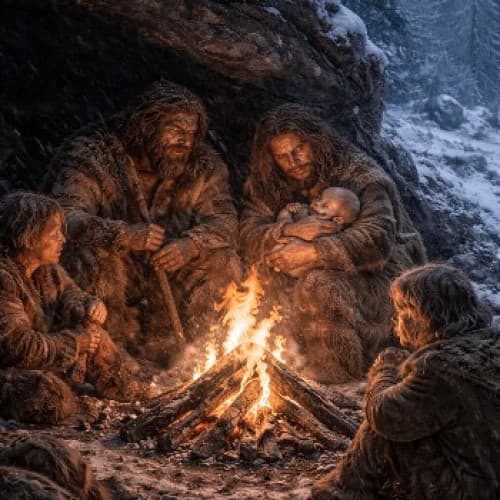
The valley was quiet, but not peaceful. Snow lay heavy on the cliffs, covering the tracks of both predator and prey. Gor's family moved cautiously, tending to Bruk’s wounded arm.
The cut had been deep, and infection could be deadly if left untreated. Ogg pressed a strip of animal hide to the wound, tying it tight, his eyes never leaving the ridge.
“They are clever,” Old Vern murmured. “They watch, they wait. Soon, they will strike again.”
Gor nodded, understanding that the others were not mindless hunters. They had observed, learned, and adapted. And perhaps, in their own way, they were curious.
It was Nera who first noticed the small signs of change. While scouting for firewood, she saw tracks near a frozen stream—smaller, lighter prints that did not match the
Neanderthal family’s. They were Cro-Magnon children, moving silently, playful but cautious. She called the others. “They are not hunting. They are… watching.”
Gor studied the prints. His gut told him the Others were testing boundaries, learning, but not immediately attacking. “We are not the only hunters who know fear,” he said quietly.
“We must use it wisely.”
A few days later, the snow deepened, and hunger clawed at them all. Mammoth herds had vanished, reindeer were scarce, and even the small game had learned to hide. Gor had led his family over frozen rivers and across jagged cliffs, but the ice offered no mercy.
That night, something unexpected happened. A Cro-Magnon woman appeared at the edge of their camp, carrying a small bundle of dried meat. Her eyes were wary, but she did not advance with aggression. Nera stepped forward, blade raised, but Gor raised his hand.
“Wait,” he said.
The woman nodded slightly, then placed the meat on a flat stone. “Food. Cold. Share?” she gestured, speaking in strange sounds that Gor did not understand, yet somehow comprehended.
Brak stared, disbelief and suspicion mixing in his eyes. “Is this trick? Trap?”
Gor shook his head. “Perhaps… but survival sometimes requires risk. Watch, learn, adapt.”
They shared the meat cautiously, firelight flickering over faces that were still strangers to one another. Gor watched Lyra—the Cro-Magnon woman—her movements precise, her hands skillful in ways his family could learn from. The fire burned low, and a strange understanding settled over them: conflict and cooperation were not opposites; they were two sides of survival.
Over the following weeks, interactions became more frequent. Nera observed Lyra teaching her child to set small snares for rabbits. Brak learned how to sharpen spears more efficiently from one of the Cro-Magnon men. And in quiet moments, the boundaries between families softened—trust forming in small, fragile gestures.
Then, during a blizzard that trapped both families in a narrow ravine, the two groups had no choice but to share shelter. Gor watched Brak huddled beside Lyra, her warmth saving Old Varn from hypothermia. It was the first time he realized that their bloodlines, their futures, could merge, not as enemies, but as partners in survival.
The storm passed. Snow dripped from jagged cliffs. Yet the lessons remained: strength alone could not guarantee life. Cooperation, knowledge, and even trust with the Others might be the only way to endure the frozen valleys.
Gor looked across the ridge at the retreating shadows of the Cro-Magnons. Their eyes met, not with hostility, but with recognition. The age of survival was changing. And so was Gor’s family.
_______________________________________________________
Winter’s Hunger
Winter had tightened its grip on the valley. Snow fell in relentless sheets, blanketing the ridges and choking the rivers. Gor’s family, lean from the lack of prey, trudged through waist-deep drifts, the cold gnawing at their bones. Even Brak’s healed arm ached with the frost. The wind carried distant howls of wolves, hungry and desperate, echoing across the frozen cliffs.
The Cro-Magnons had returned. Their tracks ran parallel to Gor’s path, showing the careful, silent stalking that had earned them their reputation. Gor signaled to his family, halting their march.
“They follow the herds,” Old Varn muttered. “And us.”
Gor studied the tracks, noting the smaller footprints of three Cro-Magnon . Nera crouched beside him, eyes wide. “They move with purpose, but they do not strike. Not yet.”
Hunger pressed upon them all. Days without substantial prey had made the family desperate. Even the ice-frozen carcasses of deer were too few to sustain them. Gor knew the Others were in the same peril. Survival required cunning, and cunning sometimes required allies, not enemies.
He led his family toward a narrow pass, where the tracks converged with the Cro-Magnons. There, both groups froze, eyes measuring each other across the snow. Gor stepped forward slowly, arms open in the ancient gesture of peace.
Lyra emerged, carrying a small bundle of dried fish. Her gaze was steady. Gor gestured toward the stream, nodding. “Food?”
She nodded.
The two groups arranged a crude hunting plan. They would cooperate to drive a herd of reindeer into a narrow canyon, where traps could ensure that both families had enough meat to survive. Trust was fragile; a single misstep could trigger chaos or violence.
The hunt began at dawn. Snow drifted around them as they moved like shadows. Gor and Old Varn flanked the herd from one side, Brak and Nera guided the Cro-Magnons at the other flank. Spears flew, traps snapped, and the valley echoed with the cries of prey.
A reindeer broke free, charging straight at Brak. Before he could react, a Cro-Magnon boy leapt, tripping the animal with a hidden branch. Brak recovered, driving his spear into the creature. Life and death intertwined in a ballet of chaos and precision.
When the hunt ended, both families gathered around the frozen carcasses, sharing the meat and tending to injuries. The fire warmed their bodies, but the real warmth was in the fragile trust that had formed between them.
That night, Gor and Una watched Lyra and Brak moving near the fire, her hands shaping spears with a skill unmatched by his own family. She glanced at Brak and nodded, acknowledging what both knew but could not yet speak: survival would demand more than muscle—it would demand union.
As sleep claimed them, the wind howled across the valley. Wolves circled the ridges. Snow threatened to bury them alive. And yet, for the first time, Gor felt that the Others were not only rivals—they were part of the path forward.
In the frozen world of the Ice Age, strength alone was no longer enough. Adaptation, cunning, and the courage to trust—even with former enemies—were the keys to enduring the relentless cold. And in that understanding, Gor sensed the faint stirrings of something new: lines of blood and knowledge that might blend to create a future stronger than either family alone.
_______________________________________________-________
Bonds in the Snow
The snowstorm had raged for three days, burying the valley in silence except for the whistling wind. Gor’s family huddled in a narrow cave, their breaths steaming in the icy air. Brak shivered violently, fever burning through his young body. Even wrapped in furs, the cold seemed to seep into his bones.
Gor crouched beside him, pressing his hands to his son’s forehead. “Hold, Brak,” he murmured, eyes flicking toward the entrance of the cave. “We will not lose you to the cold.”
Outside, a shadow moved. Lyra, the Cro-Magnon woman, had braved the storm, carrying a bundle of dried meat and soft furs. Her eyes met Gor's, steady and fearless, and she gestured with a few words and signs he understood instinctively: help. share. survive.
Nera stood, blade ready, but Gor shook his head. “She comes for life, not for battle.”
Lyra knelt beside Brak, wrapping him in the furs and pressing warmth into his skin. Nera helped, her small hands mimicking the Cro-Magnon gestures. Brak’s shivering eased, and for the first time in days, Gor allowed himself a long exhale.
The two groups shared the cave for several days. Outside, the storm raged, but inside, something unusual began to form: trust and quiet understanding. Lyra and Gor exchanged knowledge—how to set more effective traps, how to find edible roots beneath the snow, how to recognize subtle changes in wind that foretold predators.
Brak recovered, stronger each day. And slowly, subtle bonds formed between the families. The Cro-Magnon laughed alongside Nera and Brak, their games cautious at first, then fearless. Lyra spoke softly to Nera, offering guidance in fire-making and preparing hides. The line between enemy and ally blurred, replaced by shared survival.
It was during one long, frozen night that Brak recognized the depth of this change. He sat close to the Cro-Magno, their hands brushing as they repaired a broken spear. He looked into her eyes and understood—their worlds, though born apart, could merge. Bloodlines, knowledge, and survival were not separate. They could intertwine.
Old Varn observed silently, leaning on his cane. “You see it, Brak,” he rasped. “This is how the world will endure—not by fighting, but by learning. And by sharing… even blood.”
Brak nodded, watching Nera and the Cro-Magnon boy spar playfully in the snow outside. “I see it,” he whispered. “The Others are no longer strangers. They are part of our path.”
By the next dawn, the storm had passed. The valley glistened in frost and sunlight. Gor led both families out, across ice and snow, toward a ridge where reindeer tracks promised food. But the lessons of the storm lingered: survival required cooperation, courage, and the willingness to trust.
In the frozen silence of the valley, Gor felt a spark of something new: the intertwining of two peoples, two lineages, bound by necessity, respect, and the first fragile stirrings of connection. The age of Neanderthals alone was ending, but the age of survival—shared, cooperative, and enduring—was only beginning.
________________________________________
The Mountain Hunt
The sun had barely risen when the valley shook with distant thunder—not from storms, but from the heavy steps of a mammoth herd moving through the mountains. Gor's family crouched low behind a ridge, breath clouding in the cold air. The Cro-Magnons were nearby, equally tense, eyes tracking the massive beasts.
Gor motioned to his family, then to the Cro-Magnons. “We drive them together. One mistake, and the snow takes us all.”
The plan was simple in theory but deadly in practice: flank the herd from opposite sides, driving them toward a narrow canyon where hidden pits and traps awaited. Any misstep could crush a hunter under the mammoth’s weight.
Brak’s hands trembled on his spear. “They are enormous,” he whispered, awe mixing with fear.
“They are life,” Gor said. “And death. Choose carefully which one you take today.”
The hunt began. Gor and Old Varn approached from the west, snow crunching underfoot. Nera darted ahead, signaling the Cro-Magnon to her side, guiding them in silent, precise movements. The group advanced from the east, eyes sharp for movement in the snow.
The mammoths noticed them almost immediately. Dusting snow off their massive backs, they trumpeted and charged. One misstep by a Cro-Magnon sent him tumbling down a small slope. Brak dove, catching him by the arm before a tusk could strike. Gor roared, smashing a pit trap with his axe to drive the herd in the correct direction.
The battle between hunter and prey was brutal. Snow flew in blinding clouds. Spears struck flesh; ice cracked beneath massive feet. Nera and the Cro-Magnon woman worked in tandem, tripping a smaller mammoth into a pit, while Gor drove another toward the hidden gorge. The families shouted and gestured, their coordination imperfect but growing stronger.
Halfway through, disaster struck. One massive mammoth veered off course, charging directly toward Brak. The Cro-magnon woman leapt, grabbing him and pulling him to safety. The beast thundered past, crushing traps and sending snow and stone flying. Gor’s axe smashed against a tusk, sparks flying, before the mammoth finally veered into the gorge.
Exhausted, battered, and exhilarated, the families gathered the fallen beasts. Blood soaked the snow, but the warmth of cooperation ran deeper. For the first time, Gor understood that neither his family nor the Cro-Magnons could thrive alone in this frozen world. Their survival was intertwined, bound by courage, trust, and necessity.
As night fell, both groups huddled around fires built side by side. The mammoth meat would last weeks; the hides and bones could be fashioned into tools and clothing. Bruk and the Cro-magnon woman stoked the fire, as she mimicks hunting gestures she had learned from both Neanderthals and Cro-Magnons.
Brak looked at the Cro-magnon woman across the flames. “Our strength alone is not enough. Together, we endure. Together, we are more.”
She nodded, eyes reflecting the firelight. Somewhere deep in the cold, harsh valley, a new era had begun—one where survival demanded both blood and knowledge, both muscle and mind, both family and alliance.
The mountain hunt had ended in victory, but it was also a lesson: the cold would always return, and so would the dangers. Only unity would keep them alive.
________________________________________
Scars of Battle
The valley was quiet at dawn, the snow reflecting pale light across frozen cliffs. Gor’s family and the Cro-Magnons had just finished butchering the mammoth, their hands raw from ice and blood. Fatigue hung heavy in their bones, yet a shared sense of accomplishment warmed the cold air.
Then came the first warning: footsteps not their own. Larger, heavier, moving with deliberate intent. A rival Cro-Magnon clan, drawn by the scent of fresh kills, crested the ridge. Their eyes were sharp, their spears glinting in the morning sun.
Gor's heart tightened. “They are not curious,” he growled. “They are hunting—us, and our food.”
Una stepped beside him, hands ready on her spear. “We fight together. Or we die apart.”
The families moved into battle positions. Gor, Kelm, Brak, and Old Varn flanked the ridge, while the others took cover behind snowdrifts and boulders. The first spear flew, striking a tree trunk near Nera. The fight erupted in chaos: snow and stone flying, screams echoing against the mountains, and the clash of bodies and weapons.
Brak lunged at a rival warrior, knocking him off balance, while Lyra drove her spear into another’s thigh. Gor met the leader of the opposing clan face-to-face—a towering figure with eyes cold as frost. They circled each other, spears raised. Muscle and cunning met agility and strategy, each testing the other’s skill and resolve.
A scream tore through the valley: Kelm had been struck, his limp now worse from a glancing blow. Gor fought with fury, smashing his axe against the enemy’s shield, then tossing the man into the snow. The families, Neanderthal and Cro-Magnon alike, fought as one, instincts and tactics blending into a single unit.
Hours passed, though it felt like days. Snow was stained with blood. Bodies, alive and dead, littered the ridges. And yet, gradually, the rival clan faltered. The unity, courage, and coordination of Gor’s family and their Cro-Magnon allies proved stronger than individual skill alone. The remaining invaders fled, leaving the valley to its survivors.
When silence fell again, the families were battered, shaken, and scarred. Old Varn leaned heavily on Gor, eyes bright despite pain. “You see it now,” he rasped. “Together… we endure. Alone… even the strongest fall.”
Una knelt beside Gor, wiping blood from a gash on her cheek. “We survive,” she said simply. “Together.”
That night, around the fire, both families tended to their wounds and shared the last of the mammoth meat. Brak and the Cro-Magnon boy nursed bruises and cuts, but their laughter returned, a small sound of resilience in the frozen valley.
Gor watched the flames, thinking of the future. The scars from the battle would fade, but the lesson remained. Conflict would always be part of survival, but cooperation, respect, and trust were now stronger than any rivalry. And somewhere deep in the snow and blood, he knew that the ties between these families would endure—through shared knowledge, shared courage, and perhaps shared blood.
The frozen valley had tested them all. And together, they had survived.
___________________________________________________________
Blending of Lines
Spring arrived slowly, dripping through the snow with stubborn warmth. The valley thawed, rivers gurgling with fresh water, and the wind softened. Gor’s family and the Cro-Magnons gathered around the remains of their mammoth hunt, cleaning bones and preparing hides. The icy silence that had defined their winters was giving way to something new—a fragile, shared world.
The past months had changed everything. Where once there was fear, now there was trust. Where once there were sharp words and sharper spears, now there were gestures, shared knowledge, and laughter. Brak taught the Cro-Magnon children how to set snares for small game. Nera showed Lyra’s daughters how to make warm clothing from mammoth fur. Even Old Varn, limping still from battle, nodded with approval as Lyra demonstrated a better way to sharpen spear points.
But survival demanded more than skill alone. Gor noticed subtle changes among the families. Relationships had begun to intertwine in ways both obvious and quiet. Lyra spent long hours with Kelm , repairing furs and sharing food. Brak and a Cro-Magnon boy trained together in mock combat, laughing and jostling despite bruises and scars.
And Gor himself—standing beside Una as she shaped a spear—felt the unspoken truth: their bloodlines, their futures, could merge.
It began subtly. A night spent sharing warmth during a cold spring storm. Hands brushing while mending hides. The first kiss, cautious and fleeting, between Lyra and Gor—an unspoken pledge of trust and unity.
Then the children began to bear the signs of this blending. Small features combined Neanderthal strength with Cro-Magnon agility. They were clever, resilient, and curious—able to navigate the frozen cliffs and snowfields with an instinct that reflected both heritages. Gor watched them, chest swelling with a pride older than thought. These were the living proof that survival in the frozen valley was no longer the struggle of one family or one species alone.
Old Varn grunted as he observed them playing together. “See it?” he asked. “Strength alone cannot endure. Knowledge, courage… and blood shared… that is what carries the future.”
Gor nodded. The valley stretched before him, jagged cliffs and frozen rivers softened by the thaw. The Others—once strangers, then rivals, then allies—had become part of his family, part of the lineage that would endure beyond winter, beyond fear. Survival had demanded conflict, and conflict had demanded cooperation, and cooperation had brought something more: unity, shared strength, and the promise of a new generation.
As night fell over the valley, Gor and Una stood side by side, watching the children huddle by the fire. The stars blinked cold and distant, but below them, life—shared, intertwined, enduring—blazed bright. The frozen valleys had tested them all. And together, they had not only survived—they had forged a new line, stronger than either could have known alone.
________________________________________
Spring Thaws
The snow melted in slow rivers, carving new paths through the valley. The frozen cliffs glistened under the pale sun, and the ice that had gripped the streams for months gave way to rushing water. Life returned cautiously: small birds, insects, and the first green shoots of plants peeked through the soil.
Gor’s family and the Cro-Magnons stood together on a ridge, surveying the valley they had fought, hunted, and survived in. The winter had tested them in every way—physically, mentally, and emotionally—but they had endured. Now, survival demanded movement. Game herds had shifted north, and the valley could no longer provide enough for both families long-term.
“We move,” Gor said, his voice carrying across the thawing cliffs. “Further north. There, the rivers widen, the forests shelter prey, and the land offers life.”
Una nodded, gathering the children. “Together,” she said. “We survive together.”
The journey was arduous. Frozen rivers thawed into rushing torrents, cliffs were slick with melting ice, and predators—wolves, bears, and even rival humans—remained threats.
But the families had learned to move as one, combining Neanderthal strength and resilience with Cro-Magnon agility and strategy. Brak and the Cro-Magnon boys scouted ahead, Nara and Lyra’s daughters foraged for edible plants, and Gor and Varn carried supplies while keeping watch.
Along the way, the children of mixed heritage demonstrated their unique strengths: endurance from Neanderthal ancestors, keen eyesight and dexterity from Cro-Magnons.
They learned quickly, navigating cliffs and frozen streams that would have tested even the adults. Gor watched them with pride, realizing that the blending of lineages had created something stronger, more adaptable, and prepared for the challenges ahead.
One evening, after crossing a narrow canyon, the families camped beside a small lake.
The fire crackled, reflections shimmering on the water. Gor looked at Una, then at the children playing in the snow. “Our world is larger than the frozen valley,” he said. “The ice is retreating. New lands await. We must be ready—together.”
Una smiled. “And the lessons of winter remain. Strength alone is not enough. Knowledge, courage, and the bonds we share—these carry us further than muscle or instinct ever could.”
As the families settled for the night, wolves howled in the distance, and the stars blinked cold above them. But below, the warmth of fire, the laughter of children, and the unity of the families burned bright. The frozen valleys had shaped them, but the future lay beyond, guided by shared survival, shared knowledge, and shared blood.
Gor knew one truth above all: the children of these families, born of both Neanderthal and Cro-Magnon lines, would carry the legacy of adaptation, courage, and cooperation into the new lands awaiting them. And in that knowledge, he felt the first true hope in a long, hard life.
________________________________________
Echoes of the Cold Valleys
Years had passed. The frozen valleys that had tested Gor’s family were now memories etched in muscle, scars, and story. The riverbanks had softened with spring thaw, forests crept higher into the mountains, and the ice that once ruled the cliffs had melted, leaving fertile land in its place.
Gor stood on a ridge, the wind warm for the first time in memory. Beside him, Una adjusted a child’s fur, while Brak and the Cro-Magnon boys wrestled playfully in the grass. Nera chased the youngest across the slope, laughter ringing through the valley. Even Old Varn, now stooped with age, watched with pride, cane in hand but eyes sharp and alive.
The valley had been their crucible. Snow, storms, beasts, rival clans—all had tested them. But Gor knew the true lesson of survival: strength alone could not endure. Unity, knowledge, courage, and lineage intertwined—that was what would carry life forward.
The children played freely, embodying the blending of Neanderthal endurance, Cro-Magnon agility, and the wisdom of both families. Their eyes were keen, their movements sure, their voices strong and confident. They were the living proof that survival was more than a daily struggle—it was a legacy passed through blood, learning, and cooperation.
Gor looked toward the horizon, where new valleys and forests awaited. “The world is larger than we thought,” he said to Lyra, his voice steady. “And our path does not end here. What we have begun… it will continue.”
Una nodded, her hand brushing his. “The future will remember this valley,” she said. “Our children, their children… they will carry the echoes of what we endured, what we fought for, and what we shared.”
Gor closed his eyes, feeling the wind on his face, tasting the warmth of life he had fought so hard to preserve. Conflict had shaped them, yes—wounds still marked their bodies—but cooperation had forged them into something greater than themselves. The frozen valleys had tested them. They had survived. And in surviving, they had created a future no frost, no predator, no rival could ever take away.
The stars blinked above, distant and indifferent, but below, in the valley, life flourished. Laughter, firelight, and the steady beat of hearts—Neanderthal and Cro-Magnon—echoed through the cliffs and rivers, leaving a mark that time itself would carry forward.
Gor knew one final truth: the frozen valleys were only the beginning. Their story, their bloodlines, and the lessons of survival would echo far beyond, shaping generations yet to come.
And so the cold, harsh world of the Ice Age became not just a place of survival, but a crucible of legacy, unity, and enduring life.
________________________________________
The End