



They did not rush the reunion. Some rivers, Ganapathi understood now, need time to find their old course again after being dammed for thirty years. He visited the old woman every week that monsoon, sitting with her on the veranda while she told him, slowly, in fragments, about a young clerk named Vasant who used to bring her wild honeycomb and recite verses by the Kali river, and about the two brief months of hope she had held onto after his death, believing at least the child would live.
He brought Radha with him always. Once, he brought a small tin of cardamom from the very Kamath estate that had once cast her out, bought honestly, this time, from the market, a small private joke between husband and wife about how far a family's shame can travel before it finally comes home in a stranger's basket.
To the Kamath family itself, still proud, still unforgiving in the manner of old wealth, Ganapathi made no claim. He wanted neither their land nor their name. What he found instead, one evening on a red mud veranda above the Kali gorge, with Radha's hand in his and his mother's trembling fingers tracing his jaw as though memorising it before it could be taken from her again, was simpler and larger than any inheritance. It was the plain, quiet relief of finally knowing where he had come from.
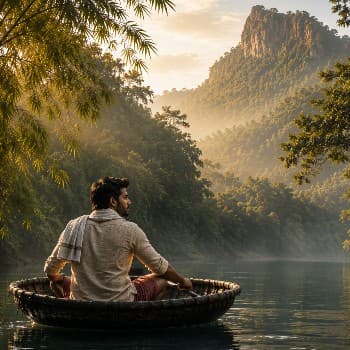
That evening, guiding his coracle back down the Kali as the light failed and the hornbills called their last of the day, Ganapathi thought about how the whole valley had known his story long before he did: the water that had carried his mother's grief past his own foster home for thirty years, the hills that had watched a poor clerk walk to his death in the rain, the forest that had kept every secret and given none away for free, only in its own slow time, to a man patient enough and sharp enough to ask the right questions of the right people.
He was still, by every official measure, an uneducated man. He could not have written the story of his own life in the fine, careful hand of the woman in that old photograph. But he had read it all the same, letter by letter, the way he read everything that mattered: not from a page, but from the world itself, the way the Kali river reads the shape of every stone it must move around, slowly, patiently, until at last it reaches the sea.
Moral
A person's worth is not measured by the schooling they received, but by the honesty, patience, and quiet wisdom with which they meet the truth. Ganapathi could not read books, yet he could read the world around him, and it was this gift, not a degree, that led him home. The story reminds us that education of the classroom and education of the heart are two different things, and that a family, whether given by blood or by love, is built not on secrets but on the courage to finally speak them.