


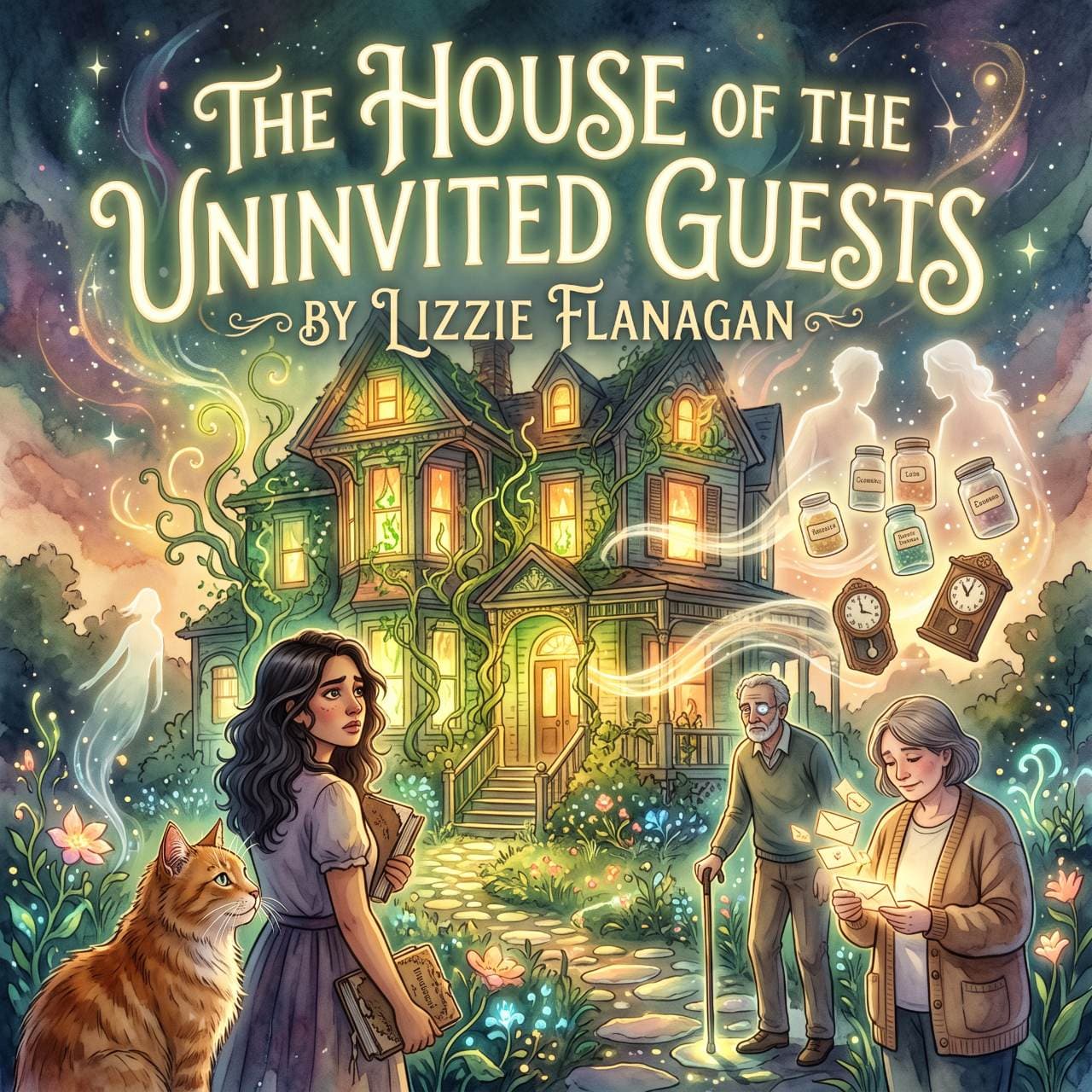

Winter arrived on Meridian Street with the subtlety of a thief, stealing color from the trees and warmth from the soil until the world existed in shades of waiting. The rain collection system was complete, a cathedral of copper and glass that sang when the wind blew, but Maria had stopped hearing it. She was listening for something else, the particular rhythm of Clementine's breathing, which had changed in November from the easy cadence of sleep to something labored, something that sounded like swimming against a current.
The cat had moved permanently indoors. She still hissed when startled, still guarded her territory with the ferocity of something that had survived by refusing to surrender, but she slept now on Arthur's old sweater, and she allowed Thistle to stroke her head when he visited, his thumb brushing the scarred socket where her ear had been.
"She's not in pain," Thistle said, though his voice carried the particular cadence of someone reassuring themselves. "Just tired. Old cats get tired."
"She's waiting," Maria said. She'd been reading Arthur's later journals, the ones from the years after Solene's death, and she'd found an entry that wouldn't leave her: The dying know something we don't. They stand at the threshold and see the shape of the room beyond. We think they're suffering, but maybe they're just concentrating. Learning the layout of their next home.
"Waiting for what?"
Maria didn't answer. She was watching Clementine's ribs rise and fall, counting the seconds between breaths the way Arthur had counted everything, trying to find the pattern in the chaos.
The knock came at dusk, when the light fell at that particular angle Arthur had documented, degrees at 4:30 PM in October, though this was December and the angle had shifted to something more severe, more demanding. Maria opened the door to find a woman standing on the porch who seemed to have been assembled from the winter itself: silver hair cropped close to her skull, eyes the color of faded denim, a coat that had once been purple but had weathered to something approaching twilight.
"You're not Arthur," the woman said. Her voice carried the rasp of someone who had smoked for decades and then stopped, leaving the texture but not the habit.
"No. I'm Maria. His niece."
"Zephyr Locke." The woman extended a hand that was all knuckle and tendon, strength without softness. "I was his wife's hospice nurse. Twelve years ago. I kept meaning to visit, but time..." she laughed, a sound like gravel in water, "time has a way of accelerating when you're not paying attention. I only heard he died last month. Came to pay respects."
Maria stepped aside. "Come in. It's cold."
"Can't stay long. I'm..." Zephyr paused in the doorway, swaying slightly, and Maria caught the scent of morphine patches and something else, something cellular and failing. "I'm not well. But I brought something. Something he left with me. When Solene died."
The name hit Maria like a physical thing. Solene. Arthur's wife. The ghost in the machine of this house, present in every carefully labeled jar, every precisely placed object, every silence that seemed to hold a conversation just below the threshold of hearing.
They sat in the kitchen. Thistle had gone home an hour before, leaving behind his cane by accident...a frequent oversight that meant he would return tomorrow, that their friendship had become something rhythmic, expected. Clementine lifted her head from Arthur's sweater, nostrils flaring at the new scent, and Maria watched the cat's nose work, cataloging information: illness, medicine, the particular smell of endings.
"I have cancer," Zephyr said, without preamble. "Pancreatic. Fast. I've got weeks, maybe days. I wanted to bring this back before..." she reached into her coat and withdrew a wooden box, hand-carved, inlaid with copper wire that had oxidized to green. "Solene made this. In her last month. She was an artist. Did Arthur ever tell you?"
"No. He didn't tell me anything about her. I didn't know he was married until Thistle mentioned it."
Zephyr's denim eyes softened. "Arthur didn't talk about her because he couldn't. Not wouldn't...couldn't. The grief was too loud. When you feel everything at full volume, like he did, loss isn't an event. It's a permanent environmental condition. Like living at high altitude. You adapt, but you never stop being breathless."
She opened the box. Inside, nestled in velvet the color of dried blood, was a collection of objects: a feather, a pressed flower, a photograph of a woman with Arthur's eyes and someone else's smile, and a letter, unsealed, addressed in a hand that was not Arthur's...not the architectural precision, but something wilder, more urgent.
"Solene wrote this the day she died," Zephyr said. "She made me promise to give it to Arthur when he was ready. But he never was. And then I got sick, and I kept it, and I..." she stopped, coughing into her fist, and Maria saw the blood before Zephyr could hide it. "I think I'm supposed to give it to you now. You're the inheritor. The one who comes after."
Maria didn't touch the box. "Why didn't he ever mention her? Twelve years of marriage, and he just...erased it?"
"Not erased," Zephyr said, and her voice had changed, become the voice she must have used with dying patients, gentle but unflinching. "Preserved. Arthur couldn't process endings. To him, death was a category error. Solene wasn't supposed to die because she was Solene, and Solene was real, and real things don't just stop. So he kept her alive by not speaking. By keeping her things exactly where she left them. By building systems that would outlast him, as if longevity could substitute for presence."
Maria thought of the house, the clocks stopped at different hours, the journals attempting to trap time in amber. She thought of her own divorce, how she'd been unable to say Luke's name for months, as if naming him would summon him, or as if not naming him could erase what they'd been.
"She was neurodivergent too," Zephyr said. "Did you know that? Cystic fibrosis was her diagnosis, but she was also autistic. They found each other like two instruments tuning to the same frequency. They didn't need to translate. They just...played."
Maria picked up the photograph. Solene was small, bird-boned, with dark hair that fell in a single braid down her back. She was standing in this kitchen, Maria realized, in front of this window, and she was holding something that looked like...
"Is that Clementine?" Maria asked.
Zephyr smiled, showing teeth that were too perfect to be original. "Solene found her. 2009. The cat was feral, half-dead, ear already gone from some fight. Solene said she recognized her. 'Another creature surviving on terms the world doesn't understand.' She named her Clementine because of the song, the line about being lost and found. Arthur kept her after. When Solene died, Clementine stopped eating for three weeks. Arthur had to syringe-feed her. He said she was negotiating with death, trying to decide if the bargain was worth it."
Maria looked at the cat, who had closed her eyes again, her breathing shallower now, each inhale seeming to require deliberation.
"She's dying," Maria said. It wasn't a question anymore.
"Yes."
"And you."
"Yes."
"And Arthur."
"Yes."
Maria set the photograph down. "Why do we fight it so hard? If it's inevitable, if it's just...transfer, like Thistle says, like water...why does it feel like theft?"
Zephyr reached across the table and took Maria's hand. Her skin was fever-hot, the heat of a body burning its last reserves. "Because we're not water, not entirely. We're also memory. And memory wants to persist. It's not death we fear, Maria. It's forgetting. It's the idea that the particular, specific, unrepeatable configuration of neurons and history and love that is us will just...dissolve. And it will. It does. But..."
She coughed again, longer this time, and Maria got up to get water, but Zephyr waved her off.
"But," she continued, her voice thinner, "that's what makes it matter. The fact that it ends. If we lived forever, we'd be like Arthur's clocks, stopped at different hours, meaningless. The ticking is what tells the time. The stopping is what gives it shape."
She stood, unsteady, and Maria moved to help her, but Zephyr shook her head. "I need to go. I have my own endings to attend to. But read the letter. Not now. When you're ready. When you understand that the uninvited guests...the disabilities, the divorces, the diagnoses, the deaths...they're not interruptions to your life. They ARE your life. The whole thing is uninvited. We don't choose to be born. We don't choose our brains or our bodies or the people who will love us and leave us. We just choose how fiercely we love them while they're here."
At the door, Zephyr turned back. "Clementine will go soon. Don't try to save her. Just be there. Witness it. That's what Arthur taught me...that death, like everything else, requires accommodation. Not acceptance, necessarily. Just... presence. Don't look away."
Then she was gone, down the porch steps, into the winter dusk, leaving behind the box and the smell of morphine and the sudden, crushing understanding that Maria had been preparing for the wrong thing. She'd thought she was learning to live alone. She was actually learning to die properly.
She read the letter that night, sitting on the floor beside Clementine, who had stopped eating two days before and now only drank water, small laps, methodical, as if calculating exactly how much was needed to maintain the machinery a little longer.
My Arthur, the letter began, in that wild, urgent hand.
If you're reading this, I have gone ahead. I have died, which is a word I hate because it suggests I did something wrong, failed at living. I prefer to think I have simply moved to a different address. You know how I hate goodbyes. This is not a goodbye. This is a forwarding of mail.
I need you to do something for me. Something hard. I need you to love again. Not instead of me...there is no instead, we are not interchangeable, but in addition to me. The world is full of uninvited guests, Arthur. The broken, the strange, the too-much and the not-enough. You have always collected them. The boy with the damaged leg. The woman with too many cats. The child who speaks in frequencies only you can hear.
Don't stop when I'm gone. That would be the real death. The second death, the one that happens when we stop being kind because we're afraid of losing again.
I am not afraid. I am curious. I want to know what comes next. And I want you to know that whatever comes next for you...whoever comes next for you...I have already loved them, because I love you, and they will be part of your life, which is the only immortality I believe in.
Love is not water, Arthur. It doesn't evaporate or transfer. It just grows more rooms. This house will hold me and whoever comes after. That's not betrayal. That's architecture.
Build on, my love. Build on.
—S.
Maria read it three times. Then she lay down on the floor, her head near Clementine's, and she told the cat about Solene, about Arthur, about the rain collection system that held two tons of liquid memory in the basement. She told her about Thistle, about the weight of water, about how she was beginning to understand that her divorce from Luke had not been a failure but a renovation...the removal of a wall that had been load-bearing but wrong, allowing light into rooms that had been dark for too long.
Clementine purred. It was a rattling sound, imperfect, like a motor failing, but it was there. Maria put her hand on the cat's side, feeling the ribs, the heartbeat, the stubborn persistence of warmth in a cooling body.
"You're not leaving me," Maria whispered. "You're just going ahead. Like she said."
The purring stopped. Clementine's eyes opened, those amber eyes that had never trusted, had only negotiated, and she looked at Maria with something that might have been recognition. Then she closed them again, and her breathing slowed, and slowed, and Maria did not look away.
She witnessed it. The final uninvited guest, arriving not with scythe and drama but with the quiet dignity of a cat who had decided the terms were acceptable. The last breath was not a gasp but a release, a letting go of the tension that had held Clementine together for so long. She had been waiting, Maria realized, for permission to stop fighting. And Maria had given it, simply by being there, by not looking away, by saying: I see you. I see this. It matters that you were here.
She sat with the body until morning. Thistle found her there, still on the floor, the letter in one hand, her other hand on Clementine's still side. He didn't speak. He just sat down beside her, his bad leg folded beneath him, and he put his hand over hers, and they stayed like that while the sun came up and the rain collection system sang its metallic song and the house on Meridian Street did what it had always done, it held them, uninvited and grieving and alive.
"I need to bury her," Maria said finally. "In the garden. Where Solene found her."
Thistle nodded. "I'll get the shovel."
"No," Maria said, and she was crying now, but they were not the tears of someone who was breaking. They were the tears of someone who was finally, fully, present. "I need to do it. She was mine. She was Arthur's. She was Solene's. She was uninvited, and she was everything."
She buried Clementine beneath the window where Solene had carved her name, beside the hydrangeas that had grown wild without Arthur's precise pH calculations. She put the wooden box in the ground with the cat, Solene's letter and the photograph and the feather, all the evidence that this life had been specific, had been real, had mattered.
When she was done, Thistle helped her stand. He didn't let go of her hand.
"Zephyr?" Maria asked.
"Gone," Thistle said. "I saw the ambulance this morning. Two blocks over. She was staying at the Meridian Motel. The manager said she left something for you. At the front desk."
It was a key. Old, iron, with a tag that read: Rain System. Overflow Valve.
Maria understood. She walked to the basement, Thistle following, and they opened the cistern's overflow mechanism. Inside, wrapped in oilcloth, was Arthur's final journal. Not the daily observations, but the one he'd never shown anyone. The one about Solene. About death. About love that doesn't end but changes frequency.
The first page read: To the one who comes after: You are not a replacement. You are a continuation. The house will teach you if you let it. The guests will arrive uninvited. Love them anyway. That's the whole secret. That's the architecture.
Maria closed the journal. She looked at Thistle, at his clouded eye and his steady hand, at the way he stood slightly askew to accommodate his damaged pelvis, at the specific, unrepeatable configuration of history and pain and kindness that he was.
"Stay for dinner," she said. It was not a question. It was an invitation, finally offered, to the uninvited.
Thistle smiled. "I'll need to check the rain system first. There's a storm coming. I can hear it in the pipes."
"Yes," Maria said, and she could hear it too, the future gathering itself, the water remembering where it needed to go. "There's always a storm coming. That's why we build the systems. That's why we stay."